


Gay, lesbian, transgender and sex worker rights activists yesterday accused President Ma Ying-jeou (馬英九) of failing to fulfill his promise to improve the rights of gender minority groups.
“Ma said in his New Year's speech that he would not hesitate to come to the rescue of whoever is suffering — and it's all bullshit,” Chung Chun-chu (鍾君竺), executive director of the Collective of Sex Workers and Supporters, said during a press conference to publicize a list of new items highlighting government violations of gender and sexual rights.
“He is a more skillful liar than [former president] Chen Shui-bian [陳水扁],” Chung said, as she commented on news reports about the government's failure to make any progress on legalizing prostitution and gay marriage.
During the presidential election campaign last year, Ma said he was not against legalizing prostitution and gay marriage if a consensus could be reached in public first.
However, after organizing a government-sponsored forum on the subject, with 18 representatives randomly selected from the general public, the Ministry of the Interior said more discussions should be held to gather public opinion before a decision could be made.
“On Jan. 5, the MOI organized another meeting, inviting conservative academics and representatives to discuss the issue — and surprisingly, those people also spoke for decriminalizing prostitution,” Chung said.
However, the government again said “it needed to hear more public opinion,” Chung said.
“When Chen [Shui-bian] raided brothels [as Taipei mayor], he did it openly,” Chung said. “Ma, however, makes beautiful but empty promises.”
J.J. Lai (賴正哲), the owner of Gingin's, a bookstore in Taipei that specializes in books on gay and lesbian topics, echoed Chung's remarks.
“I was very hopeful last year [when Ma was elected president], because Ma had always come across as a gay-friendly politician. I was hopeful that maybe gay marriage would soon become legal,” Lai said. “But there has not been the slightest progress at all — all we have heard is 'there needs to be a public consensus first.'”
Josephine Ho (何春蕤), a professor at National Central University's Center for the Study of Sexualities, said she was shocked at the news of police investigating two people for posting pictures of naked babies on the Internet.
In one case, the police questioned a man surnamed Lu for allegedly “spreading obscene pictures” after he posted naked pictures of his seven-month old son on the Internet last July. In another, a university student surnamed Hsieh was investigated for posting two pictures of her two-month-old cousin in the bath.
“Most of us have some pictures of naked infants, and most of us never think of them as obscene. Sometimes parents are just proud to show these pictures around to relatives and friends,” Ho told the news conference. “Since when have these pictures become illegal?”
Ho said she could not support a law labeling “infant pictures as pornography.”
Other news items on the list included publication of private pictures of celebrities, police raids on convenience stores or video shops looking for pornography and random raids on the homes of immigrant spouses.

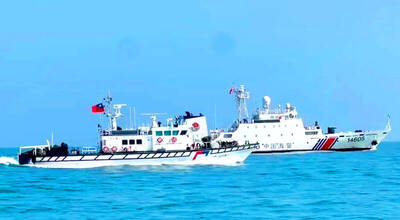
The military has spotted two Chinese warships operating in waters near Penghu County in the Taiwan Strait and sent its own naval and air forces to monitor the vessels, the Ministry of National Defense (MND) said. Beijing sends warships and warplanes into the waters and skies around Taiwan on an almost daily basis, drawing condemnation from Taipei. While the ministry offers daily updates on the locations of Chinese military aircraft, it only rarely gives details of where Chinese warships are operating, generally only when it detects aircraft carriers, as happened last week. A Chinese destroyer and a frigate entered waters to the southwest
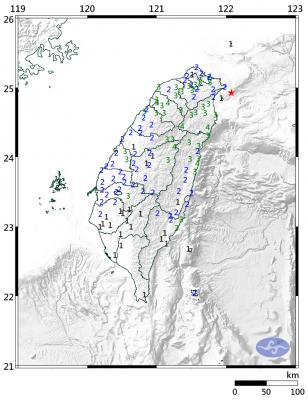
A magnitude 6.1 earthquake struck off the coast of Yilan County at 8:39pm tonight, the Central Weather Administration (CWA) said, with no immediate reports of damage or injuries. The epicenter was 38.7km east-northeast of Yilan County Hall at a focal depth of 98.3km, the CWA’s Seismological Center said. The quake’s maximum intensity, which gauges the actual physical effect of a seismic event, was a level 4 on Taiwan’s 7-tier intensity scale, the center said. That intensity level was recorded in Yilan County’s Nanao Township (南澳), Hsinchu County’s Guansi Township (關西), Nantou County’s Hehuanshan (合歡山) and Hualien County’s Yanliao (鹽寮). An intensity of 3 was
Instead of focusing solely on the threat of a full-scale military invasion, the US and its allies must prepare for a potential Chinese “quarantine” of Taiwan enforced through customs inspections, Stanford University Hoover fellow Eyck Freymann said in a Foreign Affairs article published on Wednesday. China could use various “gray zone” tactics in “reconfiguring the regional and ultimately the global economic order without a war,” said Freymann, who is also a nonresident research fellow at the US Naval War College. China might seize control of Taiwan’s links to the outside world by requiring all flights and ships entering or leaving Taiwan
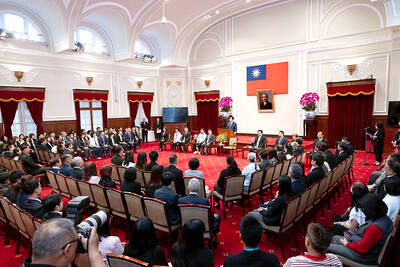
The next minimum wage hike is expected to exceed NT$30,000, President William Lai (賴清德) said yesterday during an award ceremony honoring “model workers,” including migrant workers, at the Presidential Office ahead of Workers’ Day today. Lai said he wished to thank the awardees on behalf of the nation and extend his most sincere respect for their hard work, on which Taiwan’s prosperity has been built. Lai specifically thanked 10 migrant workers selected for the award, saying that although they left their home countries to further their own goals, their efforts have benefited Taiwan as well. The nation’s industrial sector and small businesses lay


 RSS
RSS