


The character hei (黑) — meaning “black” or “darkness” — was yesterday named “word of the year” to represent the Legislative Yuan by political watchdog group Citizens Congress Watch (CCW).
“The legislature is still full of darkness for the public — it failed to fulfill its promise to allow public access to the video-on-demand [VOD] system,” executive director Ho Tsung-hsun (何宗勳) said, explaining why the word was chosen in a news conference outside the legislature yesterday morning.
The VOD system allows access inside the legislature through live broadcasts or recorded video clips of legislative meetings. At the request of legislative watchdog groups, Legislative Speaker Wang Jin-pyng (王金平) agreed to allow outside public access to the system during the second legislative session which began in September — but the promise has yet to be kept.
“We consider it hei also because the lawmakers acted irresponsibly when reviewing certain bills or budgets,” Ho said.
Some bills and budgets were passed without in-depth discussions, Ho said, citing the Act for Distributing Consumer Vouchers to Boost the Economy (振興經濟消費券發放特別條例) and next year’s central government budget as examples.
“The consumer voucher bill, which involved tens of billions of NT dollars, was passed within 12 days,” Ho said. “And the entire central government budget — which is about NT$1.8 trillion [US$5.5 billion] — was passed almost untouched.”
Only about 0.17 percent of the entire central government budget was held up by the legislature, and budgets for seven ministries were completely untouched.
Fifteen candidate characters — including an (暗, darkness), e (噁, disgusting), lan (爛, horrible) and mi (謎, mysterious) — were nominated by civic groups that formed the CCW. Representatives from seven groups then voted on the final result.
While disappointed at the legislature’s performance last year, the CCW is still hopeful, the group said.
“The coming of darkness means that the dawn is not far from us,” Ho said. “If we look at this word positively, it represents the expectations for reforms in the legislature in the coming year.”
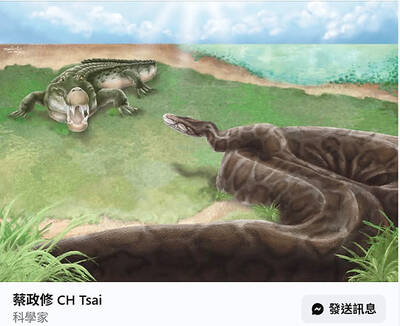
Taiwanese paleontologists have discovered fossil evidence that pythons up to 4m long inhabited Taiwan during the Pleistocene epoch, reporting their findings in the international scientific journal Historical Biology. National Taiwan University (NTU) Institute of Ecology and Evolutionary Biology associate professor Tsai Cheng-hsiu (蔡政修) led the team that discovered the largest snake fossil ever found in Taiwan. The single trunk vertebra was discovered in Tainan at the Chiting Formation, dated to between 400,000 and 800,000 years ago in the Middle Pleistocene, the paper said. The area also produced Taiwan’s first avian fossil, as well as crocodile, mammoth, saber-toothed cat and rhinoceros fossils, it said. Discoveries

Taiwanese paleontologists have discovered fossil evidence that pythons up to 4m long inhabited Taiwan during the Pleistocene epoch, reporting their findings in the international scientific journal Historical Biology. National Taiwan University (NTU) Institute of Ecology and Evolutionary Biology associate professor Tsai Cheng-hsiu (蔡政修) led the team that discovered the largest snake fossil ever found in Taiwan. A single trunk vertebra was discovered in Tainan at the Chiting Formation, dated to between 800,000 to 400,000 years ago in the Middle Pleistocene, the paper said. The area also produced Taiwan’s first avian fossil, as well as crocodile, mammoth, sabre-toothed cat and rhinoceros fossils, it said. Discoveries

Whether Japan would help defend Taiwan in case of a cross-strait conflict would depend on the US and the extent to which Japan would be allowed to act under the US-Japan Security Treaty, former Japanese minister of defense Satoshi Morimoto said. As China has not given up on the idea of invading Taiwan by force, to what extent Japan could support US military action would hinge on Washington’s intention and its negotiation with Tokyo, Morimoto said in an interview with the Liberty Times (sister paper of the Taipei Times) yesterday. There has to be sufficient mutual recognition of how Japan could provide
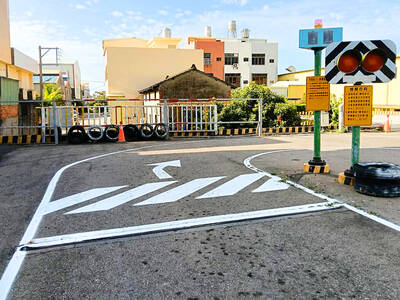
UPDATED TEST: The new rules aim to assess drivers’ awareness of risky behaviors and how they respond under certain circumstances, the Highway Bureau said Driver’s license applicants who fail to yield to pedestrians at intersections or to check blind spots, or omit pointing-and-calling procedures would fail the driving test, the Highway Bureau said yesterday. The change is set to be implemented at the end of the month, and is part of the bureau’s reform of the driving portion of the test, which has been criticized for failing to assess whether drivers can operate vehicles safely. Sedan drivers would be tested regarding yielding to pedestrians and turning their heads to check blind spots, while drivers of large vehicles would be tested on their familiarity with pointing-and-calling


 RSS
RSS