


Taipei City Fire Department Commissioner Hsiung Kuang-hua (熊光華) drew harsh criticism from Democratic Progressive Party (DPP) Taipei City councilors yesterday for failing to arrive at the scene when a fire broke out at National Taiwan University Hospital on Wednesday.
One patient, who was suffering from esophageal cancer and was undergoing surgery, died after the fire.
The fire department dispatched 41 fire trucks shortly after the fire broke out at about 7:20pm, while four precinct directors rushed to the scene to handle the situation.
However, Hsiung and two deputy commissioners did not show up at the scene, DPP councilors said.
DPP Taipei City Councilor Chuang Ruei-hsiung (莊瑞雄) said the commissioner was attending a private dinner gathering with Examination Yuan members while firefighters helped put the fire out.
“Where was Hsiung when such a disaster happened in the city? Who was he drinking and eating with during the fire? Why didn’t he leave the dinner and do his job by going to the scene?” Chuang asked at a Taipei City Council press conference yesterday.
DPP Taipei City Councilor Wang Hsiao-wei (王孝維) and Huang Hsiang-chun (黃向群) joined Chuang to condemn Hsiung, and urged Taipei Mayor Hau Lung-bin (郝龍斌) to remove Hsiung from his post.
“The incident highlighted the fact that Hau administration officials are getting lazy, and do not do their jobs,” Huang said.
In response, Hsiung declined to confirm his whereabouts on Wednesday night, arguing that the department had handled the incident according to standard protocol.
“We followed SOP [standard operating procedure] in putting down the fire and saving the residents and successfully reduced the damage,” he said.
“The public may have a negative perception of the matter and we will reflect on our handling of the incident,” he said.
The hospital evacuated 800 patients and arranged hospital transfers for 23 patients who had to rely on respirators. The fire was put out at 9:10pm.
Huang read from a copy of the regulations on fire scene management in cities and counties, saying department heads were supposed to serve as the commander at the scene when serious fires occurred.
Bi Yo-ming (畢幼明), director of the department’s dispatch center, said the fire did not exceed Level 3 and therefore Hsiung was not required at the scene.
Bi said he did call Hsiung to report the situation, while acknowledging that he did not suggest that the commissioner should rush to the site.

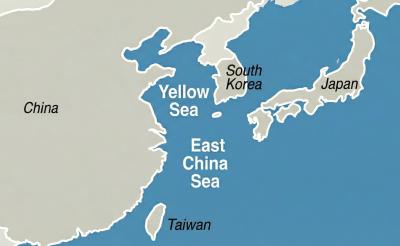
China has reserved offshore airspace in the Yellow Sea and East China Sea from March 27 to May 6, issuing alerts usually used to warn of military exercises, although no such exercises have been announced, the Wall Street Journal (WSJ) reported yesterday. Reserving such a large area for 40 days without explanation is an “unusual step,” as military exercises normally only last a few days, the paper said. These alerts, known as Notice to Air Missions (Notams), “are intended to inform pilots and aviation authorities of temporary airspace hazards or restrictions,” the article said. The airspace reserved in the alert is

South Korea is planning to revise its controversial electronic arrival card, a step Taiwanese officials said prompted them to hold off on planned retaliatory measures, a South Korean media report said yesterday. A Yonhap News Agency report said that the South Korean Ministry of Foreign Affairs is planning to remove the “previous departure place” and “next destination” fields from its e-arrival card system. The plan, reached after interagency consultations, is under review and aims to simplify entry procedures and align the electronic form with the paper version, a South Korean ministry official said. The fields — which appeared only on the electronic form
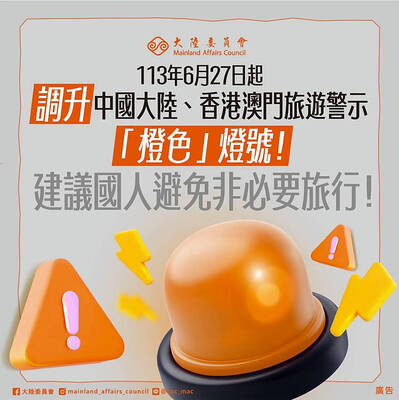
More than 6,000 Taiwanese students have participated in exchange programs in China over the past two years, despite the Mainland Affairs Council’s (MAC) “orange light” travel advisory, government records showed. The MAC’s publicly available registry showed that Taiwanese college and university students who went on exchange programs across the Strait numbered 3,592 and 2,966 people respectively. The National Immigration Agency data revealed that 2,296 and 2,551 Chinese students visited Taiwan for study in the same two years. A review of the Web sites of publicly-run universities and colleges showed that Taiwanese higher education institutions continued to recruit students for Chinese educational programs without

A bipartisan group of US senators has introduced a bill to enhance cooperation with Taiwan on drone development and to reduce reliance on supply chains linked to China. The proposed Blue Skies for Taiwan Act of 2026 was introduced by Republican US senators Ted Cruz and John Curtis, and Democratic US senators Jeff Merkley and Andy Kim. The legislation seeks to ease constraints on Taiwan-US cooperation in uncrewed aerial systems (UAS), including dependence on China-sourced components, limited access to capital and regulatory barriers under US export controls, a news release issued by Cruz on Wednesday said. The bill would establish a "Blue UAS


 RSS
RSS