


Taiwan and the Cook Islands have activated a mechanism to help uncover illegal, unreported and unregulated (IUU) fishing activities, the Fisheries Agency said yesterday.
The Cook Islands in the South Pacific recently notified the West and Central Pacific Fisheries Commission (WCPFC) that it would operate a mutual fishery examination system with Taiwan.
Under the deal, Taiwanese fishing boats operating in WCPFC areas are required to let Cook Islands fishery officials or police — after checking that they are genuine Cook Islands authorities — board and inspect their vessels to help crack down on transboundary IUU fishing, the Fisheries Agency said.
The Cook Islands is the second country after New Zealand to sign such a mutual fishery examination agreement with Taiwan. Taiwan and New Zealand inked their agreement late last month.
About 1,500 Taiwanese commercial fishing boats operate in the western and central parts of the Pacific Ocean, mainly to catch tuna, sharks and sailfish.
Of the total, 100 smaller longline fishing vessels, mainly used to catch tuna, that operate in open seas or in other economic zones under contract from those countries are the most likely to be targeted for inspection, the agency said.
Taiwanese vessels that don't cooperate with the inspections or are found to have violated regulations may be banned from fishing commercially in those areas, an agency official said.
The official urged Taiwanese vessels to have their documents and fishing logbooks ready for inspection. They should also be properly equipped with fish-measuring and other monitoring equipment to help them avoid catching protected sea turtles or birds, or amassing younger fish that they are not allowed to catch.
The Taiwan-New Zealand mutual fishery examination mechanism marked the first time that Taiwan had participated in such inspection efforts, which are aimed at maximizing long-term benefits from west and central Pacific fishing grounds.
IUU catches can bring in up to US$9.5 billion, a World Commission on Protected Areas' High Seas Task Force study found.
Up to 30 percent of IUU fishing occurs beyond national jurisdiction, where there are fewer controls, the study said.

The military has spotted two Chinese warships operating in waters near Penghu County in the Taiwan Strait and sent its own naval and air forces to monitor the vessels, the Ministry of National Defense (MND) said. Beijing sends warships and warplanes into the waters and skies around Taiwan on an almost daily basis, drawing condemnation from Taipei. While the ministry offers daily updates on the locations of Chinese military aircraft, it only rarely gives details of where Chinese warships are operating, generally only when it detects aircraft carriers, as happened last week. A Chinese destroyer and a frigate entered waters to the southwest

The eastern extension of the Taipei MRT Red Line could begin operations as early as late June, the Taipei Department of Rapid Transit Systems said yesterday. Taipei Rapid Transit Corp said it is considering offering one month of free rides on the new section to mark its opening. Construction progress on the 1.4km extension, which is to run from the current terminal Xiangshan Station to a new eastern terminal, Guangci/Fengtian Temple Station, was 90.6 percent complete by the end of last month, the department said in a report to the Taipei City Council's Transportation Committee. While construction began in October 2016 with an
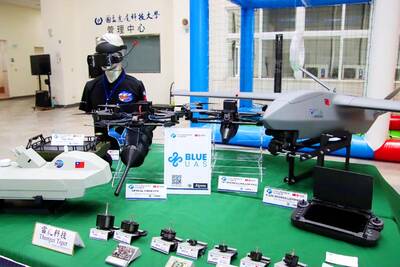
NON-RED SUPPLY: Boosting the nation’s drone industry is becoming increasingly urgent as China’s UAV dominance could become an issue in a crisis, an analyst said Taiwan’s drone exports to Europe grew 41.7-fold from 2024 to last year, with demand from Ukraine’s fight against Russian aggression the most likely driver of growth, a study showed. The Institute for Democracy, Society and Emerging Technology (DSET) in a statement on Wednesday said it found that many of Taiwan’s uncrewed aerial vehicle (UAV) sales were from Poland and the Czech Republic. These countries likely transferred the drones to Ukraine to aid it in its fight against the Russian invasion that started in 2022, it said. Despite the gains, Taiwan is not the dominant drone exporter to these markets, ranking second and fourth

Japanese Prime Minister Sanae Takaichi’s comment last year on Tokyo’s potential reaction to a Taiwan-China conflict has forced Beijing to rewrite its invasion plans, a retired Japanese general said. Takaichi told the Diet on Nov. 7 last year that a Chinese naval blockade or military attack on Taiwan could constitute a “survival-threatening situation” for Japan, potentially allowing Tokyo to exercise its right to collective self-defense. Former Japan Ground Self-Defense Force general Kiyofumi Ogawa said in a recent speech that the remark has been interpreted as meaning Japan could intervene in the early stages of a Taiwan Strait conflict, undermining China’s previous assumptions


 RSS
RSS