

President Ma Ying-jeou’s (馬英九) mentor during his studies at Harvard University called yesterday for an independent commission to be set up to investigate the recent string of detentions of present and former Democratic Progressive Party (DPP) government officials.
In a South China Morning Post opinion piece titled “Improved cross-strait relations appear to have come at a cost to some civil liberties in Taiwan,” Professor Jerome Cohen said that pre-indictment detention, although legal, made it difficult for the detained party to “mount an adequate defense.”
Cohen suggested that the legislature or an independent commission look at revising the law to “strike a new balance between the threat of corruption to a democratic government and the threat of incommunicado detention to civil liberty.”

PHOTO: CNA
He also criticized apparent leaks by prosecutors that have been a feature of the investigations, saying that such behavior “cannot be allowed in a democratic system.”
Commenting on police handling of the protests during Association for Relations Across the Taiwan Strait Chairman Chen Yunlin’s (陳雲林) visit to Taiwan earlier this month, Cohen — a professor of law at New York University’s School of Law and an adjunct senior fellow at the Council on Foreign Relations — said that confiscating flags from demonstrators went “beyond the limits of a free society.”
Cohen wrote that Ma should honor his election campaign promises and seek to amend the Assembly and Parade Law (集會遊行法) to eliminate the need for protesters to apply for permission.
He also said that police training needed to be reformed to enhance compliance with the law.
Although police had reacted to often violent provocation by protesters, this did not justify incidents of police brutality, he wrote.
When asked about the opinion piece by the Taipei Times, Presidential Office Spokesman Wang Yu-chi (王郁琦) said that he “could not comment on the article as he was not aware of it.”
“The president respects the independence of the judiciary and has no intention of interfering in judicial affairs,” Wang said.
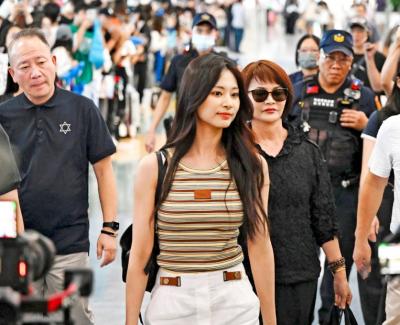
A Straits Exchange Foundation official today warned that yielding to political pressure in exchange for access to China’s entertainment industry rarely ends well, amid rumors that China is seeking to lure Taiwanese K-pop star Chou Tzu-yu (周子瑜). Chou, more commonly known as Tzuyu, is the only Taiwanese member of the girl group Twice. Her contract with JYP Entertainment is set to expire at the end of this year, and there have been widespread reports that she would not renew it. She is reportedly planning to pursue solo activities under her parents’ agency, Yu Hai Entertainment (瑜海娛樂), although China has also reportedly offered
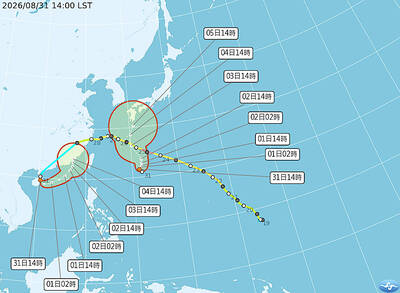
A tropical depression near Hainan that was once Typhoon Saudel may once again strengthen into a tropical storm, the Central Weather Administration (CWA) said yesterday, but a sea warning for waters around Taiwan is unlikely. CWA forecaster Huang En-hung (黃恩鴻) said that Saudel would return to being a weak tropical storm by late yesterday or early this morning. However, as the storm is to gradually weaken again and would head toward China’s Guangdong Province away from Taiwan, the chances that it would affect Taiwan enough for the CWA to issue a sea warning are relatively low,
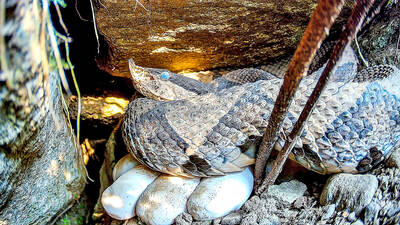
NATURE TAKES ITS COURSE: The agency’s head said he felt a sense of loss watching red-banded snakes eat the babies, as they had decided on non-intervention The Forestry and Nature Conservation Agency yesterday released a documentary on a hundred-pace viper that had incubated 16 eggs, all of which hatched, but only a baby viper escaped after they were attacked by red-banded snakes. The agency’s Taichung branch last year launched the viper reproduction monitoring project soon after forest rangers Lin Chun-yu (林俊佑) and Chou Chia-cheng (周家成) spotted a pregnant hundred-pace viper in a grass-covered burrow near a parking lot in Tbulan Village (松鶴部落). The Atayal village, in Taichung’s Heping District (和平), is headed by Ecyang Yapu, who was positive about the project and assisted in access control and power
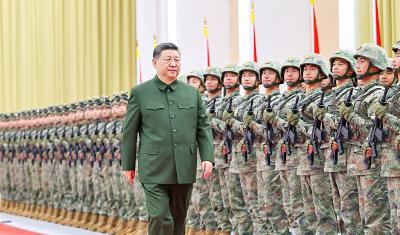
China has revised its National Defense Mobilization Law to prepare for a rapid transition to wartime, with an official today saying the measures are aimed at helping Chinese President Xi Jinping (習近平) fulfill his “historic mission of national unification.” The revised version of the mobilization law is to take effect on Oct. 1, marking the first major revision since the law was enacted in 2010. The amendments define national defense mobilization as measures taken in response to threats to national sovereignty, unification, territorial integrity, security and development interests, including efforts to ensure rapid transition between peacetime and wartime and convert economic and


 RSS
RSS