


Legislators across party lines unanimously passed a resolution yesterday demanding a formal apology and compensation from the Japanese government to former “comfort women” in Taiwan.
“[We] hereby demand that the Japanese government officially admit, apologize for and take the historical responsibility for Japanese military’s sex slave system during the World War [II] in a clear and unambiguous fashion,” the resolution said.
“[Tokyo] should directly apologize to and compensate the victims [of the system] who are still alive to restore the reputation and dignity of the [former] comfort women. It should also take the advice of the UN Commission on Human Rights to teach this and the next generation the correct historical facts,” the resolution said.
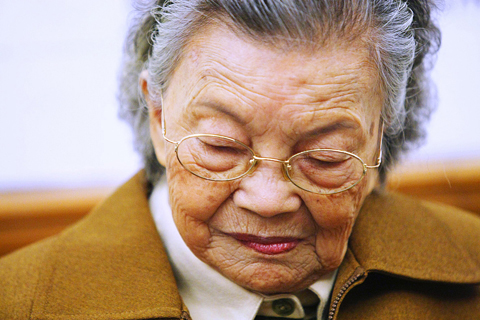
PHOTO: CNA
“Comfort women” is a term used to describe women from countries and regions occupied by Japan — including Taiwan, Korea, China and the Philippines — who were forced to provide sexual services to Japanese soldiers in military brothels during World War II.
Taiwan’s resolution in support of the women came after the US Congress and the Dutch, Canadian and European parliaments took similar action last year and earlier this year.
The proposal — initiated by Democratic Progressive Party legislators Huang Sue-ying (黃淑英), William Lai (賴清德) and Pan Meng-an (潘孟安) and Chinese Nationalist Party (KMT) Legislator Yang Li-huan (楊麗環) — enjoyed widespread support by lawmakers across party lines.
Huang said passage of the resolution was encouraging to those who had been fighting for compensation for former “comfort women” in Taiwan.
“Taiwanese ‘comfort women’ came forward and began fighting for compensation in 1992. [Sixteen] years have passed, but the response we have received from Japan’s Interchange Association has been lukewarm,” Huang said.
Of the 58 Taiwanese women that came forward to request compensation in 1992, only 20 remain alive, Huang said.
“We hope Japan will recognize the harm it did to these women in the war,” Yang said.
Ninety-two-year-old Wu Hsiu-mei (吳秀妹) — the oldest living former “comfort women” in Taiwan — said she was very happy about the resolution.
“Japan’s apology and compensation are of the utmost importance [to me]. It [Japan’s use of comfort women] is true, but Japan still refuses to admit it,” Wu said.
Chen Shu-li (陳淑麗), a board member of the Taipei Women’s Rescue Foundation, said that she hoped the Ministry of Education would include details of the women’s 16-year campaign in the nation’s human rights education curriculum.

Taiwanese paleontologists have discovered fossil evidence that pythons up to 4m long inhabited Taiwan during the Pleistocene epoch, reporting their findings in the international scientific journal Historical Biology. National Taiwan University (NTU) Institute of Ecology and Evolutionary Biology associate professor Tsai Cheng-hsiu (蔡政修) led the team that discovered the largest snake fossil ever found in Taiwan. The single trunk vertebra was discovered in Tainan at the Chiting Formation, dated to between 400,000 and 800,000 years ago in the Middle Pleistocene, the paper said. The area also produced Taiwan’s first avian fossil, as well as crocodile, mammoth, saber-toothed cat and rhinoceros fossils, it said. Discoveries

Taiwanese paleontologists have discovered fossil evidence that pythons up to 4m long inhabited Taiwan during the Pleistocene epoch, reporting their findings in the international scientific journal Historical Biology. National Taiwan University (NTU) Institute of Ecology and Evolutionary Biology associate professor Tsai Cheng-hsiu (蔡政修) led the team that discovered the largest snake fossil ever found in Taiwan. A single trunk vertebra was discovered in Tainan at the Chiting Formation, dated to between 800,000 to 400,000 years ago in the Middle Pleistocene, the paper said. The area also produced Taiwan’s first avian fossil, as well as crocodile, mammoth, sabre-toothed cat and rhinoceros fossils, it said. Discoveries

Whether Japan would help defend Taiwan in case of a cross-strait conflict would depend on the US and the extent to which Japan would be allowed to act under the US-Japan Security Treaty, former Japanese minister of defense Satoshi Morimoto said. As China has not given up on the idea of invading Taiwan by force, to what extent Japan could support US military action would hinge on Washington’s intention and its negotiation with Tokyo, Morimoto said in an interview with the Liberty Times (sister paper of the Taipei Times) yesterday. There has to be sufficient mutual recognition of how Japan could provide

UPDATED TEST: The new rules aim to assess drivers’ awareness of risky behaviors and how they respond under certain circumstances, the Highway Bureau said Driver’s license applicants who fail to yield to pedestrians at intersections or to check blind spots, or omit pointing-and-calling procedures would fail the driving test, the Highway Bureau said yesterday. The change is set to be implemented at the end of the month, and is part of the bureau’s reform of the driving portion of the test, which has been criticized for failing to assess whether drivers can operate vehicles safely. Sedan drivers would be tested regarding yielding to pedestrians and turning their heads to check blind spots, while drivers of large vehicles would be tested on their familiarity with pointing-and-calling


 RSS
RSS