


Several university student groups in the central and southern parts of the country launched sit-ins yesterday in support of the student demonstrators at Liberty Square in front of National Taiwan Democracy Memorial Hall.
Holding up posters that read “human rights,” about 20 students launched their sit-in campaign in front of National Cheng Kung University (NCKU) in Tainan amid drizzling rain.
“We support the three statements of [the students] in Taipei. President Ma [Ying-jeou (馬英九)] and [Premier] Liu Chao-shiuan (劉兆玄) should apologize to the people while [National Police Agency (NPA)] Director-General Wang Cho-chiun (王卓鈞) and [National Security Bureau] Director-General Tsai Chao-ming (蔡朝明) should step down,” Huang You-heng (黃羑衡), the spokesman for the protesters at NCKU, told reporters.
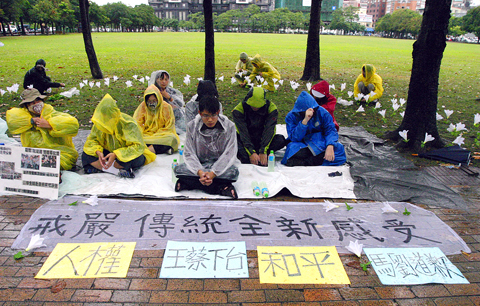
PHOTO: CHAN CHAO-YANG, TAIPEI TIMES
“We hope similar campaigns will be launched at every university in Taiwan,” Huang said.
Meanwhile, a group of students began another sit-in at the Peoples’ Square in Taichung City yesterday afternoon in support of their counterparts in Taipei.
TAIPEI
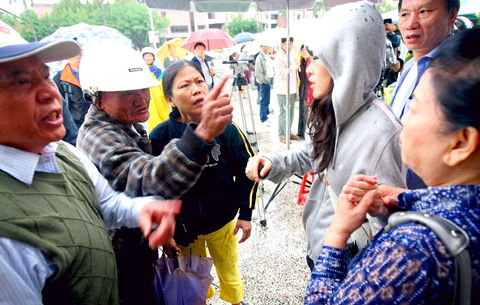
PHOTO: CNA
About 400 students, led by National Taiwan University sociology professor Lee Ming-tsung (李明璁) began their silent sit-in on Thursday in front of the Executive Yuan in Taipei.
The protesters have argued that police used excessive force against demonstrators opposing the visit of China’s Association for the Relations Across the Taiwan Strait (ARATS) Chairman Chen Yunlin (陳雲林) between Monday and Friday last week.
The students urged the government to amend the Assembly and Parade Law (集會遊行法) by removing the article that obliges rally organizers to gain police approval before launching an event.
The students were evicted from the Executive Yuan by the police on Friday night because they had not filed an application for their sit-in in accordance with the Assembly and Parade Law.
They reassembled at Liberty Square later that night.
RAIN OR SHINE
The sit-in at the square has continued, despite poor weather.
“Many people think we are staging the protest against a specific political camp. Therefore, we would like to emphasize our call for an amendment to the Assembly and Parade Law,” said Chou Fu-yi (周馥儀), a representative of Taipei students.
Chou said no government officials — except director of Taiwan Democracy Memorial Hall Tseng Kun-ti (曾坤地) — had checked on them since they reconvened at the hall.
Ho Tung-hung (何東洪), an associate professor of psychology at Fu Jen Catholic University and a participant in the Wild Lily Student Movement (野百合學運) in the 1990s, visited the students in Taipei to share his experiences yesterday, encouraging them to cherish their opportunity to participate in the sit-in.
Wu Eing-ming (吳英明), president of Kaohsiung Open University, also visited the students on behalf of Kaohsiung Mayor Chen Chu (陳菊).
Wu lauded the students’ action, saying that their campaign showed the nation should spend next year “relearning the value of human rights.”
In related developments, heated exchanges between government officials and legislators were expected to take place in the legislature today as the Internal Administration Committee has convened a special report by Wang regarding the NPA’s behavior last week.
For his part, Minister of Health Yeh Chin-chuan (葉金川) is scheduled to report today on the food safety agreement signed by Straits Exchange Foundation Chairman Chiang Ping-kun (江丙坤) and Chen Yunlin last week to the legislature’s Health, Environment and Labor Committee.

Considering that most countries issue more than five denominations of banknotes, the central bank has decided to redesign all five denominations, the bank said as it prepares for the first major overhaul of the banknotes in more than 24 years. Central bank Governor Yang Chin-lung (楊金龍) is expected to report to the Legislative Yuan today on the bank’s operations and the redesign’s progress. The bank in a report sent to the legislature ahead of today’s meeting said it had commissioned a survey on the public’s preferences. Survey results showed that NT$100 and NT$1,000 banknotes are the most commonly used, while NT$200 and NT$2,000

The Centers for Disease Control (CDC) yesterday reported the first case of a new COVID-19 subvariant — BA.3.2 — in a 10-year-old Singaporean girl who had a fever upon arrival in Taiwan and tested positive for the disease. The girl left Taiwan on March 20 and the case did not have a direct impact on the local community, it said. The WHO added the BA.3.2 strain to its list of Variants Under Monitoring in December last year, but this was the first imported case of the COVID-19 variant in Taiwan, CDC Deputy Director-General Lin Ming-cheng (林明誠) said. The girl arrived in Taiwan on

ANNUAL EVENT: Two massive Pokemon balloons are to be set up in Daan Park, with an event zone operating from 10am to 6pm This year’s Taipei Floral Picnic is to be held at Daan Park today and tomorrow, featuring an exclusive Pokemon Go event, a themed food market, a coffee rave picnic area and stage performances, the Taipei Department of Information and Tourism said yesterday. Two massive Pokemon balloons are to be set up in the park as attractions, with an exclusive event zone operating from 10am to 6pm, it said. Participants who complete designated tasks on-site would have a chance to receive limited-edition souvenirs, it added. People could also try the newly launched game Pokemon Pokopia in the trial area, the department said. Three PokeStops are

South Korea is planning to revise its controversial electronic arrival card, a step Taiwanese officials said prompted them to hold off on planned retaliatory measures, a South Korean media report said yesterday. A Yonhap News Agency report said that the South Korean Ministry of Foreign Affairs is planning to remove the “previous departure place” and “next destination” fields from its e-arrival card system. The plan, reached after interagency consultations, is under review and aims to simplify entry procedures and align the electronic form with the paper version, a South Korean ministry official said. The fields — which appeared only on the electronic form


 RSS
RSS