


Medical researchers at National Cheng Kung University Hospital have found a new way to produce target drugs that allow physicians to build an optimal combination of “targeting” and “curing” elements based on the characteristics of a specific cancer, the Tainan-based hospital announced on Friday.
Introducing the concept of “smart ammunition,” the researchers said that a “modularly assembled” target drug was similar to a smart missile, which is made of a targeting unit that hones in on a target — through means such as heat-seeking, infrared or radar guidance — and an ammunition compartment that can deliver the greatest damage to the designated target, such as standard, armor-piercing or incendiary.
Shieh Dar-bin (謝達斌), an oral disease expert at the hospital, said individual patients may develop different varieties of cancer, with unique cell surface antigens and specific conditions that require customized therapy to induce the best curative effects.
To target cancer cells, physicians have to select a targeting module, or moiety, that recognizes the given type of antigen, Shieh said.
To kill the tumorous cells, physicians should select a curing agent that can most efficiently destroy them according to the patients’ condition, Shieh said. “These factors may not be easily predetermined in the laboratory or the production line.”
“What we do is to allow greater flexibility for physicians in terms of selecting and using the drugs that can best heal their patients,” he said.
Shieh said that for example, if there are 10 existing targeting modules and 10 available curing agents, a facility capable of combining modularly assembled target drugs would be able to produce 100 different combinations of drugs.
And the physicians who have placed the orders could then use the tailor-made drugs on their patient, Shieh said.
The hospital said the new target drugs have passed animal testing and that it has applied for permission to test the modular approach on humans.
With luck, the therapy could be available in hospitals in five years, Shieh said.
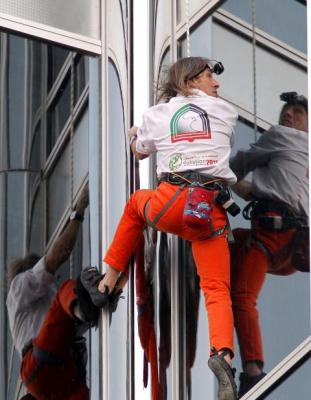
Alain Robert, known as the "French Spider-Man," praised Alex Honnold as exceptionally well-prepared after the US climber completed a free solo ascent of Taipei 101 yesterday. Robert said Honnold's ascent of the 508m-tall skyscraper in just more than one-and-a-half hours without using safety ropes or equipment was a remarkable achievement. "This is my life," he said in an interview conducted in French, adding that he liked the feeling of being "on the edge of danger." The 63-year-old Frenchman climbed Taipei 101 using ropes in December 2004, taking about four hours to reach the top. On a one-to-10 scale of difficulty, Robert said Taipei 101

Nipah virus infection is to be officially listed as a category 5 notifiable infectious disease in Taiwan in March, while clinical treatment guidelines are being formulated, the Centers for Disease Control (CDC) said yesterday. With Nipah infections being reported in other countries and considering its relatively high fatality rate, the centers on Jan. 16 announced that it would be listed as a notifiable infectious disease to bolster the nation’s systematic early warning system and increase public awareness, the CDC said. Bangladesh reported four fatal cases last year in separate districts, with three linked to raw date palm sap consumption, CDC Epidemic Intelligence

Two Taiwanese prosecutors were questioned by Chinese security personnel at their hotel during a trip to China’s Henan Province this month, the Mainland Affairs Council (MAC) said yesterday. The officers had personal information on the prosecutors, including “when they were assigned to their posts, their work locations and job titles,” MAC Deputy Minister and spokesman Liang Wen-chieh (梁文傑) said. On top of asking about their agencies and positions, the officers also questioned the prosecutors about the Cross-Strait Joint Crime-Fighting and Judicial Mutual Assistance Agreement, a pact that serves as the framework for Taiwan-China cooperation on combating crime and providing judicial assistance, Liang
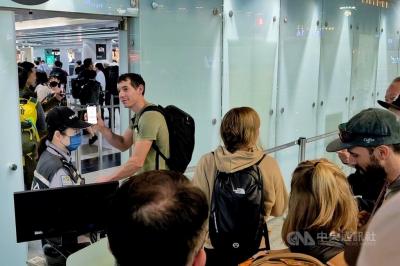
US climber Alex Honnold left Taiwan this morning a day after completing a free-solo ascent of Taipei 101, a feat that drew cheers from onlookers and gained widespread international attention. Honnold yesterday scaled the 101-story skyscraper without a rope or safety harness. The climb — the highest urban free-solo ascent ever attempted — took just more than 90 minutes and was streamed live on Netflix. It was covered by major international news outlets including CNN, the New York Times, the Guardian and the Wall Street Journal. As Honnold prepared to leave Taiwan today, he attracted a crowd when he and his wife, Sanni,


 RSS
RSS