


Representatives of the nation’s airlines and the travel industry yesterday expressed high hopes for the upcoming meeting between Straits Exchange Foundation (SEF) Chairman Chiang Pin-kung (江丙坤) and his Chinese counterpart, Association for Relations Across the Taiwan Strait (ARATS) Chairman Chen Yunlin (陳雲林), hoping that they would address urgent issues and make substantial changes to cross-strait charter flight services.
Travel Agent Association chairman Yao Ta-kuan (姚大光) said yesterday that the number of charter flights could be increased to at least 200 per week.
The meeting could also help add five more Chinese airports to the list of those eligible for charter flights, he said.
Yao said China only allows residents from 13 provinces to visit Taiwan and only 33 travel agencies in China are authorized to arrange tour groups. He said he hoped these numbers would be at least doubled following the meeting.
Tony Su (蘇宏義), chairman of the Taipei Airlines Association, said on Thursday that both sides had agreed during the first meeting in June that airline companies could start setting up offices on either side of the strait. However, Taiwanese airlines still cannot operate offices in China because the Mainland Affairs Council (MAC) has yet to stipulate guidelines that legalize such business operations in China, he said.
Su said the safety of cross-strait charter flights was another critical issue.
“In China, our aircraft can only take off after a technical professional, whose qualifications have been certified by Taiwan’s Civil Aeronautics Administration [CAA], signs off the plane,” Su said. “Other skilled workers and replacement parts also need to be certified. Likewise, our maintenance crews cannot touch any of the aircraft from China if our technical personnel and the components have not been certified by the Chinese aviation authority.”
These certification mechanisms have yet to be established, so, aside from the passengers and cabin crews, each charter flight also has to carry its own technical crew.
While the two sides have reached a consensus to move from weekend-only charter flights to daily charter flights, Su said the number of Chinese tourists would also have to grow simultaneously.
“There must be a real increase in the numbers of Chinese tourists and that increase cannot be just those who used to take transit flights via Hong Kong and Macau,” he said.
Rather than assigning an airline to fly a certain route, the government should allow airlines to choose whichever route they wish as long as they provide at least one flight per day on that route, he said.
Su suggested there should be at least 84 flights a week when daily charter flights are implemented.
Meanwhile, Minister of Transportation and Communications Mao Chi-kuo (毛治國) said on Thursday that the ministry is aiming to have an average of 1,000 Chinese tourists arriving daily by the end of the year.
Tourism Bureau Director General Janice Lai (賴瑟珍) said that 3,000 tourists a day — one of President Ma Ying-jeou’s (馬英九) campaign pledges — was the maximum number of Chinese tourists that can be accepted per day, not necessarily the number that will arrive.
Mao indicated that more Chinese airports would be available for cross-strait charter flights following the meeting.
Yesterday, Mao said the results of a survey conducted by the CAA last month showed that about 75 percent of Taiwanese entrepreneurs in China said expanding cross-strait charter flights would make them consider returning to invest in Taiwan.
While approximately 54 percent said that they would continue to live in China if daily charter flights become a reality, about 43 percent said they would like to move back to Taiwan.
“It will be interesting to know if the so-called ‘one-day living circle’ will actually be formed,” he said.


UPGRADE: The Kang Ding-class frigate is replacing its Chaparall missiles with Tien Chien II and Hua Yang VLS, which would provide it with long-range, 360° air defense Taiwan plans to produce 1,200 to 1,376 Hai Chien II missiles (海劍二, Sea Sword II) — also known as TC-2N — to serve as the standard air defense system of the navy’s surface combatant fleet, a source said yesterday. Last week, the Hai Chien II, the naval version of the Tien Kung II missile (天劍二, Sky Sword II), completed a live-fire test in waters off the National Chungshan Institute of Science and Technology’s Jiupeng facility (九鵬) in Pingtung County’s Manjhou Township (滿州). The MIM72 Chaparral and other dated air defense missiles that currently arm Taiwanese ships have inadequate range to combat Chinese

REASONS FOR TRAVEL: An assistant professor said that proposed amendments to penalize drivers if they used drugs overseas would not deter people from traveling People who operate a motor vehicle under the influence of marijuana would have their driver’s license revoked, even if they used the substance while overseas, the Ministry of Transportation and Communications said yesterday, citing proposed amendments to the Road Traffic Management and Penalty Act (道路交通管理處罰條例). The amendments would also authorize the government to revoke the licenses of people determined to have used Category 1 or Category 2 narcotics, even if they were not operating a vehicle while under the influence of drugs, as well as ban them from taking the license test for three years, the ministry said. People aged 18 or
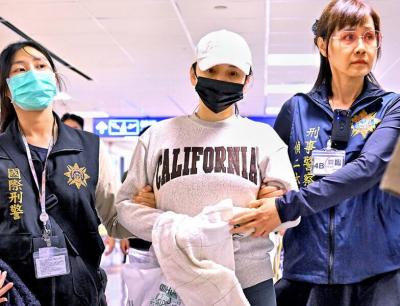
Johanne Liou (劉喬安), a Taiwanese woman who shot to unwanted fame during the Sunflower movement protests in 2014, returned to Taiwan last night after being deported from the US. She is to stand trial in Taiwan for charges involving embezzlement, fraud and drug crimes. The Criminal Investigation Bureau (CIB) said it took her into custody at Taiwan Taoyuan International Airport and would first question her before transferring her to the New Taipei District Prosecutors’ Office. She was arrested upon disembarking a flight from San Francisco that landed shortly before 7pm. Liou absconded to the US in 2019 after jumping bail
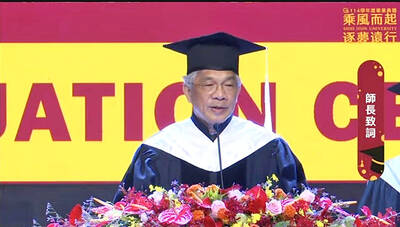
Shih Hsin University President Chen Ching-he (陳清河) yesterday issued a public apology for comments made in his commencement speech last week, stating that he has asked the school to suspend his duties and halt his wages for two months as a show of contrition. At the commencement ceremony on May 30, Chen said, “If you don’t manage your time well, or your own emotions, or your health, then I am telling every one of you — put a quick end to ‘you,’ because the world has no need for ‘you.’” The comments have sparked significant controversy online, and Chen through an open


 RSS
RSS