


The Taiwan Alliance to End the Death Penalty (TAEDP) held a concert on the Double Ten holiday yesterday to mark the World Day Against the Death Penalty, intended to raise public support for its campaign against capital punishment.
Individual singers and rock bands began performances at around 3:30pm in a small performance hall in Kaohsiung City.
Behind the bands, a message read: The death penalty must be abolished in Taiwan.
“Abolishing the death penalty is actually a global trend,” TAEDP executive director Lin Hsin-yi (林欣怡) told the Taipei Times in a phone interview.
During the General Assembly meeting last year, the UN decided to take a more active role in ending executions by adopting a “moratorium on the use of the death penalty.”
“We’ve seen too many cases around the world in which people are found innocent only after they were executed — There is unfortunately no chance of reversing the sentence for them,” Lin said.
Asia is considered the most “death penalty-active” continent, with the death penalty still in place in 14 countries.
However, Lin said she believed Taiwan could take a leading role in ending capital punishment in Asia.
“There has been no execution at all in Taiwan for nearly three years, and there are already debates on the topic,” she said. “We think there’s a hope, especially because Minister of Justice Wang Ching-feng [王清峰] has openly spoken against the death penalty and President Ma Ying-jeou [馬英九] hinted so as well during the [presidential] campaign.”
Upon her inauguration, Wang said she was in favor of abolishing the death penalty.
Ma promised during his presidential campaign that he would govern the country following ideas outlined in the Universal Declaration of Human Rights, International Covenant on Civil and Political Rights and the International Covenant on Economic, Social and Cultural Rights.
“Although Ma did not say it clearly, ending the death penalty is one of the ideas outlined in these documents,” Lin said.

In a historic first, Taiwanese officials participated in this year’s Riga Strategic Communications Dialogue in Latvia from Wednesday to Friday last week, which debuted a breakout session focused on Taiwan The event organizer, the NATO Strategic Communications Center of Excellence, displayed Taiwan’s national flag and the officials’ formal titles on their Web site. Taiwanese attendees included National Security Council (NSC) Deputy Secretary-General Lin Fei-fan (林飛帆) and deputy head of the Taipei Representative Office in the UK, Chiang Ya-chi (江雅綺). In addition to the session discussing Taiwan titled “Taiwan: Navigating Strategic Communication in a Tense Environment,” the dialogue also included sessions
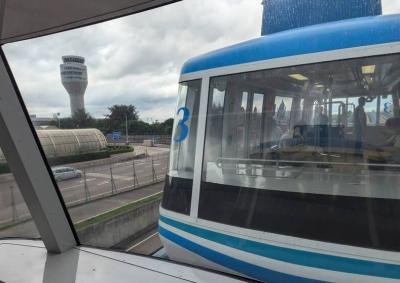
Taiwan Taoyuan International Airport is to suspend its automated Skytrain service connecting Terminal 1 and Terminal 2 starting on July 1 to facilitate connection works for the upcoming Terminal 3, the airport operator said today. Passengers and staff who need to travel between the two terminals after the suspension can instead use the Taoyuan MRT or the airport's 24-hour shuttle bus service, Taoyuan International Airport Corp said. The Taoyuan MRT Airport Line directly links the two terminals, while the shuttle buses are to operate around the clock, the company added. The Skytrain provides free transportation between the airport’s two terminals for travelers and
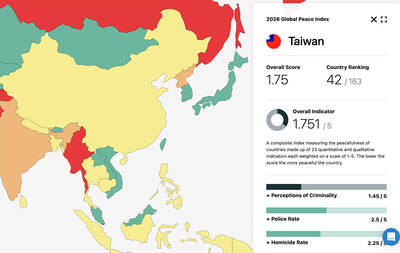
Taiwan ranked 42nd in terms of peacefulness among 163 countries, down five places from last year, according to this year’s Global Peace Index. With an overall score of 1.751, Taiwan dropped from 37th last year, the report published by the global Institute for Economics and Peace showed. The overall score measures a country’s level of peacefulness using 23 quantitative and qualitative indicators across three domains — ongoing domestic and international conflict, societal safety and security, and militarization. While Taiwan ranked 42nd worldwide, it was listed in ninth place among the 19 Asian-Pacific countries in the report, after New Zealand, Singapore, Japan, Malaysia,

TOKYO-MANILA DELIMITATION TALKS: Beijing is attempting to use this opportunity to normalize patrols and law enforcement in the waters east of Taiwan, MOFA said China has no law enforcement authority over the waters east of Taiwan, the Ministry of Foreign Affairs (MOFA) said yesterday, accusing China of undermining regional peace and stability. The Chinese Ministry of Transport on Saturday evening announced that it had launched a “special maritime law enforcement operation” in the waters east of Taiwan, dispatching coast guard vessels to engage in illegal enforcement activities, the ministry said. State-run Xinhua news agency said the operation was “a necessary action taken in response to Japan and the Philippines unilaterally announcing the initiation of maritime boundary delimitation negotiations in the waters east of China’s Taiwan island,


 RSS
RSS