


A French judge on Wednesday ordered the dismissal without trial of one of France’s biggest graft cases involving the 1991 sale of French warships to Taiwan, judicial sources said.
Judge Renaud van Ruymbeke found there were no grounds for a trial over accusations of massive kickbacks after prosecutors cited a lack of evidence.
France led a seven-year inquiry into claims that illegal commissions were paid to politicians, military officers and middlemen in Taiwan, China and France as part of a US$2.8 billion contract with Taiwan for six frigates.
French investigators wrapped up the probe in 2006, but complained they had been denied access by the government to top-secret defense files at the heart of the case.
State prosecutor Jean-Claude Marin in August requested that the case be dropped, saying the investigation had not “brought to light the existence of retro-commissions [kickbacks].”
The prosecutor said the probe had “not enabled the beneficiaries to be identified.”
The Taiwanese Navy bought the six Lafayette-class frigates from French defense company Thomson-CSF (now called Thales).
A 2001 investigation by Taiwan’s highest anti-graft body concluded that as much as US$400 million in kickbacks may have been paid throughout the course of the deal.
Thirteen military officers and 15 arms brokers in Taiwan were convicted of bribery and leaking military secrets in connection with the case and have been jailed.
In France, the scandal drew in a colorful cast of characters, including former foreign minister Roland Dumas, his then-mistress Christine Deviers-Joncour — whom he later dubbed “Mata Hari” — and Loik Le Floch-Prigent, the flamboyant former head of then state oil giant Elf.
Although Elf was not officially involved in the deal, it paid Deviers-Joncour to convince Dumas to drop his opposition to the sale. The former minister had feared it would strain Paris’ ties with Beijing.
The former minister, who was questioned in the case, claimed to know who received the alleged kickbacks, but accused governments of locking up documents that could have identified them.
Former finance ministers Laurent Fabius, Francis Mer and Thierry Breton invoked state secrecy laws to oppose the release of the documents sought by investigators.
Allegations of backhanders emerged after the body of Taiwanese Navy Captain Yin Ching-feng (尹清楓), who was opposed to the deal, was found floating in the sea off Ilan in 1993.
At the time, Yin ran the Taiwanese Navy’s weapons acquisitions office.
Further suspicions arose when Swiss courts discovered US$520 million in accounts held by businessman Andrew Wang (汪傳浦), the main suspect in the case.
Wang, dubbed “Mister Shampoo” for his supposed wizardry as a money launderer, was allegedly tasked with convincing Taiwan to buy the ships and renege on a nearly clinched deal with South Korea’s Hyundai.
Taiwan is still seeking the return of the US$520 million held in Wang’s Swiss accounts, but Switzerland in April rejected the request.
A total of US$900 million remain frozen by Swiss banks on suspicion of being bribes.
A Swiss court judgment concluded that bribes had been paid by Thomson-CSF to middlemen in the deal.
Taiwan is still seeking hundreds of millions of dollars in compensation and interest from France. It argues that the under-the-table payments paid to ensure the deal that went through were explicitly forbidden by the contract.
The penalty clause in the contract stipulated reimbursement of the hidden payments.
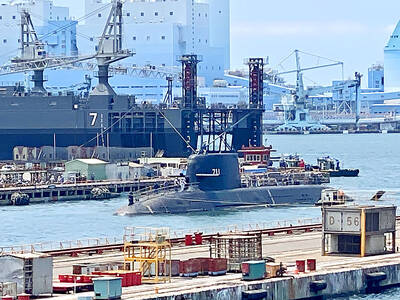
AGING: While Japan has 22 submarines, Taiwan only operates four, two of which were commissioned by the US in 1945 and 1946, and transferred to Taiwan in 1973 Taiwan would need at least 12 submarines to reach modern fleet capabilities, CSBC Corp, Taiwan chairman Chen Cheng-hung (陳政宏) said in an interview broadcast on Friday, citing a US assessment. CSBC is testing the nation’s first indigenous defense submarine, the Hai Kun (海鯤, Narwhal), which is scheduled to be delivered to the navy next month or in July. The Hai Kun has completed torpedo-firing tests and is scheduled to undergo overnight sea trials, Chen said on an SET TV military affairs program. Taiwan would require at least 12 submarines to establish a modern submarine force after assessing the nation’s operational environment and defense

A white king snake that frightened passengers and caused a stir on a Taipei MRT train on Friday evening has been claimed by its owner, who would be fined, Taipei Rapid Transit Corp (TRTC) said yesterday. A person on Threads posted that he thought he was lucky to find an empty row of seats on Friday after boarding a train on the Bannan (Blue) Line, only to spot a white snake with black stripes after sitting down. Startled, he jumped up, he wrote, describing the encounter as “terrifying.” “Taipei’s rat control plan: Release snakes on the metro,” one person wrote in reply, referring
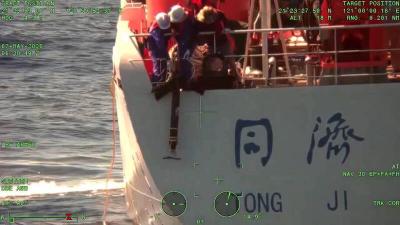
The coast guard today said that it had disrupted "illegal" operations by a Chinese research ship in waters close to the nation and driven it away, part of what Taipei sees a provocative pattern of China's stepped up maritime activities. The coast guard said that it on Thursday last week detected the Chinese ship Tongji (同濟號), which was commissioned only last year, 29 nautical miles (54km) southeast of the southern tip of Taiwan, although just outside restricted waters. The ship was observed lowering ropes into the water, suspected to be the deployment of scientific instruments for "illegal" survey operations, and the coast
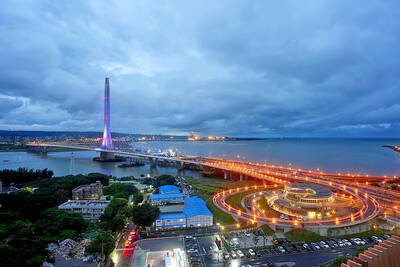
An inauguration ceremony was held yesterday for the Danjiang Bridge, the world’s longest single-mast asymmetric cable-stayed bridge, ahead of its official opening to traffic on Tuesday, marking a major milestone after nearly three decades of planning and construction. At the ceremony in New Taipei City attended by President William Lai (賴清德), Premier Cho Jung-tai (卓榮泰), Minister of Transportation and Communications Chen Shih-kai (陳世凱) and New Taipei City Mayor Hou Yu-ih (侯友宜), the bridge was hailed as both an engineering landmark and a long-awaited regional transport link connecting Tamsui (淡水) and Bali (八里)


 RSS
RSS