


Environmental groups yesterday filed an appeal with the Control Yuan, accusing the Taipei City Government of conspiring with Farglory Group (遠雄企業) in a Build-Operate-Transfer (BOT) case for a sports stadium and stripping Taipei citizens of their rights and benefits.
The construction company plans to build a sports stadium more than twice the size of the Taipei Arena — or 40,000 seats — on the former site of the Taipei Songshan Tobacco plant. The environmental group claimed not only that the contract between the city and Farglory “suspiciously advantageous to the company,” but also that old trees on the historic premises would not be protected as promised. Also, Chen Chin-tsi (陳錦賜), a member of the city’s review committee, may have received benefits from Farglory the day before the BOT contract was signed, the group said.
Green Party Taiwan Secretary-General Pan Han-sheng (潘翰聲) said the property of the former tobacco plant was acquired by the city in 2002 for NT$24 billion (US$745 million) and divided into two parts.
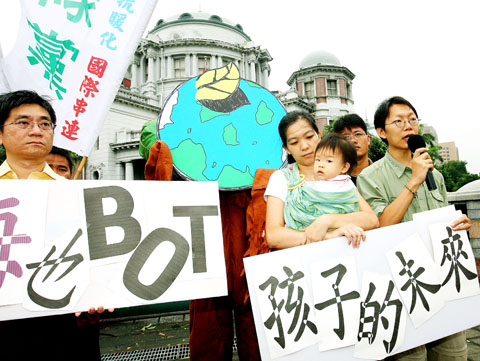
PHOTO: CNA
“While the smaller and less valuable piece is contracted to Fubon Land Development (富邦建設) and the Eslite Group (誠品集團) as a ‘Culture Zone’ for NT$1.2 billion plus 0.5 percent of annual profits, the larger piece at the prime location on the intersection of Guangfu S Road and Zhongxiao E Road, has been planned as a ‘Sports Zone,’ in a BOT to Farglory for no money,” he said.
The draft BOT contract had strict terms and was unfavorable to the contractor, so Farglory was the only company that entered the bidding, Arthur Yo (游藝) of The Society of Wilderness said.
After Farglory won the bid, the city loosened regulations considerably in the final contract signed with the company. In the appeal papers, the groups listed nine alterations made to the contract that favored the company.
“This smells suspiciously fishy that the city was deliberately warding off potential contenders so that Farglory would end up with the contract,” Yo said.
One alteration allowed Farglory to rent the BOT property to third parties, which means there can be commercial operations [shops and restaurants] on the property, which violates the spirit of BOT for the contractor to “build and operate” independently, Pan said.
“Sixty percent of local residents we polled opposed commercial operation on the premises. When the city first held a public hearing on the case, we were given the impression that this would be a public sports stadium and cultural park,” said Yo, who lives near the site.
Pan said the city deleted terms mandating that the contractor provide operational profit reports, and also canceled a contract deposit.
In terms of environmental impact, he said that while the city listed more than 1,000 old trees on the premises as potentially protected by law in the draft contract, the final contract only listed 136 of them as protected.
Yo said the environmental groups are counting on the Control Yuan to investigate the case.

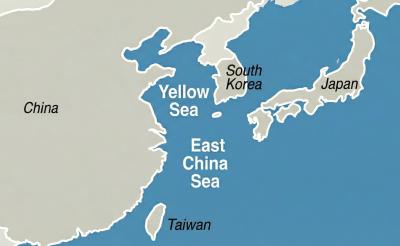
China has reserved offshore airspace in the Yellow Sea and East China Sea from March 27 to May 6, issuing alerts usually used to warn of military exercises, although no such exercises have been announced, the Wall Street Journal (WSJ) reported yesterday. Reserving such a large area for 40 days without explanation is an “unusual step,” as military exercises normally only last a few days, the paper said. These alerts, known as Notice to Air Missions (Notams), “are intended to inform pilots and aviation authorities of temporary airspace hazards or restrictions,” the article said. The airspace reserved in the alert is

South Korea is planning to revise its controversial electronic arrival card, a step Taiwanese officials said prompted them to hold off on planned retaliatory measures, a South Korean media report said yesterday. A Yonhap News Agency report said that the South Korean Ministry of Foreign Affairs is planning to remove the “previous departure place” and “next destination” fields from its e-arrival card system. The plan, reached after interagency consultations, is under review and aims to simplify entry procedures and align the electronic form with the paper version, a South Korean ministry official said. The fields — which appeared only on the electronic form

A bipartisan group of US senators has introduced a bill to enhance cooperation with Taiwan on drone development and to reduce reliance on supply chains linked to China. The proposed Blue Skies for Taiwan Act of 2026 was introduced by Republican US senators Ted Cruz and John Curtis, and Democratic US senators Jeff Merkley and Andy Kim. The legislation seeks to ease constraints on Taiwan-US cooperation in uncrewed aerial systems (UAS), including dependence on China-sourced components, limited access to capital and regulatory barriers under US export controls, a news release issued by Cruz on Wednesday said. The bill would establish a "Blue UAS

More than 6,000 Taiwanese students have participated in exchange programs in China over the past two years, despite the Mainland Affairs Council’s (MAC) “orange light” travel advisory, government records showed. The MAC’s publicly available registry showed that Taiwanese college and university students who went on exchange programs across the Strait numbered 3,592 and 2,966 people respectively. The National Immigration Agency data revealed that 2,296 and 2,551 Chinese students visited Taiwan for study in the same two years. A review of the Web sites of publicly-run universities and colleges showed that Taiwanese higher education institutions continued to recruit students for Chinese educational programs without


 RSS
RSS