


Following the great success he achieved with the movie Cape No. 7, film director Wei Te-sheng (魏德勝) is now more confident about restarting his ambitious shoot for the film Seediq Bale.
Wei and his team spent four years researching the topic before finishing the script, selecting the locations and shooting a preview film.
“We couldn’t go any further because we were short of money,” Wei said, adding that the budget for the movie would be about US$10 million.
However, with the recent success of Cape No. 7 — ticket sales amounted to NT$60 million (US$1.8 million) within three weeks of its release — Wei is now more confident he can complete his ambitious project.
“Before, I was a nobody, now many people know my name and this should make it easier to get sponsorship,” he said yesterday in a phone interview with the Taipei Times.
However, Wei stressed that he would not compromise on certain things in order to get sponsorship.
“All the actors have to be Aborigines and the dialogue has to be in Sedeq [and Japanese],” he said. “If a company tells me that they would give me a lot of money on the condition that I have to hire some famous non-Aboriginal actors, I’d rather not take the money.”
A couple of years ago when the five-minute preview film titled Seediq Bale was posted on the Internet, it created a lot of discussion on the Internet, although at the time not many people had heard of the director’s name.
The Sedeq are an Aboriginal tribe that live mostly in Nantou and Hualien counties.
The film title, Seediq Bale, means “the real person” in their language.
The movie Seediq Bale tells the story of Sedeq warrior Mona Rudao who led a large-scale uprising against the Japanese in present-day Wushe (霧社) in Nantou County.
On the morning of Oct. 27, 1930, Mona led a group of more than 300 Sedeq and launched a surprise attack as the Japanese gathered to participate in a local sports event, killing 125 and wounding 215.
The Sedeq then cut the telephone lines and occupied Wushe for three days, before retreating to their strongholds deep in the mountains.
The Japanese colonial government cracked down on the Sedeq, using more than 2,000 military and police officers, and even used poisonous gas banned by international law.
After being under siege for months, Mona, along with about 300 other Sedeq warriors, killed himself.
“Inspiration from ancestral spirits plays an important part in their resistance, therefore I think the Sedeq were searching for spiritual freedom, rather than corporal freedom,” said Wei, explaining why he wanted to make the movie. “That makes the story very unique and interesting.”

Yangmingshan National Park authorities yesterday urged visitors to respect public spaces and obey the law after a couple was caught on a camera livestream having sex at the park’s Qingtiangang (擎天崗) earlier in the day. The Shilin Police Precinct in Taipei said it has identified a suspect and his vehicle registration number, and would summon him for questioning. The case would be handled in accordance with public indecency charges, it added. The couple entered the park at about 11pm on Thursday and began fooling around by 1am yesterday, the police said, adding that the two were unaware of the park’s all-day live

Fast food chain McDonald's is to raise prices by up to NT$5 on some products at its restaurants across Taiwan, starting on Wednesday next week, the company announced today. The prices of all extra value meals and sharing boxes are to increase by NT$5, while breakfast combos and creamy corn soup would go up by NT$3, the company said in a statement. The price of the main items of those meals, if ordered individually, would remain the same. Meanwhile, the price of a medium-sized lemon iced tea and hot cappuccino would rise by NT$3, extra dipping sauces for chicken nuggets would go up
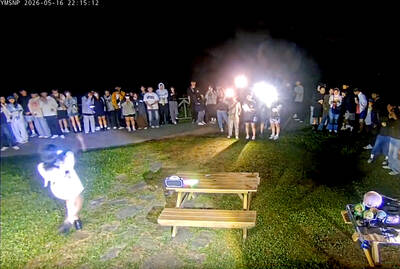
Yangmingshan National Park’s Qingtiangang (擎天崗) nature area has gone viral after a park livestream camera observed a couple in the throes of intimate congress, which was broadcast live on YouTube, drawing large late-night crowds and sparking a backlash over noise, bright lights and disruption to wildlife habitat. The area’s livestream footage appeared to show a couple engaging in sexual activity on a picnic table in the park on Friday last week, with the uncensored footage streamed publicly online. The footage quickly spread across social media, prompting a tide of visitors to travel to the site to “check in” and recreate the

Minister of Digital Affairs Lin Yi-ching (林宜敬) yesterday cited regulatory issues and national security concerns as an expert said that Taiwan is among the few Asian regions without Starlink. Lin made the remarks on Facebook after funP Innovation Group chief executive officer Nathan Chiu (邱繼弘) on Friday said Taiwan and four other countries in Asia — China, North Korea, Afghanistan and Syria — have no access to Starlink. Starlink has become available in 166 countries worldwide, including Ukraine, Malaysia, the Philippines and Vietnam, in the six years since it became commercial, he said. While China and North Korea block Starlink, Syria is not


 RSS
RSS