


Blood transfusions during liver transplant operations can now be more guided and accurate, providing patients with improved quality of care and reducing unnecessary waste of medical resources, the Taipei Veterans General Hospital said at a press conference yesterday.
The hospital achieved its improved blood transfusion method using a thromboelastography analyzer (TEG), a device that was first used in liver transplant operations in the 1980s and recently upgraded with new software to increase speed and accuracy, hospital chief of anesthesiology Tsou Mei-yung (鄒美勇) said.
“During major surgeries, massive blood loss may complicate the operation, leading to traumatic or even fatal results. This is especially true in orthotopic liver transplants, where patients, because of their poor liver function, often suffer from coagulopathy [inefficient blood coagulation],” Tsou said.
Traditionally, surgeons and anesthesiologists rely on experience to determine how much blood to transfuse into a patient intraoperatively, Tsou said, adding that medical analyses — including activated coagulation time and platelet count — are also taken into consideration when making a decision.
However, as the tests take up to two hours to conduct, “a lot of times, by the time the test results turn out, the data is already outdated, or the best time for the patient to receive the transfusion has passed,” he said.
In addition, modern research has shown that when a patient needs a blood transfusion, he or she may only need certain components of blood — such as red cells, white cells, platelets and plasma — rather than “the whole blood,” Tsou said.
As the traditional method is not accurate enough, anesthesiogists may administer insufficient or excess blood transfusions, which may in turn have a negative impact on a patient’s well-being, Tsou said.
Based on clinical operations done in the past three years, the hospital has obtained preliminary results to show that TEG-guided blood transfusion may not only aid surgeons and anesthesiologists perform more successful operations, but also save up to 50 percent of medical resources, including the amount of blood and medication used, Tsou said.
“Within 15 minutes, the TEG is able to determine at bedside [during surgery] the three major blood coagulation indexes, as well as how much of which component of blood the patient needs,” Tsou said.
The TEG also monitors patient blood coagulation functions so that drugs can be administered to coagulopathic patients to reduce blood loss, he said, adding that “the administration of blood components rather than a whole blood transfusion also means that a bag of blood can be given to several patients, which stretches blood resources out significantly.”
In the about 60 patients the hospital has treated in the past two years, the average blood loss for patients undergoing a surgery using TEG was about 5,000ml, Tsou said, adding that those operated on without the TEG lost about 11,000ml of blood.
“One patient we treated this year lost only 400ml of blood, which is extremely little for a liver transplant recipient. He therefore did not receive any transfusion,” he said.
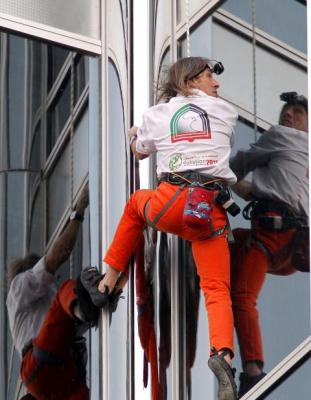
Alain Robert, known as the "French Spider-Man," praised Alex Honnold as exceptionally well-prepared after the US climber completed a free solo ascent of Taipei 101 yesterday. Robert said Honnold's ascent of the 508m-tall skyscraper in just more than one-and-a-half hours without using safety ropes or equipment was a remarkable achievement. "This is my life," he said in an interview conducted in French, adding that he liked the feeling of being "on the edge of danger." The 63-year-old Frenchman climbed Taipei 101 using ropes in December 2004, taking about four hours to reach the top. On a one-to-10 scale of difficulty, Robert said Taipei 101
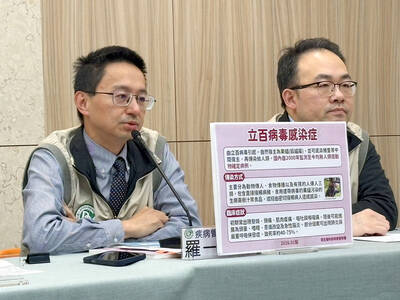
Nipah virus infection is to be officially listed as a category 5 notifiable infectious disease in Taiwan in March, while clinical treatment guidelines are being formulated, the Centers for Disease Control (CDC) said yesterday. With Nipah infections being reported in other countries and considering its relatively high fatality rate, the centers on Jan. 16 announced that it would be listed as a notifiable infectious disease to bolster the nation’s systematic early warning system and increase public awareness, the CDC said. Bangladesh reported four fatal cases last year in separate districts, with three linked to raw date palm sap consumption, CDC Epidemic Intelligence

Two Taiwanese prosecutors were questioned by Chinese security personnel at their hotel during a trip to China’s Henan Province this month, the Mainland Affairs Council (MAC) said yesterday. The officers had personal information on the prosecutors, including “when they were assigned to their posts, their work locations and job titles,” MAC Deputy Minister and spokesman Liang Wen-chieh (梁文傑) said. On top of asking about their agencies and positions, the officers also questioned the prosecutors about the Cross-Strait Joint Crime-Fighting and Judicial Mutual Assistance Agreement, a pact that serves as the framework for Taiwan-China cooperation on combating crime and providing judicial assistance, Liang
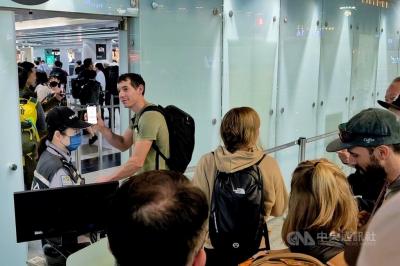
US climber Alex Honnold left Taiwan this morning a day after completing a free-solo ascent of Taipei 101, a feat that drew cheers from onlookers and gained widespread international attention. Honnold yesterday scaled the 101-story skyscraper without a rope or safety harness. The climb — the highest urban free-solo ascent ever attempted — took just more than 90 minutes and was streamed live on Netflix. It was covered by major international news outlets including CNN, the New York Times, the Guardian and the Wall Street Journal. As Honnold prepared to leave Taiwan today, he attracted a crowd when he and his wife, Sanni,


 RSS
RSS