


The public is becoming frustrated with the government two months after the inauguration of President Ma Ying-jeou (馬英九), a poll released by the Chinese-language United Evening News suggested yesterday.
The newspaper, which is sympathetic to the pan-blue camp, reported that the percentage of people unhappy with the performance of Ma and Premier Liu Chao-shiuan (劉兆玄) had surpassed the percentage of those satisfied with the administration.
The survey, conducted on Thursday with 830 respondents aged 20 and older, found that 41 percent were dissatisfied with Ma and the premier, while 35 percent were satisfied.
In a survey conducted by the newspaper last month, 43 percent of respondents said they were satisfied with the administration, while 33 percent were not.
Thursday’s survey also found that 43 percent questioned Ma’s leadership of the administration, while 37 percent approved of his leadership.
When approached for comment, Presidential Office Spokesman Wang Yu-chi (王郁琦) said yesterday that the president was open to public opinion.
“We will take a humble look at our [performance] and improve,” Wang said.
The United Evening News survey followed other polls in recent days that suggested Ma’s approval ratings have declined.
Cable station TVBS made a poll public on Thursday that ranked Ma as seventh among 10 prominent political figures in terms of public approval ratings — down from the top slot in a poll last August — while DPP Chairwoman Tsai Ing-wen (蔡英文) ranked first.
Separately, a recent Democratic Progressive Party (DPP) poll found that disapproval ratings for Ma and Liu had climbed to 56 percent since Ma’s May 20 inauguration.
Commenting on the ratings, Tsai yesterday said that ups and downs in opinion polls were temporary and only to be expected.
The most important thing is for politicians to learn something from a drop in approval ratings, she said.
The public still have faith in the DPP, and the 5.44 million voters who voted for the DPP’s candidate in the March 22 presidential election remain firm supporters, she said.
Following a series of meetings recently with grassroots supporters and party officials, Tsai said she felt strongly that the DPP’s backers had not abandoned the party.
The party’s supporters want to see the party recover, she said.
A report in the Chinese-language United Daily News yesterday said that Tsai, in a letter to party staff, on Thursday encouraged all DPP personnel to “get back on their feet” in the face of challenging times.
“As long as we can get through this period, we will certainly stage a comeback,” Tsai was quoted as saying.
The DPP will regain its strength as a party willing to fight for its cause, she reportedly said.

Fast food chain McDonald's is to raise prices by up to NT$5 on some products at its restaurants across Taiwan, starting on Wednesday next week, the company announced today. The prices of all extra value meals and sharing boxes are to increase by NT$5, while breakfast combos and creamy corn soup would go up by NT$3, the company said in a statement. The price of the main items of those meals, if ordered individually, would remain the same. Meanwhile, the price of a medium-sized lemon iced tea and hot cappuccino would rise by NT$3, extra dipping sauces for chicken nuggets would go up
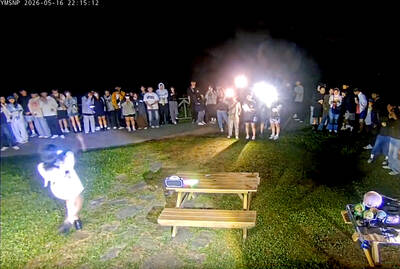
Yangmingshan National Park’s Qingtiangang (擎天崗) nature area has gone viral after a park livestream camera observed a couple in the throes of intimate congress, which was broadcast live on YouTube, drawing large late-night crowds and sparking a backlash over noise, bright lights and disruption to wildlife habitat. The area’s livestream footage appeared to show a couple engaging in sexual activity on a picnic table in the park on Friday last week, with the uncensored footage streamed publicly online. The footage quickly spread across social media, prompting a tide of visitors to travel to the site to “check in” and recreate the
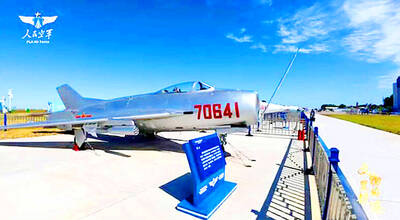
GROUNDED: A KMT lawmaker proposed eliminating drone development programs and freezing funding for counterdrone systems, despite China’s adoption of the technology China has deployed attack drones at air bases near the Taiwan Strait in a strategy aimed at overwhelming Taiwan’s air defense systems through saturation attacks, the Mainland Affairs Council (MAC) said. The council’s latest quarterly report on China said that satellite imagery and open-source intelligence indicate that the Chinese People’s Liberation Army (PLA) had converted retired J-6 fighter jets into J-6W drones, which the PLA has stationed at six air bases near Taiwan, five in China’s Fujian Province and one in Guangdong Province. The report cited J. Michael Dahm, a senior fellow at the US-based Mitchell Institute, as saying that China has

Carrefour Taiwan is to begin using a new name from the start of July, but it cannot divulge the name until then, the chairman of the supermarket chain's parent company said today. President Chain Store Co chairman Lo Chih-hsien (羅智先) was asked by reporters after a shareholders' meeting to confirm whether the company has settled on a new name for the supermarket brand. In March, the government-registered name of two Carrefour Taiwan branches was quietly changed to "Le Chia Kang" (樂家康) in Chinese, raising speculation that has been selected as the name. Lo said that because of local regulations and contractual obligations, the


 RSS
RSS