


As much as 95 percent of the public cannot tell fresh food from spoiled food, Taipei Medical University Hospital (TMUH) said yesterday, adding that to avoid tossing out good food or getting food poisoning from bad food, people should not hoard food in their refrigerators.
Chief nutritionist at TMUH Su Hsiu-yueh (蘇秀悅) told a press conference that “2.6 million people in this country have suffered from diarrhea in the past year, so it is very important that Taiwanese know how to keep their food fresh.”
“Many people mistakenly think that putting food in the fridge stops germs from multiplying, when in fact the low temperature only slows down germ proliferation,” Su said.
Improper storage also increases the rate of spoilage in refrigerated food, Su said.
“Sixty percent of people shove their food into the fridge directly in its original packaging, which leads to cross-contamination,” Su said, citing a survey the hospital conducted with 636 respondents.
“To keep food fresh ... keep it in air-tight containers,” she said.
Most people aren’t sure when the foods in their fridge go bad, Su said.
“Seventy-five percent of people rely on visual examination to tell if food is okay to eat, while another 18 percent decide whether food is spoiled by the smell. In reality, most foods don’t keep more than a week in the fridge,” Su said.
Cooked foods and fresh seafood can only be kept for two days, poultry and fruits can last three, and pork, beef and juices can stay fresh for up to six days, Su said.
Su said that buying food in smaller quantities would help reduce unnecessary waste, as 92 percent of survey respondents reported tossing out food.
Each family throws out an average of NT$66 of food per week, which adds up to NT$25.8 billion per year nationwide, Su said.
“Most people throw out these foods to avoid health hazards. But if it were eaten while still fresh, the amount of food thrown away could provide lunches for 223,000 elementary school students for 20 years,” she said.
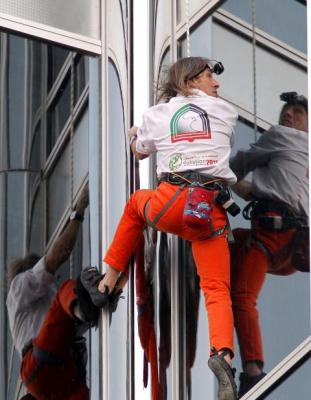
Alain Robert, known as the "French Spider-Man," praised Alex Honnold as exceptionally well-prepared after the US climber completed a free solo ascent of Taipei 101 yesterday. Robert said Honnold's ascent of the 508m-tall skyscraper in just more than one-and-a-half hours without using safety ropes or equipment was a remarkable achievement. "This is my life," he said in an interview conducted in French, adding that he liked the feeling of being "on the edge of danger." The 63-year-old Frenchman climbed Taipei 101 using ropes in December 2004, taking about four hours to reach the top. On a one-to-10 scale of difficulty, Robert said Taipei 101

Nipah virus infection is to be officially listed as a category 5 notifiable infectious disease in Taiwan in March, while clinical treatment guidelines are being formulated, the Centers for Disease Control (CDC) said yesterday. With Nipah infections being reported in other countries and considering its relatively high fatality rate, the centers on Jan. 16 announced that it would be listed as a notifiable infectious disease to bolster the nation’s systematic early warning system and increase public awareness, the CDC said. Bangladesh reported four fatal cases last year in separate districts, with three linked to raw date palm sap consumption, CDC Epidemic Intelligence

Two Taiwanese prosecutors were questioned by Chinese security personnel at their hotel during a trip to China’s Henan Province this month, the Mainland Affairs Council (MAC) said yesterday. The officers had personal information on the prosecutors, including “when they were assigned to their posts, their work locations and job titles,” MAC Deputy Minister and spokesman Liang Wen-chieh (梁文傑) said. On top of asking about their agencies and positions, the officers also questioned the prosecutors about the Cross-Strait Joint Crime-Fighting and Judicial Mutual Assistance Agreement, a pact that serves as the framework for Taiwan-China cooperation on combating crime and providing judicial assistance, Liang
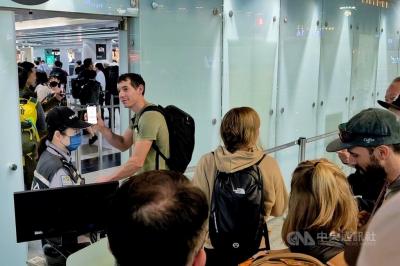
US climber Alex Honnold left Taiwan this morning a day after completing a free-solo ascent of Taipei 101, a feat that drew cheers from onlookers and gained widespread international attention. Honnold yesterday scaled the 101-story skyscraper without a rope or safety harness. The climb — the highest urban free-solo ascent ever attempted — took just more than 90 minutes and was streamed live on Netflix. It was covered by major international news outlets including CNN, the New York Times, the Guardian and the Wall Street Journal. As Honnold prepared to leave Taiwan today, he attracted a crowd when he and his wife, Sanni,


 RSS
RSS