


The pan-blue-dominated Legislative Yuan yesterday approved a controversial amendment to the Labor Insurance Regulations (勞工保險條例) that would increase the labor premium rate by at least 1 percent.
Under the existing law, the premium rate ranges between 6.5 percent and 11 percent, but after passage of the Chinese Nationalist Party (KMT)-initiated amendment, the minimum premium rate will become 7.5 percent and increase annually until it reaches the maximum premium rate at 13 percent.
The legislature also passed a disputed amendment that would allow workers who lose their ability to work because of illness to apply for a monthly disability pension of a minimum of NT$4,000 (US$130).

PHOTO: CNA
The current regulation only allows laborers to apply for a sum of money according to the scale of their disability.
Another controversial amendment also passed its third reading. The amendment would allow laborers over age 60 who have worked for a period of 15 years to enjoy a monthly allowance.
The amendment would also allow laborers over 60 years old who have not worked for 15 years to apply for a one-time payment.
The amount of the monthly allowance and the sum of the one-time payment varies depending on the monthly salary of the insured person. For an employee with a monthly salary of NT$30,000, he or she could enjoy a monthly allowance of around NT$12,000.
After pushing through the amendments by calling for a vote, KMT legislators chanted “justice for laborers,” while Democratic Progressive Party (DPP) legislators, angry at the rate rises, chanted “the KMT deceives laborers,” inside the legislative building.
Meanwhile, the legislature agreed to increase the central government’s budget by NT$45.4 billion and then cut it by NT$19.6 billion, resulting in a net budget increase of NT$25.8 billion.
The Legislative Yuan also approved the central government’s NT$130.1 billion special budget request to help local governments finance a variety of spending programs to boost domestic demand.
However, the legislature rejected a proposal by the DPP that government chiefs responsible for drawing up plans to boost domestic demand step down if the nation’s economic growth fails to reach 5.2 percent this year.
In related developments, the legislature also passed an amendment to the Civil Servant Retirement Law (公務人員退休法) that would treat caregivers who worked in public day care centers between 1994 and 1996 as public officials.
Public day care center caregivers did not officially become public servants until 1997. The amendment allows their working experience in the three years prior to 1997 to be considered when they apply for retirement.
The legislature will discuss the premier’s nominees for the National Communications Commission today as planned despite the typhoon, Legislative Speaker Wang Jin-pyng (王金平) said.

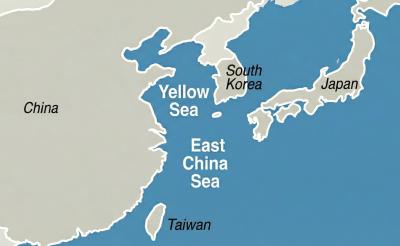
China has reserved offshore airspace in the Yellow Sea and East China Sea from March 27 to May 6, issuing alerts usually used to warn of military exercises, although no such exercises have been announced, the Wall Street Journal (WSJ) reported yesterday. Reserving such a large area for 40 days without explanation is an “unusual step,” as military exercises normally only last a few days, the paper said. These alerts, known as Notice to Air Missions (Notams), “are intended to inform pilots and aviation authorities of temporary airspace hazards or restrictions,” the article said. The airspace reserved in the alert is

South Korea is planning to revise its controversial electronic arrival card, a step Taiwanese officials said prompted them to hold off on planned retaliatory measures, a South Korean media report said yesterday. A Yonhap News Agency report said that the South Korean Ministry of Foreign Affairs is planning to remove the “previous departure place” and “next destination” fields from its e-arrival card system. The plan, reached after interagency consultations, is under review and aims to simplify entry procedures and align the electronic form with the paper version, a South Korean ministry official said. The fields — which appeared only on the electronic form

A bipartisan group of US senators has introduced a bill to enhance cooperation with Taiwan on drone development and to reduce reliance on supply chains linked to China. The proposed Blue Skies for Taiwan Act of 2026 was introduced by Republican US senators Ted Cruz and John Curtis, and Democratic US senators Jeff Merkley and Andy Kim. The legislation seeks to ease constraints on Taiwan-US cooperation in uncrewed aerial systems (UAS), including dependence on China-sourced components, limited access to capital and regulatory barriers under US export controls, a news release issued by Cruz on Wednesday said. The bill would establish a "Blue UAS

More than 6,000 Taiwanese students have participated in exchange programs in China over the past two years, despite the Mainland Affairs Council’s (MAC) “orange light” travel advisory, government records showed. The MAC’s publicly available registry showed that Taiwanese college and university students who went on exchange programs across the Strait numbered 3,592 and 2,966 people respectively. The National Immigration Agency data revealed that 2,296 and 2,551 Chinese students visited Taiwan for study in the same two years. A review of the Web sites of publicly-run universities and colleges showed that Taiwanese higher education institutions continued to recruit students for Chinese educational programs without


 RSS
RSS