


The Executive Yuan should come up with a bill on regulating the signing of agreements between the two sides of the Taiwan Strait, Legislative Speaker Wang Jin-pyng (王金平) said on Friday.
Noting that cross-strait affairs are crucial to the nation’s survival and sustainable development, Wang said no single party or individual could solely decide on the course of development of cross-strait relations.
While cross-strait relations have been developing very quickly since the inauguration of the new Chinese Nationalist Party (KMT) government, Wang said the country had yet to develop a sufficient supervisory mechanism to oversee the developments.
Recalling that the previous KMT administration had twice referred bills governing the signing of cross-strait agreements to the legislature for screening, Wang, a KMT heavyweight, said he wondered why the party had not yet come up with such a proposal now that it has regained power. In his view, Wang said, cross-strait affairs should be kept as transparent as possible.
“Otherwise, disputes or controversies could arise after a bilateral accord is reached,” he said.
It is also very important that opposition parties be allowed to have a say in the process of negotiations, Wang said.
“By so doing, hindrances could be minimized in striking a cross-strait deal,” he said.
Parliamentary supervision of major policy issues is the norm in mature democratic countries, Wang said, and the lawmaking body should not be excluded from the crafting and implementation of cross-strait policies because they are critical to security, sovereignty and popular rights and interests.
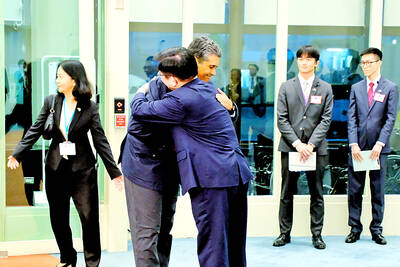
Palauan President Surangel Whipps Jr arrived in Taiwan last night to kick off his first visit to the country since beginning his second term earlier this year. After arriving at Taoyuan International Airport at around 6:30 pm, Whipps and his delegation were welcomed by Minister of Foreign Affairs Lin Chia-lung (林佳龍). Speaking to gathered media, the Palauan leader said he was excited and honored to be back in Taiwan on his first state visit to Taiwan since he was sworn in this January. Among those traveling with Whipps is Minister of State Gustav N. Aitaro, Public Infrastructure
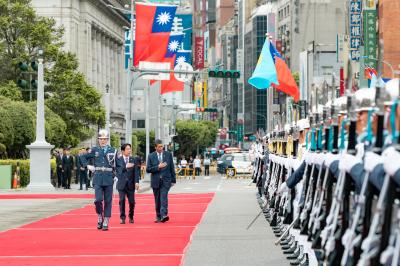
President William Lai (賴清德) yesterday thanked Palau for its continued support of Taiwan's international participation, as Taipei was once again excluded from the World Health Assembly (WHA) currently taking place in Switzerland. "Palau has never stopped voicing support for Taiwan" in the UN General Assembly, the WHO and other UN-affiliated agencies, Lai said during a bilateral meeting with visiting Palau President Surangel Whipps Jr. "We have been profoundly touched by these endorsements," Lai said, praising the Pacific island nation's firm support as "courageous." Lai's remarks came as Taiwan was excluded for the ninth consecutive year from the WHA, which is being held in
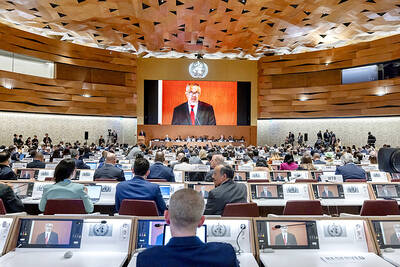
RESOLUTIONS DEBATE: Taiwan’s allies said that UN and WHA resolutions cited by China and other nations ‘do not determine Taiwan’s participation in WHO activities’ A proposal to invite Taiwan to this year’s World Health Assembly (WHA) was rejected on Monday, resulting in Taipei’s absence from the annual meeting for a ninth consecutive year, although partners spoke up for Taiwan’s participation at the first day of the meeting. The first agenda item after the opening was a “two-on-two debate” on a proposal to invite Taiwan to participate at the WHA as an observer. Similar to previous years, two countries made statements in favor of the proposal, while two others expressed their opposition. Philippine Secretary of Health Teodoro Herbosa, president of the 78th WHA, accepted the WHA General Committee’s
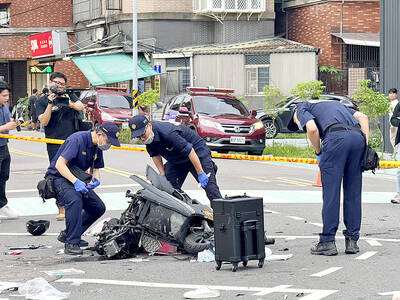
At least three people died and more than a dozen were injured yesterday afternoon when a vehicle struck a group of pedestrians in New Taipei City’s Sansia District (三峽). The incident happened at about 4pm when a car rammed into pedestrians at an intersection near Bei Da Elementary School. Witnesses said the sedan, being driven at a high speed, ran a red light, knocking scooters out of the way and hitting students crossing the road before careening into a median near the intersection of Guocheng and Guoguang streets. The incident resulted in three deaths and 13 injuries, including the driver, a 78-year-old man


 RSS
RSS