


Taiwanese director Sung Ming-chieh's (宋明杰) latest project will trace a Taiwanese-American man’s movements as he looks for his father in the US, Sung said from Washington on Tuesday.
Sung said his documentary film crew would spend two weeks in the US shooting footage of the man’s search, which will take him to various schools and black communities as he tries to locate his African-American father.
The 33-year-old Jimmy Liao Chih-lung (廖枝龍), who works as a DJ in Taiwan and has performed several times on TV drag shows, said that his parents met in Taiwan in 1974 when his father was serving in the US Air Force during the Vietnam War.

PHOTO: CNA
Liao said his Taiwanese mother lost contact with his father, known by his middle name Morgan and the surname Steward or Stewart, when he left Taiwan one month before he was born in 1975.
Liao also carries the English name James Morgan Steward and is known as Jimmy. He said he is not sure whether his father’s last name is Stewart or Steward.
Sung said he hoped that Liao and the film crew could get help from people who might have some clues as to the former airman’s whereabouts.

PHOTO: CNA
Liao said his father is probably in his 60s and that he only wants to know whether he is in good health. Liao said he has no wish to disturb his father’s life.
The documentary is a sequel to an earlier film produced in 2004 titled Hey Jimmy, which featured Liao’s setbacks and frustrations living in Taiwan as a person of mixed race without a father. The film became popular and was screened at several local and international film festivals, Sung said.
Sung said that in the sequel he wants to further discuss the race issue in Taiwan, as well as family values.
The documentary is partly funded by the Government Information Office.
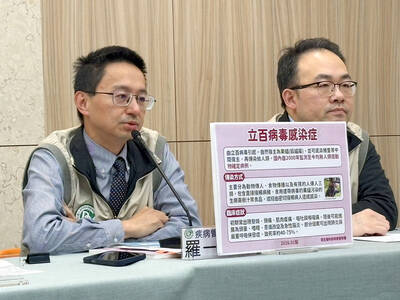
Nipah virus infection is to be officially listed as a category 5 notifiable infectious disease in Taiwan in March, while clinical treatment guidelines are being formulated, the Centers for Disease Control (CDC) said yesterday. With Nipah infections being reported in other countries and considering its relatively high fatality rate, the centers on Jan. 16 announced that it would be listed as a notifiable infectious disease to bolster the nation’s systematic early warning system and increase public awareness, the CDC said. Bangladesh reported four fatal cases last year in separate districts, with three linked to raw date palm sap consumption, CDC Epidemic Intelligence

The manufacture of the remaining 28 M1A2T Abrams tanks Taiwan purchased from the US has recently been completed, and they are expected to be delivered within the next one to two months, a source said yesterday. The Ministry of National Defense is arranging cargo ships to transport the tanks to Taiwan as soon as possible, said the source, who is familiar with the matter. The estimated arrival time ranges from late this month to early next month, the source said. The 28 Abrams tanks make up the third and final batch of a total of 108 tanks, valued at about NT$40.5 billion

Two Taiwanese prosecutors were questioned by Chinese security personnel at their hotel during a trip to China’s Henan Province this month, the Mainland Affairs Council (MAC) said yesterday. The officers had personal information on the prosecutors, including “when they were assigned to their posts, their work locations and job titles,” MAC Deputy Minister and spokesman Liang Wen-chieh (梁文傑) said. On top of asking about their agencies and positions, the officers also questioned the prosecutors about the Cross-Strait Joint Crime-Fighting and Judicial Mutual Assistance Agreement, a pact that serves as the framework for Taiwan-China cooperation on combating crime and providing judicial assistance, Liang
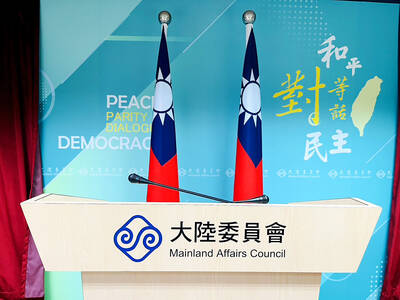
Reports of Taiwanese going missing, being detained or interrogated, or having their personal liberties restricted in China increased about fourfold annually last year, the Mainland Affairs Council (MAC) said yesterday. Last year, 221 Taiwanese who traveled to China were reported missing, were detained and interrogated, or otherwise had their personal freedom restricted, up from 55 the previous year, the council said. Reopening group tours to China would be risky, as it would leave travelers with no way to seek help through official channels after Beijing shut down dialogue between the associations tasked with handling cross-strait tourism, the MAC said. Taipei’s Taiwan Strait Tourism


 RSS
RSS