


On Saturday, President Ma Ying-jeou (馬英九) may have advised local governments to try and keep schools in remote areas with dwindling numbers of students open, but Penghu County has a bigger challenge than most to heed his advice.
The archipelago consists of 90 small islets covering an area of 141km². Only 18 of the islands are inhabited.
Many of the residents of the county’s more remote islands have left their homes because of the lack of economic opportunities and inconvenient transportation links to more populated centers, leading to a severe decline in the number of school-age children — and to schools with enrollments in single digits.
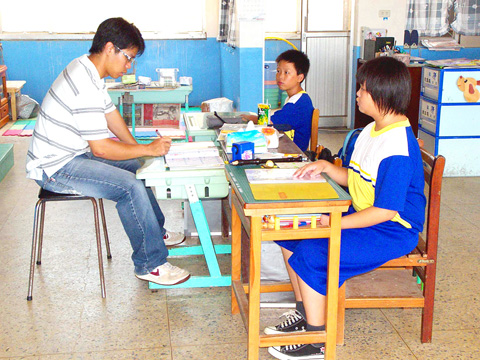
PHOTO: CNA
Since 1983, six elementary schools have been closed in Penghu, leaving only eight standing. The latest to close was Dacang Elementary School in Baisha Township, which shut its doors for good in 2005, forcing its only two students to travel to the county capital of Magong (馬公) to continue their education.
Graduation ceremonies at the schools in recent days should have been festive occasions, but they only served to highlight the ominous clouds hovering over their futures, and the problems students and educators face in dealing with small class sizes.
Only three students graduated from the elementary schools on Niaoyu and Huayu islands, while only two graduated from the school on Hujingyu.
Kangzi and Shiaomen elementary schools each saw off only one graduate this year.
Chang Yi-ling (張翊翎) was the only graduate of Shiaomen Elementary School. Over the past six years, she has been the only student in her grade, and therefore always ranked the top for academic performance.
She was the only “model student” in her class and was honored at the graduation ceremony with every award her school could offer.
Over the years, Chang also had the privilege of having her teachers to herself; she had no classmates to compete with her or distract her.
But that doesn’t mean it was a perfect environment.
“There’s a lot of pressure when attending class alone because it was impossible to take a nap when I was tired,” Chang said.
Chang’s teacher, Lin Chung-teh (林宗德), said the advantage of teaching one on one is that he was able to control the progress of the class and had no problems in communicating with his student.
But there were also drawbacks, Lin said. Chang did not face any competition and had nothing to compel her to learn. He added that students in such a situation are also likely to be less inquisitive than when learning in a group.
The mother of Cheng Ai-tung (鄭愛彤), who recently graduated from Magong Elementary School, expressed her support for the idea of closing these “mini schools” because she believes children can only grow up normally within a group environment.
Chen had studied at Dacang Elementary School before it was closed three years ago, Chen’s mother recalled, saying her daughter had been the only student when she was in the first, second and third grades.
In those days, Chen always was first — and last — in every exam, Chen’s mother said.
To the principals, teachers and parents of students in Penghu County’s schools, the prospect of school closures weighs heavily.
Some parents of children at Shiaomen Elementary School, which now only has nine students, have begun a campaign to persuade parents of students in other parts of the county to transfer their children to Shiaomen next semester to keep the school alive.
County Bureau of Education Director Hu Chung-kai (胡中鎧) admitted that there is little the bureau can do to keep the mini schools in remote areas open because its education resources are limited and have to be used in the most efficient way.
Complicating Hu’s dilemma is that it is extremely difficult to hire teachers willing to work on the island, he said.
Despite the obstacles, though, Hu said the county has no plans to abolish any schools in the near future.
On Saturday at a graduation ceremony held by Hong Ye Elementary School in a remote area in Taitung, where six students graduated, Ma said no remote schools should be closed rashly. He said he believed the function of a school in a community goes beyond simply offering a place where children can get an education, and he worried that although closing a school could save money, the bonds developed between schools and their communities could never be replaced.
Yet for the teachers, parents and administrators in places like Penghu County, those bonds may still have to be sacrificed to budgetary and numerical realities, victims of inexorable modernization trends that show no signs of relenting.


An essay competition jointly organized by a local writing society and a publisher affiliated with the Chinese Communist Party (CCP) might have contravened the Act Governing Relations Between the People of the Taiwan Area and the Mainland Area (臺灣地區與大陸地區人民關係條例), the Mainland Affairs Council (MAC) said on Thursday. “In this case, the partner organization is clearly an agency under the CCP’s Fujian Provincial Committee,” MAC Deputy Minister and spokesperson Liang Wen-chieh (梁文傑) said at a news briefing in Taipei. “It also involves bringing Taiwanese students to China with all-expenses-paid arrangements to attend award ceremonies and camps,” Liang said. Those two “characteristics” are typically sufficient

The brilliant blue waters, thick foliage and bucolic atmosphere on this seemingly idyllic archipelago deep in the Pacific Ocean belie the key role it now plays in a titanic geopolitical struggle. Palau is again on the front line as China, and the US and its allies prepare their forces in an intensifying contest for control over the Asia-Pacific region. The democratic nation of just 17,000 people hosts US-controlled airstrips and soon-to-be-completed radar installations that the US military describes as “critical” to monitoring vast swathes of water and airspace. It is also a key piece of the second island chain, a string of
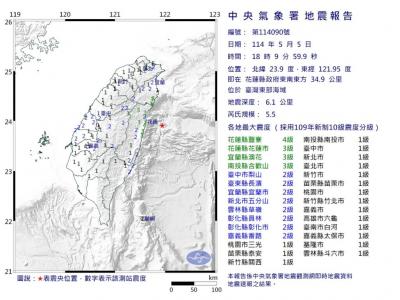
A magnitude 5.9 earthquake that struck about 33km off the coast of Hualien City was the "main shock" in a series of quakes in the area, with aftershocks expected over the next three days, the Central Weather Administration (CWA) said yesterday. Prior to the magnitude 5.9 quake shaking most of Taiwan at 6:53pm yesterday, six other earthquakes stronger than a magnitude of 4, starting with a magnitude 5.5 quake at 6:09pm, occurred in the area. CWA Seismological Center Director Wu Chien-fu (吳健富) confirmed that the quakes were all part of the same series and that the magnitude 5.5 temblor was
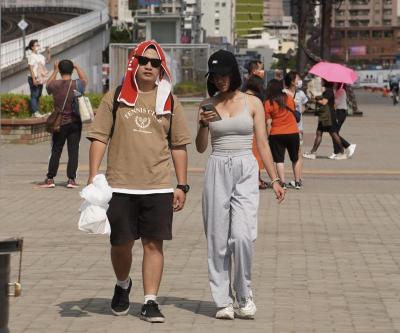
The Central Weather Administration has issued a heat alert for southeastern Taiwan, warning of temperatures as high as 36°C today, while alerting some coastal areas of strong winds later in the day. Kaohsiung’s Neimen District (內門) and Pingtung County’s Neipu Township (內埔) are under an orange heat alert, which warns of temperatures as high as 36°C for three consecutive days, the CWA said, citing southwest winds. The heat would also extend to Tainan’s Nansi (楠西) and Yujing (玉井) districts, as well as Pingtung’s Gaoshu (高樹), Yanpu (鹽埔) and Majia (瑪家) townships, it said, forecasting highs of up to 36°C in those areas


 RSS
RSS