


Although 80 percent of Taiwanese own one to three pairs of "eco-friendly chopsticks" (chopsticks in carrying cases), the nation still consumes 5 billion pairs of disposable chopsticks a year, the Environmental Protection Administration (EPA) said yesterday.
To cut that number, the agency has enlisted the help of four major convenience store chains to stop offering complementary chopsticks to people buying instant noodles or lunchboxes, Solid Waste Control Director-General Ho Soong-chin (何舜琴) told a press conference in Taipei.
“Though usage of disposable chopsticks has been declining since 2006 because of media coverage of sulfur dioxide contamination, Taiwanese still use 13 million pairs per day, which translates into one pair per person every two days,” Ho said.
Starting next month, 7-Eleven, OK, Family Mart and Hi-Life will only provide chopsticks to customers who specifically ask for them, she said.
“Twenty percent of the public we surveyed regularly bring their own chopsticks when eating out, which shows that carrying one’s own utensils is becoming a habit,” Ho said.
The EPA hopes the new policy would increase that percentage, Ho said.
“In six months, we hope to reduce convenience stores’ chopstick usage by 20 percent, which will save 36 million pairs of chopsticks, the equivalent of 10,000 20-year-old trees and 300 tonnes of carbon emissions,” she said.
However, Ho admitted that the policy would only make a slight dent in disposable chopstick use because convenience stores account for just 3.6 percent of the total number of chopsticks handed out.
Restaurants, food stalls and other eateries account for more than 90 percent of disposable chopstick usage (or 4.5 billion pairs), she said.
When told that a 20 percent cut reduction in convenience store usage would only mean a savings of 0.72 percent of the total usage, Ho said: “What we are trying to do is increase awareness, so that people will hopefully carry the concept across to other areas of dining out.”
More widespread campaigns and regulations to incorporate all sectors distributing disposable chopsticks may be launched, Ho said.
“Old habits die hard — in addition to government policies, education should also be used to foster the habit of saying no to disposable utensils,” she said.
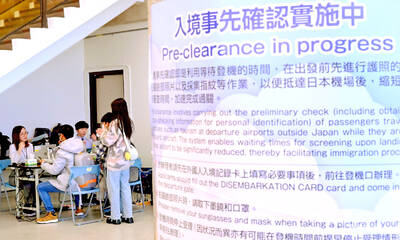
A preclearance service to facilitate entry for people traveling to select airports in Japan would be available from Thursday next week to Feb. 25 at Taiwan Taoyuan International Airport, Taoyuan International Airport Corp (TIAC) said on Tuesday. The service was first made available to Taiwanese travelers throughout the winter vacation of 2024 and during the Lunar New Year holiday. In addition to flights to the Japanese cities of Hakodate, Asahikawa, Akita, Sendai, Niigata, Okayama, Takamatsu, Kumamoto and Kagoshima, the service would be available to travelers to Kobe and Oita. The service can be accessed by passengers of 15 flight routes operated by

GIVE AND TAKE: Blood demand continues to rise each year, while fewer young donors are available due to the nation’s falling birthrate, a doctor said Blood donors can redeem points earned from donations to obtain limited edition Formosan black bear travel mugs, the Kaohsiung Blood Center said yesterday, as it announced a goal of stocking 20,000 units of blood prior to the Lunar New Year. The last month of the lunar year is National Blood Donation Month, when local centers seek to stockpile blood for use during the Lunar New Year holiday. The blood demand in southern Taiwan — including Tainan and Kaohsiung, as well as Chiayi, Pingtung, Penghu and Taitung counties — is about 2,000 units per day, the center said. The donation campaign aims to boost

ENHANCING EFFICIENCY: The apron can accommodate 16 airplanes overnight at Taoyuan airport while work on the third runway continues, the transport minister said A new temporary overnight parking apron at Taiwan Taoyuan International Airport is to start operating on Friday next week to boost operational efficiency while the third runway is being constructed, the Ministry of Transportation and Communications said yesterday. The apron — one of the crucial projects in the construction of the third runway — can accommodate 16 aircraft overnight at the nation’s largest international airport, Minister of Transportation and Communications Chen Shih-kai (陳世凱) told reporters while inspecting the new facility yesterday morning. Aside from providing the airport operator with greater flexibility in aircraft parking during the third runway construction,

American climber Alex Honnold is to attempt a free climb of Taipei 101 today at 9am, with traffic closures around the skyscraper. To accommodate the climb attempt and filming, the Taipei Department of Transportation said traffic controls would be enforced around the Taipei 101 area. If weather conditions delay the climb, the restrictions would be pushed back to tomorrow. Traffic controls would be in place today from 7am to 11am around the Taipei 101 area, the department said. Songzhi Road would be fully closed in both directions between Songlian Road and Xinyi Road Sec 5, it said, adding that bidirectional traffic controls would


 RSS
RSS