


Early on Saturday morning, crowds of cars and tourists poured into Dasi (大溪) Township in Taoyuan County, where the mausoleums of dictator Chiang Kai-shek (蔣介石) and his son, former president Chiang Ching-kuo, (蔣經國) are located.
Chiang Kai-shek’s mausoleum is located at the Tzuhu Presidential Burial Place (慈湖陵寢), while the body of Chiang Ching-kuo, who died in 1988, was placed in a mausoleum in Touliao (頭寮), not far from his father’s resting place.
At the two mausoleums, veterans, with a renewed taste for nostalgia, returned to venues that had been closed since December, kneeling down with teary eyes in front of the mausoleums to remember the old days.
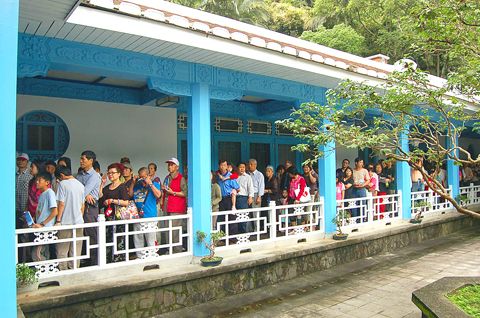
PHOTO: TSAI CHIA-YEN, TAIPEI TIMES
Meanwhile, outside the mausoleums, crowds waiting to pay tribute to the two former leaders amassed, prodded by vendors looking to sell their wares.
The temporary burial places of the two Chiangs, once prime tourist attractions, had lost some of their luster in recent decades as democratization gripped Taiwan and the authoritarian figures fell out of favor.
But better economic times may now return to Dasi following the reopening of the mausoleums, five months after the former Democratic Progressive Party (DPP) government closed the venues to public access as part of its campaign to remove public vestiges of the men, especially Chiang Kai-shek, who many see as a brutal dictator.
The reopening of the venues could be a financial bonanza for Dasi and the county.
Before President Ma Ying-jeou (馬英九) of the Chinese Nationalist Party (KMT) won the presidential election on March 22, Taoyuan County and Dasi had already geared up for the reopening of the venues amid hopes that they would again boost local tourism and inject NT$400 million (US$12.11 million) to NT$500 million into the local economy.
Tzuhu, originally called “Horn South Pond” because of its shape, was renamed by Chiang Kai-shek in memory of his mother because the scenery in the area reminded him of his hometown of Sikou in Zhejiang Province’s Fenghua County.
Chiang Kai-shek’s favorite residence was converted into his temporary resting place after his death on April 5, 1975, and opened to visitors.
The KMT-led Taoyuan County government has even turned the scenic “rear Tzuhu,” a previously restricted section of the park behind Chiang Kai-shek’s resting place, into a site for concerts or other public events in the hope of attracting more visitors and revenue.
That revenue could receive a substantial shot in the arm from Chinese tourists if talks between the Straits Exchange Foundation and its Chinese counterpart are sucessful.
“With the incoming administration’s plan to open up Taiwan to Chinese tourists in July, the cultural heritage of the Chiangs and their residences will become popular tourist attractions,” Ma, who began his political career as the English secretary to Chiang Ching-kuo, said in April.
In order to distance himself from the KMT’s negative image lingering from its autocratic past, Ma suggested in April that people in Taiwan should leave an appraisal of the historical roles of the two late presidents to the historians and allow their legacies to help develop tourism.
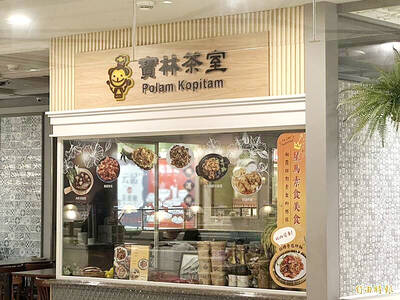
POLAM KOPITIAM CASE: Of the two people still in hospital, one has undergone a liver transplant and is improving, while the other is being evaluated for a liver transplant A fourth person has died from bongkrek acid poisoning linked to the Polam Kopitiam (寶林茶室) restaurant in Taipei’s Far Eastern Sogo Xinyi A13 Department Store, the Ministry of Health and Welfare said yesterday, as two other people remain seriously ill in hospital. The first death was reported on March 24. The man had been 39 years old and had eaten at the restaurant on March 22. As more cases of suspected food poisoning involving people who had eaten at the restaurant were reported by hospitals on March 26, the ministry and the Taipei Department of Health launched an investigation. The Food and

The long-awaited Taichung aquarium is expected to open next year after more than a decade of development. The building in Cingshui District (清水) is to feature a large ocean aquarium on the first floor, coral display area on the second floor, a jellyfish tank and Dajia River (大甲溪) basin display on the third, a river estuary display and restaurant on the fourth, and a cafe and garden on the fifth. As it is near Wuci Fishing Port (梧棲漁港), many are expecting the opening of the aquarium to bring more tourism to the harbor. Speaking at the city council on Monday, Taichung City Councilor
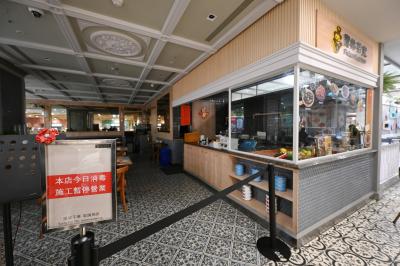
A fourth person has died in a food poisoning outbreak linked to the Xinyi (信義) branch of Malaysian restaurant chain Polam Kopitiam (寶林茶室) in Taipei, Deputy Minister of Health and Welfare Victor Wang (王必勝) said on Monday. It was the second fatality in three days, after another was announced on Saturday. The 40-year-old woman experienced multiple organ failure in the early hours on Monday, and the family decided not to undergo emergency resuscitation, Wang said. She initially showed signs of improvement after seeking medical treatment for nausea, vomiting and diarrhea, but her condition worsened due to an infection, he said. Two others who

Taiwanese should be mindful when visiting China, as Beijing in July is likely to tighten the implementation of policies on national security following the introduction of two regulations, a researcher said on Saturday. China on Friday unveiled the regulations governing the law enforcement and judicial activities of national security agencies. They would help crack down on “illegal” and “criminal” activities that Beijing considers to be endangering national security, according to reports by China’s state media. The definition of what constitutes a national security threat in China is vague, Taiwan Thinktank researcher Wu Se-chih (吳瑟致) said. The two procedural regulations are to provide Chinese


 RSS
RSS