


The Democratic Progressive Party (DPP) yesterday decided not to nominate any candidates for the Control Yuan and Examination Yuan and vowed to punish any individual accepting a nomination from President Ma Ying-jeou (馬英九).
DPP Secretary-General Wang Tuoh (王拓) told reporters after the party’s Central Standing Committee meeting yesterday afternoon that the committee had resolved to suspend members who independently accept Ma’s nomination for either of the two government branches, but that they could reclaim their membership once they left the position, he said.
Wang said the decision was made to keep the Control Yuan and Examination Yuan free from political intervention and to maintain their independence. He urged the Chinese Nationalist Party (KMT) to follow suit.
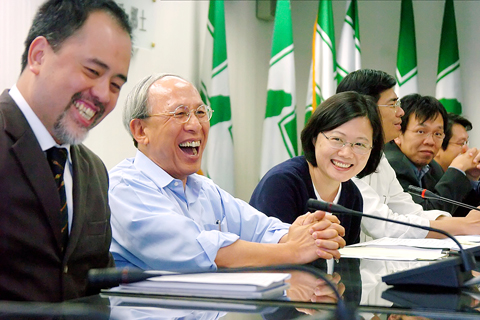
PHOTO: CHU PEI-HSIUNG, TAIPEI TIMES
The KMT has said that it would not make any nominations, but stopped short of specifying whether it would allow individual members to recommend themselves or let others recommend them.
Wang said any DPP members who want to work in the KMT Cabinet must obtain the approval of the party or face disciplinary measures, with the most severe punishment being nullification of membership.
The committee also decided to hold its weekly meetings in different cities and invited members of local charters to attend.
The committee also approved a motion proposed by DPP Chairwoman Tsai Ing-wen (蔡英文) to form three task forces.
The Policy and Think Tank Task Force will be supervised by DPP legislative caucus whip Ker Chien-ming (柯建銘) and headed by Taiwan Thinktank chairman Chen Po-chih (陳博志). Former Presidential Office secretary-general Yeh Chu-lan (葉菊蘭) will supervise the Party Reform Task Force and Wang will serve as the convener. The Election and Strategy Task Force will be supervised by Chiayi County Commissioner Chen Ming-wen (陳明文), with former chairman of the Council of Agriculture Su Jia-chyuan (蘇嘉全) serving as the convener.
In related news, several high-ranking DPP officials assumed office yesterday.
Yao Jen-to (姚人多) and Hsiao Bi-khim (蕭美琴) are assistants to Tsai. Yao, Hsiao and Wang will provide their services free of charge. Chen Chi-mai (陳其邁) and Hung Yao-fu (洪耀福) will serve as the party’s deputy secretaries-general.
Others include Lin Chen-wei (林成蔚), director of Department of International Affairs; Chao Tien-lin (趙天麟), director of the Department of Youth Development, and Cheng Wen-tsang (鄭文燦), DPP spokesman and director of the Department of Culture and Communications.
Wang said he had asked Cheng to lose weight because a spokesman represents the image of the party.
Cheng will get NT$5,000 for each kilogram he loses and must lose 4kg within two months, Wang said, but Cheng will owe him the same amount if he fails to reach the goal.
Two positions still remain vacant: the head of the Department of Women’s Development and that of the Policy Research Committee.

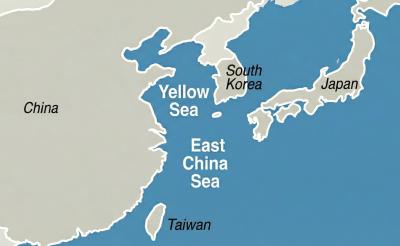
China has reserved offshore airspace in the Yellow Sea and East China Sea from March 27 to May 6, issuing alerts usually used to warn of military exercises, although no such exercises have been announced, the Wall Street Journal (WSJ) reported yesterday. Reserving such a large area for 40 days without explanation is an “unusual step,” as military exercises normally only last a few days, the paper said. These alerts, known as Notice to Air Missions (Notams), “are intended to inform pilots and aviation authorities of temporary airspace hazards or restrictions,” the article said. The airspace reserved in the alert is

South Korea is planning to revise its controversial electronic arrival card, a step Taiwanese officials said prompted them to hold off on planned retaliatory measures, a South Korean media report said yesterday. A Yonhap News Agency report said that the South Korean Ministry of Foreign Affairs is planning to remove the “previous departure place” and “next destination” fields from its e-arrival card system. The plan, reached after interagency consultations, is under review and aims to simplify entry procedures and align the electronic form with the paper version, a South Korean ministry official said. The fields — which appeared only on the electronic form
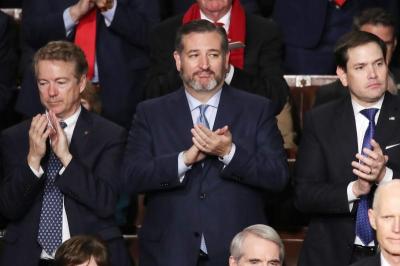
A bipartisan group of US senators has introduced a bill to enhance cooperation with Taiwan on drone development and to reduce reliance on supply chains linked to China. The proposed Blue Skies for Taiwan Act of 2026 was introduced by Republican US senators Ted Cruz and John Curtis, and Democratic US senators Jeff Merkley and Andy Kim. The legislation seeks to ease constraints on Taiwan-US cooperation in uncrewed aerial systems (UAS), including dependence on China-sourced components, limited access to capital and regulatory barriers under US export controls, a news release issued by Cruz on Wednesday said. The bill would establish a "Blue UAS

More than 6,000 Taiwanese students have participated in exchange programs in China over the past two years, despite the Mainland Affairs Council’s (MAC) “orange light” travel advisory, government records showed. The MAC’s publicly available registry showed that Taiwanese college and university students who went on exchange programs across the Strait numbered 3,592 and 2,966 people respectively. The National Immigration Agency data revealed that 2,296 and 2,551 Chinese students visited Taiwan for study in the same two years. A review of the Web sites of publicly-run universities and colleges showed that Taiwanese higher education institutions continued to recruit students for Chinese educational programs without


 RSS
RSS