


■ EARTHQUAKES
Quake off Ilan County
A 5.3-magnitude temblor struck off the east coast of Ilan County early yesterday, the US Geological Survey (USGS) said, but there were no immediate reports of damage or casualties. The quake hit at 3:41am and was centered 99km southeast of Suao, the USGS said. It struck at a depth of 10km.
■EVENTS
Michael Nobel in Taiwan
Michael Nobel, a great grand nephew of Alfred Nobel, founder of the Nobel Prize awards, will come to Taiwan to take part in a forum on energy-saving awareness and carbon dioxide-reducing initiatives. Nobel, who will deliver a speech during the forum tomorrow at the Grand Hotel in Taipei, is expected to share his perspectives on building energy-management platforms for higher energy efficiency and developing alternative energies, said the Taiwan Architecture and Building Center, one of the two sponsors of the forum. The 68-year-old Nobel, a citizen of Sweden and Switzerland, has international scientific and commercial experience in fields such as life sciences, satellite communications, Internet services for finances and investment, information management and crisis management. He participated in the introduction of magnetic resonance imaging at Fonar Corp in 1980 and has since maintained his interest in the field. He is also a chief executive officer of a group of companies that perform diagnostic imaging services. In addition, he is on the board of 12 international companies in diagnostics, treatment, investments and information systems in the medical field.
■SOCIETY
Make your wedding legal
Couples were urged yesterday to register to make their marriage legal under new marriage regulations that will come into force later this month. Under an amendment to the Civil Code taking effect on May 23, marriages will only be legal after the newlyweds register with local household registration offices, said Yang Yi-teh (楊義德), director of the Taipei County Bureau of Civil Affairs. In other words, Yang said, a marriage will not be considered legal if one partner fails to register with the authorities for any reason, even if they were married in a public wedding or at a ceremony witnessed by a judge or a notary. Yang said couples should register their marriages before the wedding ceremony takes place. Registrations can be made via telephone, the Internet or in writing.
■DEFENSE
Nation ready to buy F-16s
Taiwan is ready to buy 60 F-16C/D aircraft from the US and will pass the budget for the purchase as soon as Washington approves the sale, a lawmaker said yesterday. Legislator Lin Yu-fang (林郁方), a member of the legislature’s Diplomacy and National Defense Committee, made the remarks in response to a report by the Chinese-language China Times that said a US official would visit later this month to persuade president-elect Ma Ying-jeou (馬英九) to approve the purchase. Lin said the newspaper was wrong as the legislature had already passed the budget, but later froze it “to save face” because the US kept delaying the sale. “So as soon as the US approves the sale, we will un-freeze the budget. This has nothing to do with whether Ma approves or disapproves the purchase,” he said. “Actually, with the exception of the eight submarines, the legislature has approved the budget for the other major arms purchases from the US,” he said. Taiwan is seeking to buy 12 P-3C marine patrol, eight diesel-electric submarines, six PAC-III anti-missile batteries and 60 F-16s.

The military has spotted two Chinese warships operating in waters near Penghu County in the Taiwan Strait and sent its own naval and air forces to monitor the vessels, the Ministry of National Defense (MND) said. Beijing sends warships and warplanes into the waters and skies around Taiwan on an almost daily basis, drawing condemnation from Taipei. While the ministry offers daily updates on the locations of Chinese military aircraft, it only rarely gives details of where Chinese warships are operating, generally only when it detects aircraft carriers, as happened last week. A Chinese destroyer and a frigate entered waters to the southwest
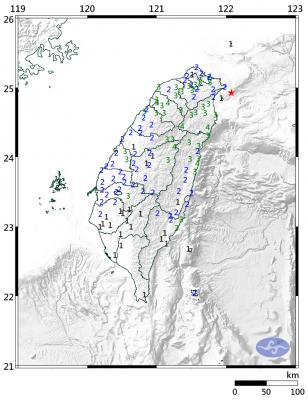
A magnitude 6.1 earthquake struck off the coast of Yilan County at 8:39pm tonight, the Central Weather Administration (CWA) said, with no immediate reports of damage or injuries. The epicenter was 38.7km east-northeast of Yilan County Hall at a focal depth of 98.3km, the CWA’s Seismological Center said. The quake’s maximum intensity, which gauges the actual physical effect of a seismic event, was a level 4 on Taiwan’s 7-tier intensity scale, the center said. That intensity level was recorded in Yilan County’s Nanao Township (南澳), Hsinchu County’s Guansi Township (關西), Nantou County’s Hehuanshan (合歡山) and Hualien County’s Yanliao (鹽寮). An intensity of 3 was

Japanese Prime Minister Sanae Takaichi’s comment last year on Tokyo’s potential reaction to a Taiwan-China conflict has forced Beijing to rewrite its invasion plans, a retired Japanese general said. Takaichi told the Diet on Nov. 7 last year that a Chinese naval blockade or military attack on Taiwan could constitute a “survival-threatening situation” for Japan, potentially allowing Tokyo to exercise its right to collective self-defense. Former Japan Ground Self-Defense Force general Kiyofumi Ogawa said in a recent speech that the remark has been interpreted as meaning Japan could intervene in the early stages of a Taiwan Strait conflict, undermining China’s previous assumptions

Taiwan Railways Corp (TRC) today announced that Shin Kong Mitsukoshi has been selected as the preferred bidder to operate the Taipei Railway Station shopping mall, replacing the current operator, Breeze Development Co Ltd. Among eight qualified firms that delivered presentations and were evaluated by a review committee, Shin Kong Mitsukoshi was ranked first, while Breeze was named the runner-up, the rail company said in a statement. Contract negotiations are to proceed in accordance with regulations, it said, adding that if negotiations with the top bidder fail, it could invite the second-ranked applicant to enter talks. Breeze in a statement today expressed doubts over


 RSS
RSS