


An experiment on the monsoon that drenches Taiwan each year will be launched near the southern coast next month.
The monsoon refers to strong winds from the Indian Ocean and Arabian Sea that bring heavy rainfall to the East Asian region in the early summer
The project, known as SoWMEX, was initiated by Taiwanese meteorologists. Scientists from around the world will participate in the study, and Ben Jou (周仲島) of the Department of Atmospheric Science at National Taiwan University is the chief coordinator.
He said the project was designed to explore the dynamics of the monsoon, particularly its effects on the southwest region of Taiwan.
“We have had [rainfall] data collected from land, but we lacked the data gathered directly from the sea,” he said. “We also have little knowledge of the special characteristics of the rainfall caused by the southwestern monsoon, especially after it hits the southern region.”
“This project can be viewed as a ‘genetic study’ of rainfall,” he said.
Jou said the chances of heavy or extreme rainfall induced by the monsoon have increased in recent years.
The experiment’s results would be helpful in developing more accurate rain forecasts and facilitating disaster control efforts, he said.
Jou said that researchers would focus on mesoscale convective systems, which are carried by the monsoon and now identified as the main reason for heavy or torrential rain in Taiwan’s south.
They will then compare data from dropsondes and other types of radar systems and analyze how the convective systems induce rainfall.
The experiment starts on May 15 and will last 42 days.
The project is a joint effort of the Central Weather Bureau, the Air Force’s Weather Wing, the Navy, the National Science Council and the Water Resources Agency.
Some 500 scientists and students from Taiwan, the US, Japan, South Korea and Canada will be involved in the project.
The US National Center for Atmospheric Research (NCAR) has brought its own S-band Polarimetric Radar System to Taiwan to observe rainfall as part of the research, which will be centered near the mouth of the Kaoping River (高屏溪) on the border of Kaohsiung and Pingtung counties.
Japan is also supporting the project by providing two X-band Doppler radar systems.
The Taiwanese government is spending about NT$100 million (US$3 million) on the project.

Former president Tsai Ing-wen (蔡英文) on Monday called for greater cooperation between Taiwan, Lithuania and the EU to counter threats to information security, including attacks on undersea cables and other critical infrastructure. In a speech at Vilnius University in the Lithuanian capital, Tsai highlighted recent incidents in which vital undersea cables — essential for cross-border data transmission — were severed in the Taiwan Strait and the Baltic Sea over the past year. Taiwanese authorities suspect Chinese sabotage in the incidents near Taiwan’s waters, while EU leaders have said Russia is the likely culprit behind similar breaches in the Baltic. “Taiwan and our European
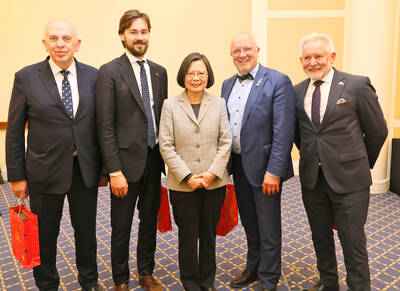
LIKE-MINDED COUNTRIES: Despite the threats from outside, Taiwan and Lithuania thrived and developed their economies, former president Tsai Ing-wen said Former president Tsai Ing-wen (蔡英文) on Saturday thanked Lithuania for its support of Taiwan, saying that both countries are united as partners in defending democracy. Speaking at a reception organized by the Lithuania-Taiwan Parliamentary Friendship Group welcoming her on her first visit to the Baltic state, Tsai said that while she was president from 2016 to last year, many Lithuanian “friends” visited Taiwan. “And I told myself I have to be here. I am very happy that I am here, a wonderful country and wonderful people,” Tsai said. Taiwan and Lithuania are in similar situations as both are neighbors to authoritarian countries, she

The Taipei District Court sentenced babysitters Liu Tsai-hsuan (劉彩萱) and Liu Jou-lin (劉若琳) to life and 18 years in prison respectively today for causing the death of a one-year-old boy in December 2023. The Taipei District Prosecutors’ Office said that Liu Tsai-hsuan was entrusted with the care of a one-year-old boy, nicknamed Kai Kai (剴剴), in August 2023 by the Child Welfare League Foundation. From Sept. 1 to Dec. 23 that year, she and her sister Liu Jou-lin allegedly committed acts of abuse against the boy, who was rushed to the hospital with severe injuries on Dec. 24, 2023, but did not

Taiwanese indie band Sunset Rollercoaster and South Korean outfit Hyukoh collectively received the most nominations at this year’s Golden Melody Awards, earning a total of seven nods from the jury on Wednesday. The bands collaborated on their 2024 album AAA, which received nominations for best band, best album producer, best album design and best vocal album recording. “Young Man,” a single from the album, earned nominations for song of the year and best music video, while another track, “Antenna,” also received a best music video nomination. Late Hong Kong-American singer Khalil Fong (方大同) was named the jury award winner for his 2024 album


 RSS
RSS