

Premier-designate Liu Chao-shiuan (劉兆玄) yesterday announced his second wave of Cabinet member appointees, naming current National Central University (NCU) chancellor Lee Lou-chuang (李羅權) as the new National Science Council (NSC) minister.
Liu yesterday also named National Tsinghua University professor of engineering and system science Tsai Chuen-horng (蔡春鴻) as the new Atomic Energy Council (AEC) minister.
Reacting to his appointment, Lee said: “Education and advanced technology are the two most important fields that will provide Taiwan with momentum to go forward.”
“In research as well as in leading a team, you need to gather your resources, set a goal and formulate a plan to achieve that goal — in both [research and leadership], you can [only succeed by] being the first, and I will build Taiwan’s research foundation upon this spirit,” he said.
Lee, an academic inducted into the Academia Sinica for his achievements in space physics, is a well-rounded leader who had propelled NCU into the ranks of elite higher education institutes, NCU vice-chancellor Ip Wing-huen (葉永烜) said.
“In addition to good leadership, Lee’s experience as the former director of the National Applied Research Laboratories [under the NSC], where he grasped technological developmental trends and was open to opinions from all sides, makes him a very good candidate for the [NSC] position,” Ip said.
Other than scientific developments, at NCU Lee had also been keenly developing the humanities fields, an experience that would help with his development of the nation’s social sciences as NSC minister, Ip said.
Addressing emerging global environmental problems, Lee said that “promoting environmental sustainability is the inescapable responsibility of scientists.”
“In the future, I plan to consolidate resources and place more emphasis on research in the fields of the environment as well as clean energies,” he said.
In related news, AEC minister-designate Tsai was described by his colleagues as an accomplished nuclear expert competently fit to lead the council.
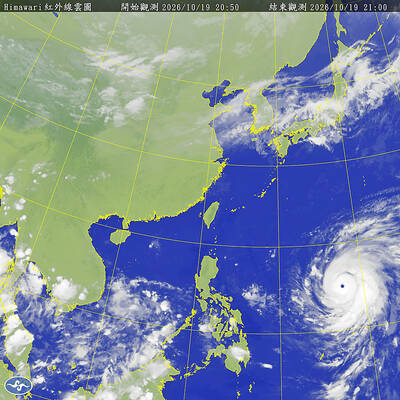
Typhoon Champi is forecast to turn northward earlier than previously expected, sparing Taiwan a direct hit but still bringing heavy rain to the north of the country on Friday and Saturday, the Central Weather Administration (CWA) said yesterday. Typhoon Champi had strengthened and increased in size over the past 12 hours, and as of yesterday afternoon, was packing sustained winds of 198kph near its center, CWA forecaster Cheng Chieh-jen (鄭傑仁) said. However, due to the weakening of a Pacific high-pressure system the storm is now expected to turn northward earlier than initially forecast, likely around Japan’s Ishigaki Island, Cheng said. As Champi brushes
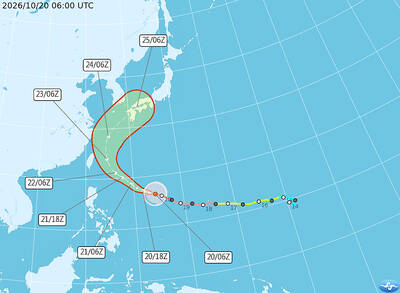
A sea warning for Typhoon Champi might be issued tonight, while the storm’s trajectory would determine whether a land warning is to be issued tomorrow night, the Central Weather Administration (CWA) said yesterday. As of 2pm yesterday, Champi was about 1,536km east-southeast of Taiwan proper’s southernmost point, Oluanpi (鵝鑾鼻), packing maximum sustained winds of 198kph, CWA forecaster Tseng Chao-cheng (曾昭誠) said. The storm was moving west-northwest at 23kph and was expected to strengthen over the next 24 hours before weakening slightly as it approaches cooler waters east of Taiwan, Tseng said. Champi is expected to turn north tomorrow, with the angle of the
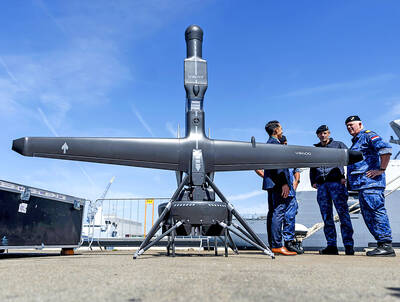
DEFENSE PROCUREMENT: Taiwan could become the largest operator of V-BAT drones outside the US if the contract is finalized, the Ministry of National Defense said The navy and the coast guard reportedly plan to acquire 292 units of MQ-35A V-BAT vertical takeoff and landing (VTOL) surveillance drones. If the contract is awarded and finalized, it would make Taiwan one of the largest buyers of the uncrewed aerial vehicle (UAV) developed by the US-based defense technology company Shield AI. The Coast Guard Administration budgeted NT$1.2 billion (US$37.1 million) to buy 12 drones, which have been delivered, Shield AI said in a report on Oct 13. The navy is planning to spend NT$36 billion under a four-year program code-named Project Yuan Hsiao (遠鴞) to acquire 280 V-BAT drones,
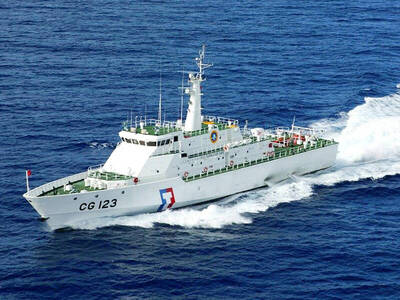
A patrol vessel donated by the Coast Guard Administration (CGA) to the Philippines would not be used in waters near Taiwan or areas where Taiwanese fishing vessels operate, Premier Cho Jung-tai (卓榮泰) said yesterday. The vessel, formerly the CGA's 500-tonne-class Kinmen (金門), was commissioned into the Philippine Coast Guard on Oct. 2. Speaking at the Legislative Yuan, Cho said the Philippines had pledged during the donation process that the vessel would be used only for designated missions and would not operate in waters related to Taiwan. The vessel could even provide assistance to Taiwan if needed, he added. Responding to questions from Chinese


 RSS
RSS