


Foreign observers yesterday praised the smooth and peaceful conduct of the presidential election yesterday, saying that the uneventful day was a mark of Taiwan's democratic maturity.
"It was extremely interesting to observe the election process and see democracy at work. I commend the people of Taiwan for having a democracy so young, but yet able to conduct such a smooth election," US Representative Gilda Cobb-Hunter of South Carolina said.
Cobb-Hunter is one of the 300-plus foreign observers from more than 30 countries that came to witness the nation's fourth democratically held elections since the lifting of martial law in 1987.
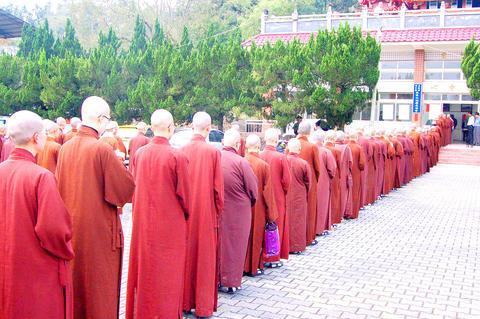
PHOTO: TUNG CHEN-KUO, TAIPEI TIMES
UN Undersecretary Eric Suy-Verbury of the Office of Legal Affairs also commended the election, saying the enthusiasm he saw among Taiwanese voters was "typical of a young democracy."
"I was in South Africa when the country held its first election when apartheid ended in 1994. This is the same atmosphere as it was in South Africa," he said.
Nicaraguan Ambassador to Taiwan William Tapia said the election was a "palpable" demonstration of democracy in Taiwan.
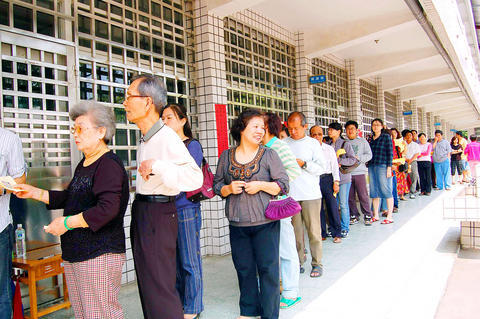
PHOTO: JUAN YI-YU, TAIPEI TIMES
"In the polling stations that we surveyed, many people were lined up nicely. Everything was very calm and quiet. I can be very proud of Taiwan and I think people of Taiwan should be very proud of themselves," said Tapia, who was the first student from Nicaragua to study in Taiwan 40 years ago.
US Representative Ellen Cohen from Texas said the turnout and the level of passion among Taiwanese voters was much more "engaging" than in the US.
"Being such a young democracy, Taiwan's democratic development can really serve as a beacon to other countries," she said, adding that heated verbal exchanges between the two candidates were healthy if the focus was issued-based.
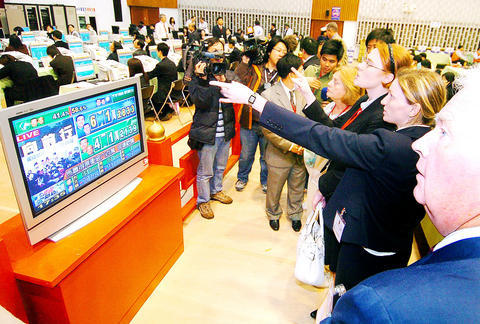
PHOTO: CHEN TSE-MING, TAIPEI TIMES
Chia Chang (
"When I was standing there, I felt very privileged to be able to watch the process. But quickly I realized that anyone could just drop by to see it," Chang said.
Another FAPA young professional, Zoe Tseng (
"We went down to speak to students at Cheng Kung University in Tainan, and the students told us they do not talk much about politics among their friends; when they do, they only do so briefly," Tseng said.
Describing the presidential election process as peaceful and law-abiding, the head of a Hong Kong-based non-governmental think tank said in Taipei yesterday that democracy in Taiwan can serve as a paragon for the global Chinese community.
"I envy Taiwan for having such a peaceful, law-abiding and smooth process of election, " said Paul Yip (
He said that party rotation is a very "important and glorious moment" for all Chinese people and he came here to learn from Taiwan's experience.
In 2000, Taiwan held its second direct presidential election in which then opposition Democratic Progressive Party candidate Chen Shui-bian (
In yesterday's election, the opposition KMT presidential candidate Ma Ying-jeou (
In related developments, former KMT chairman Lien Chan (連戰) yesterday slammed the UN referendum bids and lashed out at US Republican Congressman Dana Rohrabacher for calling on Taiwanese to fully participate in the election.
"I refused to take both of the referendum ballots ... Some of the US congressional members can be idiots," he said when asked by reporters to comment on Rohrabacher's call for Taiwanese to participate in the election and not be intimidated by threats from China.
Rohrabacher is part of the US delegation that arrived in Taiwan to observe the election and referendum yesterday.
Democratic Progressive Party vice presidential candidate Su Tseng-chang (
Speaking after casting his vote in Taipei County yesterday morning, Su said Lien should have treated the US congressional members with courtesy even though he disagreed with Rohrabacher.
ADDITIONAL REPORTING BY MO YAN-CHIH, KO SHU-LING AND CNA
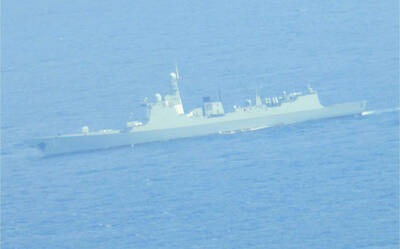
The military has spotted two Chinese warships operating in waters near Penghu County in the Taiwan Strait and sent its own naval and air forces to monitor the vessels, the Ministry of National Defense (MND) said. Beijing sends warships and warplanes into the waters and skies around Taiwan on an almost daily basis, drawing condemnation from Taipei. While the ministry offers daily updates on the locations of Chinese military aircraft, it only rarely gives details of where Chinese warships are operating, generally only when it detects aircraft carriers, as happened last week. A Chinese destroyer and a frigate entered waters to the southwest
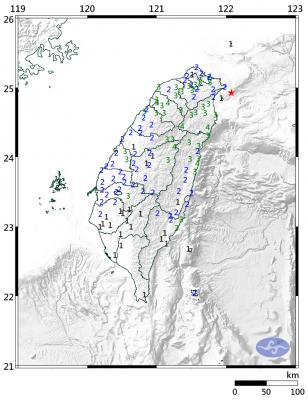
A magnitude 6.1 earthquake struck off the coast of Yilan County at 8:39pm tonight, the Central Weather Administration (CWA) said, with no immediate reports of damage or injuries. The epicenter was 38.7km east-northeast of Yilan County Hall at a focal depth of 98.3km, the CWA’s Seismological Center said. The quake’s maximum intensity, which gauges the actual physical effect of a seismic event, was a level 4 on Taiwan’s 7-tier intensity scale, the center said. That intensity level was recorded in Yilan County’s Nanao Township (南澳), Hsinchu County’s Guansi Township (關西), Nantou County’s Hehuanshan (合歡山) and Hualien County’s Yanliao (鹽寮). An intensity of 3 was
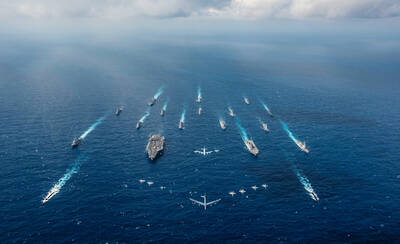
Japanese Prime Minister Sanae Takaichi’s comment last year on Tokyo’s potential reaction to a Taiwan-China conflict has forced Beijing to rewrite its invasion plans, a retired Japanese general said. Takaichi told the Diet on Nov. 7 last year that a Chinese naval blockade or military attack on Taiwan could constitute a “survival-threatening situation” for Japan, potentially allowing Tokyo to exercise its right to collective self-defense. Former Japan Ground Self-Defense Force general Kiyofumi Ogawa said in a recent speech that the remark has been interpreted as meaning Japan could intervene in the early stages of a Taiwan Strait conflict, undermining China’s previous assumptions
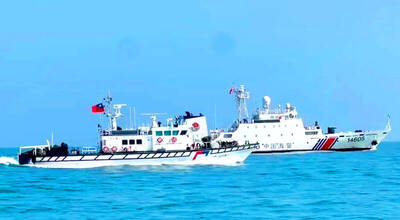
Instead of focusing solely on the threat of a full-scale military invasion, the US and its allies must prepare for a potential Chinese “quarantine” of Taiwan enforced through customs inspections, Stanford University Hoover fellow Eyck Freymann said in a Foreign Affairs article published on Wednesday. China could use various “gray zone” tactics in “reconfiguring the regional and ultimately the global economic order without a war,” said Freymann, who is also a nonresident research fellow at the US Naval War College. China might seize control of Taiwan’s links to the outside world by requiring all flights and ships entering or leaving Taiwan


 RSS
RSS