

Democratic Progressive Party (DPP) presidential candidate Frank Hsieh (謝長廷) yesterday urged his Chinese Nationalist Party (KMT) rival Ma Ying-jeou (
There are many ways to exert pressure on China over its bloody crackdown on Tibet, Hsieh said, including the KMT pulling its investments out of China, abandoning the "one China" principle, relinquishing the "one China market" idea and dropping the idea of unification.
"Ma Ying-jeou should work with me and stand on the side of freedom and democracy," Hsieh said. "Instead of sacrificing the interests of others, he should sacrifice his personal interests and those of his family."
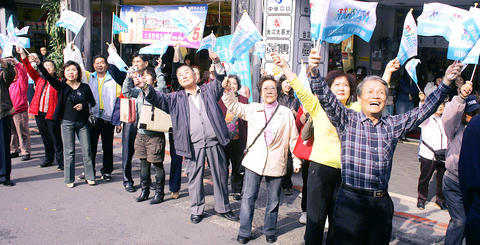
PHOTO: AP
The DPP candidate said some people had asked him whether Taiwan should boycott the Beijing Olympics if Ma is elected president, and he said the answer was simple.
"Just don't elect him," he said.
While a national leader should remain calm in times of trouble, Hsieh said, it seemed Ma was at wits' end and frequently flip-flopped on issues.
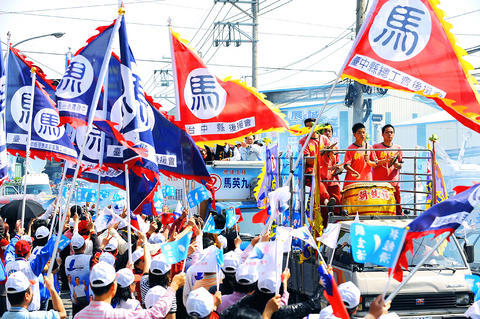
PHOTO: AFP
Hsieh said Ma was treating the Tibet issue as if it were a "trifling matter."
"It is a national affair. What would happen to this country if he were elected president?" Hsieh said.
He said that Ma had accused him of taking advantage of the incident by showing his concern for Tibetans, but then Ma had later followed suit.
Ma then proposed boycotting the Olympics, but then attached a precondition after his remarks were criticized, Hsieh said.
"Ma's comments are unwise and it is wrong to throw cold water on athletes' hopes," Hsieh said. "It just shows that he is inexperienced in national affairs and that he makes decisions in a hasty manner."
While a boycott of the Games by the rest of the world might exert pressure on China, this might not be the case if Taiwan kept its team at home, he said.
"China would be happy if we don't participate," he said. "If they manage to lure our athletes onto their teams, they can tell the world that Taiwan is part of China."
Meanwhile, Hsieh's campaign team urged Ma to relinquish the "one China market," forgo the ultimate goal of unification with China and support the DPP's referendum on joining the UN under the name "Taiwan," instead of talking about an Olympic boycott.
Hsieh spokesman Shen Fa-hui (
Shen said Ma should clearly state whether he would accept the "one China" principle, and how he expects to carry out his campaign promises if he does not.
Cheng Wen-tsang (鄭文燦), another Hsieh spokesman, called on Ma to apologize for his "improper" comments on Tibet.
Chang said Ma owed the public four apologies: First, for accusing the Hsieh team of taking advantage of the crackdown but then later attending a vigil to commemorate those who have lost their lives in the violence.
Second, for saying that it was "not a good time" for China to crack down on Tibet and third, for saying that it was unclear who should be held responsible for the unrest, Chang said.
Finally, Ma should apologize for saying that he would like to see the KMT youth corps cultivate someone like Chinese President Hu Jintao (
Meanwhile, a former diplomat yesterday denounced the KMT's "cross-strait common market" idea as being economically and politically unfeasible.
Lu Chao-chong (魯肇忠), a former envoy to the US and EU, said the "common market" idea was similar to the European Economic Community, which had the ultimate goal of unification and integration of its member states.
Lu said he wondered if the KMT candidates wanted to use the idea of a common market to pave the way for unification with China.
He also expressed concern over the possibility that the KMT would regain control of both the legislature and central government. It was too dangerous to let one party do whatever it pleases, he said.
In other developments, the DPP caucus said ensuring the referendums on UN entry passed would be more effective than a boycott of the Beijing Olympics.
"Freedom and democracy are what Tibetans expect. If we can assure that freedom and democracy are ensconced in Taiwan, it will be the best encouragement for them," DPP caucus whip Yeh Yi-ching (葉宜津) told a press conference at the caucus office yesterday.
"Do not forget that [Ma] is a `pro-China' politician. What has made him suddenly become so tough on China? The answer is the election, it is all about winning the election," DPP Legislator Tsai Huang-liang (
Additional reporting by Jimmy Chuang
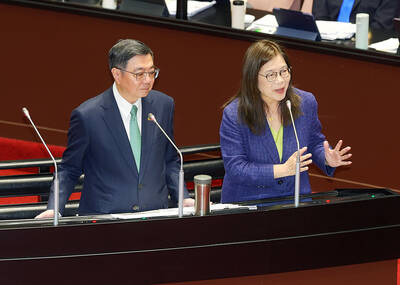
The donation of offshore patrol vessel Kinmen to the Philippines includes provisions that protect Taiwanese fishers and facilitate security cooperation across the First Island Chain, officials said yesterday. The comment was made during the Cabinet’s comprehensive administrative report at the legislature after Chinese Nationalist Party (KMT) Legislator Hsu Yu-chen (許宇甄) expressed concerns about the decision to give a ship to a country whose coast guard had in 2013 fired on a Taiwanese trawler and killed its captain without provocation. The Cabinet should lay out the safeguards that have been established to prevent the Philippine government from using the Kinmen to harass, expel
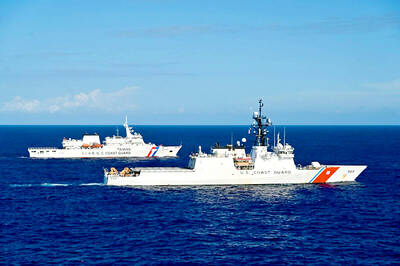
GROWING TIES: The CGA is planning a goodwill mission to the Philippines, in what would be the first time since 1975 a Taiwanese paramilitary vessel has visited the country The Coast Guard Administration (CGA) plans to significantly expand its participation in international security cooperative frameworks and its operational capabilities, a budget proposal for next year showed. The budget indicates a transformation of the CGA from a maritime law enforcement arm into a national defense and intelligence gathering entity capable of tackling larger regional security matters. The proposal showed that personnel from the coast guard’s Intelligence Division and Special Action Support Center are to participate in high-level national security talks with the US. As the CGA has dealt with China’s rising “gray zone” threats around Taiwan, it has become a valuable asset to

The National Police Agency’s Third Special Police Corps yesterday said that from May to July, it intercepted five smuggling operations from China, seizing more than 70,000 counterfeit Beyblades with an estimated infringement value of NT$34.45 million (US$1.08 million). It added that any bootleg unit that reached the local market could present hidden health hazards to players. Beyblades, a line of spinning toy tops used in competitive gaming and developed in Japan by toy company Takara Tomy, have become popular in Taiwan, making them a target for fraudsters. The Third Special Police Corps, dedicated to safeguarding maritime borders and trade lines,
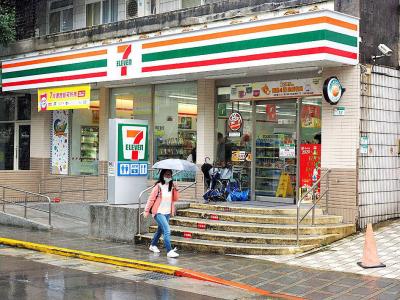
Five customers who made purchases at 7-Eleven stores across Taiwan won the top NT$10 million (US$313,716) special prize in the July-August uniform invoice lottery, including one who spent just NT$27 on photocopying, the convenience store chain said today. The five special prize winners made their purchases at stores in Taoyuan, Taipei, Taichung and Kaohsiung, 7-Eleven operator President Chain Store Corp said. The five winning purchases included NT$29 spent on snacks at a store in Taoyuan's Zhongli District (中壢), NT$27 on photocopying at a store in Taipei's Zhongzheng District (中正), NT$139 on City Cafe coffee and daily necessities at a store in Taipei's


 RSS
RSS