


The National Science Council yesterday inaugurated the Hsinchu Biomedical Science Park with the aim of putting Taiwan on the map with advanced biotechnology and rejuvenating the nation's economy.
With the post-war baby boom generation starting to go into retirement, the healthcare and pharmaceuticals industry is estimated to represent a US$200 billion market worldwide, said Hsinchu Science Park administration director-general Huang Der-ray (
"Taiwan's current market share in these industries is a mere 0.5 percent, but with the Hsinchu Biomedical Science Park we are banking on adding NT$100 billion [US$3.2 billion] to the nation's annual revenue," he said.
Several factors would contribute to creating a hub for domestic and international biotechnology as well as high-end healthcare equipment in the park, where pharmaceutical companies could congregate and lead industries in other parts of the nation, President Chen Shui-bian (陳水扁) said at the opening ceremony.
"The development of the park testifies to the government's determination to invigorate Taiwan's economy and develop high-tech industries, particularly those related to biotechnology," he said.
The National Development Fund has allocated NT$30 billion as investment seed money for firms investing in the new biotechnology park, he said.
With the legislature's approval of the Biotech and New Pharmaceutical Development Act (生技新藥產業發展條例) last June, business owners at the park would enjoy extremely favorable tax breaks and rent control policies, which could foster growth in the time-and-money-consuming industry, he said.
Huang said the park would be home to a comprehensive cluster of biotechnological establishments.
In addition to private companies, the government plans to build an incubation center for innovation development and talent training, a world-class medical center developed under a build-operate-transfer model, a Centers for Disease Control office and an exhibition center, he said.
"The Hsinchu Science Park administration will also encourage world-leading firms to set up shop in the biomedical park, banking on the successes we have achieved at the Hsinchu Science Park," Huang said.
"Whenever a new medicine or innovation is developed, we will have trained personnel to walk the companies through FDA [US Food and Drug Administration] or CE [a product marking applying to products regulated by the European Commission's health standards] certification procedures to help open up international markets," he said.
The park has the geographic advantage of being located between the Hsinchu and the Mid-Taiwan Science Parks, in addition to being right next to both the Sun Yat-sen Freeway and the Taiwan High Speed Rail Hsinchu station, which would also help to draw investors' attention, he said.
"So far we have spoken to a couple of dozen interested firms, both foreign and domestic, about the possibility of setting up shop here," Huang said.
He said that plant construction could start immediately, and, with 82 hectares of land in reserve, the 38-hectare park had ample room for expansion.
The Hsinchu Science Park administration is also looking to open Miaoli County's Tongluo Science Park, which is targeting low-pollution, high-tech industries such as microchip design, information technology and solar energy, Huang said.
Talks have been initiated with US Internet giant Google, although a final agreement has not been reached, he said.
"With forest conservation areas covering 140 hectares of the 350-hectare park, the environmental impact review regulations are much more stringent here than in other science parks," Huang said.
"A biking trail girding the park, hiking trails into the forest conservation areas ... and the view from the park looking out to a sea of green forests will no doubt make the Tongluo park the most eco-friendly high-tech park in Taiwan," he said.
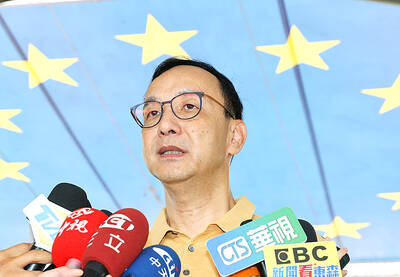
GOOD DIPLOMACY: The KMT has maintained close contact with representative offices in Taiwan and had extended an invitation to Russia as well, the KMT said The Chinese Nationalist Party (KMT) would “appropriately handle” the fallout from an invitation it had extended to Russia’s representative to Taipei to attend its international banquet last month, KMT Chairman Eric Chu (朱立倫) said yesterday. US and EU representatives in Taiwan boycotted the event, and only later agreed to attend after the KMT rescinded its invitation to the Russian representative. The KMT has maintained long-term close contact with all representative offices and embassies in Taiwan, and had extended the invitation as a practice of good diplomacy, Chu said. “Some EU countries have expressed their opinions of Russia, and the KMT respects that,” he
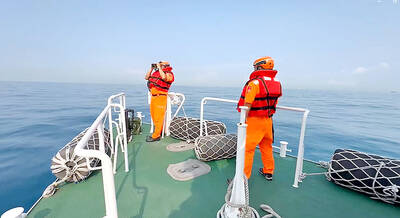
An increase in Taiwanese boats using China-made automatic identification systems (AIS) could confuse coast guards patrolling waters off Taiwan’s southwest coast and become a loophole in the national security system, sources familiar with the matter said yesterday. Taiwan ADIZ, a Facebook page created by enthusiasts who monitor Chinese military activities in airspace and waters off Taiwan’s southwest coast, on Saturday identified what seemed to be a Chinese cargo container ship near Penghu County. The Coast Guard Administration went to the location after receiving the tip and found that it was a Taiwanese yacht, which had a Chinese AIS installed. Similar instances had also
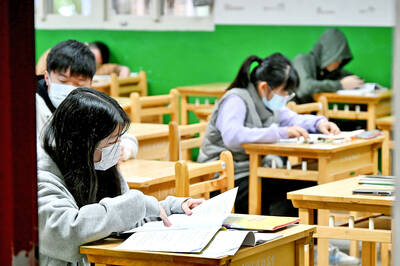
CHANGES: After-school tutoring periods, extracurricular activities during vacations or after-school study periods must not be used to teach new material, the ministry said The Ministry of Education yesterday announced new rules that would ban giving tests to most elementary and junior-high school students during morning study and afternoon rest periods. The amendments to regulations governing public education at elementary schools and junior high schools are to be implemented on Aug. 1. The revised rules stipulate that schools are forbidden to use after-school tutoring periods, extracurricular activities during summer or winter vacation or after-school study periods to teach new course material. In addition, schools would be prohibited from giving tests or exams to students in grades one to eight during morning study and afternoon break periods, the
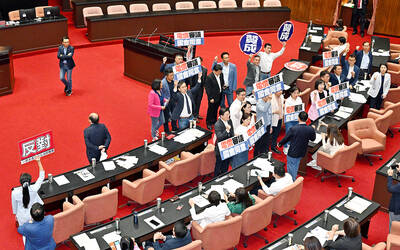
AMENDMENT: Contact with certain individuals in China, Hong Kong and Macau must be reported, and failure to comply could result in a prison sentence, the proposal stated The Chinese Nationalist Party (KMT) and the Taiwan People’s Party (TPP) yesterday voted against a proposed bill by Democratic Progressive Party (DPP) lawmakers that would require elected officials to seek approval before visiting China. DPP Legislator Puma Shen’s (沈伯洋) proposed amendments to the Act Governing Relations Between the People of the Taiwan Area and the Mainland Area (臺灣地區與大陸地區人民關係條例), stipulate that contact with certain individuals in China, Hong Kong and Macau should be reported, while failure to comply would be punishable by prison sentences of up to three years, alongside a fine of NT$10 million (US$309,041). Fifty-six voted with the TPP in opposition


 RSS
RSS