


Vincent Chiu (
In fact, he would be confined to his home without Journey, his black Labrador.
"She is my eyes and my friend. I depend on her as much he depends on me," he said.

PHOTO: CHEN TSE-MING, TAIPEI TIMES
Chiu, who recently graduated from Tamkang University, received his companion about 22 months ago. She is his first guide dog and hopefully, won't be his last, he said.
"I met Journey in Detroit in May 2006 when I went to the US to be trained how to handle a guide dog," Chiu said.
"It took us about two weeks to become familiar with each other. I tried to build a relationship with her by playing with her at night," he said, adding that Journey's favorite game is hide and seek.
However, Chiu is one of the lucky few to have a guide dog as a companion in Taiwan.
According to figures provided by the Taiwan Guide Dog Association there are only 20 trained guide dogs for the 50,000 plus visually impaired people in the nation.
Chiu and Journey were part of the "doggie diplomacy" program presented by the Ministry of Foreign Affairs at a press conference in Taipei yesterday.
Foreign Minister James Huang (黃志芳) said that the dogs are an example of the importance of international cooperation between non-government organizations.
"So far we have only five certified guide dog trainers in Taiwan to train about six to 10 dogs per year. At this rate, it will take us 20 years to produce enough dogs to meet the minimum requirement," said William Chen (陳長青), secretary-general of the association.
Chen said there are plans to provide enough guide dogs for at least 10 percent of the visually-impaired population.
At the moment, most of the guide dogs in Taiwan are "imported" from countries such as the US, the UK, Norway, South Korea and Japan, he said.
Chen noted that the government has provided a tremendous amount of support to increase the number of guide dogs in Taiwan and to educate the public about them.
In June 2004, the legislature passed the Guide Dog Assessment Act which stipulates that guide dogs or guide puppies in training must be allowed to enter all public spaces, including the mass transportation system.
Those who refuse to let dogs on their premises face a fine of between NT$10,000 and NT$20,000.
Chiu said he is fine with people petting Journey but advised them to ask him first.
"She is my eyes. Would you want people to start petting your eyes without your permission?" he asked.
Chiu said that he believes Journey would be able to serve as his eyes for 10 years before needing to retire.
He is already making plans for that day.
"I want to give her to my close friends or family. This way I can visit her often even after I get a new dog," he said.

GOOD DIPLOMACY: The KMT has maintained close contact with representative offices in Taiwan and had extended an invitation to Russia as well, the KMT said The Chinese Nationalist Party (KMT) would “appropriately handle” the fallout from an invitation it had extended to Russia’s representative to Taipei to attend its international banquet last month, KMT Chairman Eric Chu (朱立倫) said yesterday. US and EU representatives in Taiwan boycotted the event, and only later agreed to attend after the KMT rescinded its invitation to the Russian representative. The KMT has maintained long-term close contact with all representative offices and embassies in Taiwan, and had extended the invitation as a practice of good diplomacy, Chu said. “Some EU countries have expressed their opinions of Russia, and the KMT respects that,” he
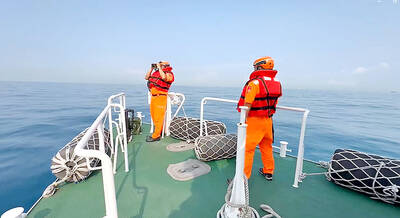
An increase in Taiwanese boats using China-made automatic identification systems (AIS) could confuse coast guards patrolling waters off Taiwan’s southwest coast and become a loophole in the national security system, sources familiar with the matter said yesterday. Taiwan ADIZ, a Facebook page created by enthusiasts who monitor Chinese military activities in airspace and waters off Taiwan’s southwest coast, on Saturday identified what seemed to be a Chinese cargo container ship near Penghu County. The Coast Guard Administration went to the location after receiving the tip and found that it was a Taiwanese yacht, which had a Chinese AIS installed. Similar instances had also

CHANGES: After-school tutoring periods, extracurricular activities during vacations or after-school study periods must not be used to teach new material, the ministry said The Ministry of Education yesterday announced new rules that would ban giving tests to most elementary and junior-high school students during morning study and afternoon rest periods. The amendments to regulations governing public education at elementary schools and junior high schools are to be implemented on Aug. 1. The revised rules stipulate that schools are forbidden to use after-school tutoring periods, extracurricular activities during summer or winter vacation or after-school study periods to teach new course material. In addition, schools would be prohibited from giving tests or exams to students in grades one to eight during morning study and afternoon break periods, the

AMENDMENT: Contact with certain individuals in China, Hong Kong and Macau must be reported, and failure to comply could result in a prison sentence, the proposal stated The Chinese Nationalist Party (KMT) and the Taiwan People’s Party (TPP) yesterday voted against a proposed bill by Democratic Progressive Party (DPP) lawmakers that would require elected officials to seek approval before visiting China. DPP Legislator Puma Shen’s (沈伯洋) proposed amendments to the Act Governing Relations Between the People of the Taiwan Area and the Mainland Area (臺灣地區與大陸地區人民關係條例), stipulate that contact with certain individuals in China, Hong Kong and Macau should be reported, while failure to comply would be punishable by prison sentences of up to three years, alongside a fine of NT$10 million (US$309,041). Fifty-six voted with the TPP in opposition


 RSS
RSS