


The Chinese Nationalist Party (KMT) caucus dominated the Legislative Yuan's committee head elections yesterday, winning 15 of the 16 seats in the eight standing committees.
KMT legislators Wu Yu-sheng (
KMT legislators Wong Chung-chun (
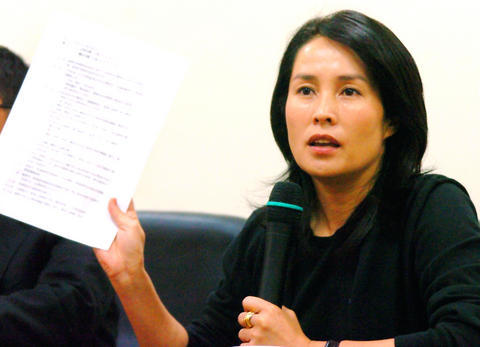
PHOTO: CHU PEI-HSIUNG, TAIPEI TIMES
The Education and Culture Committee will be led by KMT Legislator Chiang Yi-hsiung (江義雄) and People First Party (PFP) Legislator Lin Cheng-er (林正二), while the Transportation Committee meetings will be presided over by KMT legislators Huang Chao-shun (黃昭順) and Chen Ken-te (陳根德).
The Judiciary, Organic Laws and Statutes Committee will be headed by KMT legislators Hsieh Kuo-liang (謝國樑) and Wu Ching-chih (吳清池), while the Sanitation, Environment, Social Welfare and Labor Committee will be led by KMT legislators Chung Shao-ho (鍾紹和) and Hsu Shao-ping (徐少萍).
The Democratic Progressive Party (DPP) caucus, which has 27 of the 113 legislative seats, did not nominate any candidates for the elections after rejecting the KMT caucus' offer of four spots.
The Non-Partisan Solidarity Union (NPSU) caucus, which has three legislative seats, made a last-minute nomination of Legislator May Chin (高金素梅) to head the Judiciary, Organic Laws and Statutes Committee but she did not win.
When asked for comment, director of the KMT's Policy Research Committee, Lin Yi-shih (林益世), said the party was unable to negotiate committee head elections with the NPSU in advance because the union did not propose negotiations until Sunday morning.
Lin said he had personally explained the caucus' decision to support the committee head candidates it had nominated on Friday, adding that he hoped the KMT and NPSU would continue to cooperate in the future.
After the elections, however, NPSU lawmakers criticized the KMT for breaking off negotiations and not allowing a NPSU legislator to take a convener seat.
May Chin told a press conference that the KMT caucus had agreed it would allow her to take one of two Judiciary Committee convener posts, but the election results proved the KMT had broken its promise.
She said KMT legislators could not win the public's trust.
NPSU Legislator Lin Pin-Kuan (林炳坤) accused the KMT of abandoning the negotiations and said the union might refuse to negotiate with the KMT in the future.
Meanwhile, DPP deputy caucus whip Kuan Bi-ling (管碧玲) told reporters that KMT legislators had made no effort to avoid conflict of interest when choosing the committees they wanted to seat on and in the convener elections. Certain KMT legislators who have joined the Judiciary Committee are under investigation or facing trial, while those on the Economics and Energy Committee represent local interest groups, she said.
Additional reporting by Rich Chang
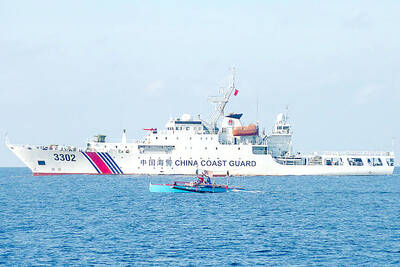
EXPANSIONIST: China deploys an average of 40 to 50 warships and coast guard vessels daily in the South China Sea, despite pledges not to militarize the region, an official said China is attempting to expand its influence across the First Island Chain and increase pressure on Japan by sending coast guard vessels into waters off of Taiwan under the pretext of maritime negotiations with Japan and the Philippines, a national security official said yesterday. China’s recent actions in the waters east of Taiwan and Japan and the Philippines’ exclusive economic zones (EEZ) are attempts to establish dominance in First Island Chain waters, said the official who declined to be named, adding that this is “expansion disguised as law enforcement.” Framing China’s actions solely as a cross-strait issue is a serious misjudgment that
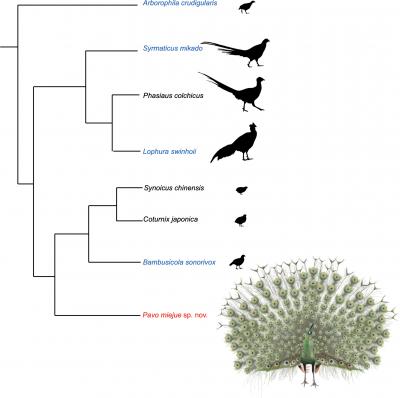
Through analyzing fossil evidence, a research team at National Taiwan University (NTU) discovered the largest endemic bird to have lived in Taiwan, naming it Pavo miejue, or extinct peafowl (滅絕孔雀). The Mikado pheasant, which is printed on the back of the NT$1,000 bank note, was previously believed to be the biggest endemic bird to Taiwan. The research team’s findings suggest that Pavo miejue lived during the Pleistocene epoch tens of thousands of years ago. It is the first endemic extinct bird species discovered and formally named in Taiwan. The study was coauthored by NTU Institute of Ecology and Evolutionary Biology professor Tsai Cheng-hsiu (蔡政修),
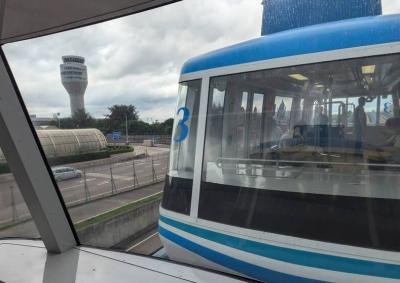
Taiwan Taoyuan International Airport is to suspend its automated Skytrain service connecting Terminal 1 and Terminal 2 starting on July 1 to facilitate connection works for the upcoming Terminal 3, the airport operator said today. Passengers and staff who need to travel between the two terminals after the suspension can instead use the Taoyuan MRT or the airport's 24-hour shuttle bus service, Taoyuan International Airport Corp said. The Taoyuan MRT Airport Line directly links the two terminals, while the shuttle buses are to operate around the clock, the company added. The Skytrain provides free transportation between the airport’s two terminals for travelers and
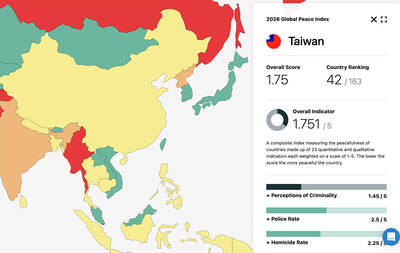
Taiwan ranked 42nd in terms of peacefulness among 163 countries, down five places from last year, according to this year’s Global Peace Index. With an overall score of 1.751, Taiwan dropped from 37th last year, the report published by the global Institute for Economics and Peace showed. The overall score measures a country’s level of peacefulness using 23 quantitative and qualitative indicators across three domains — ongoing domestic and international conflict, societal safety and security, and militarization. While Taiwan ranked 42nd worldwide, it was listed in ninth place among the 19 Asian-Pacific countries in the report, after New Zealand, Singapore, Japan, Malaysia,


 RSS
RSS