


Democratic Progressive Party (DPP) presidential candidate Frank Hsieh's (謝長廷) camp yesterday raised questions about Chinese Nationalist Party (KMT) rival Ma Ying-jeou's (馬英九) relationship with the Taipei Fubon Bank during his time as Taipei mayor.
Hsieh campaign spokesman Hsu Kuo-yong (徐國勇) told a press conference that Ma should explain why Ma defied the Taipei City Council and ordered the city government to deposit all treasury assets in Taipei Fubon Bank. Hsu said Ma made the decision only one month before leaving office in December 2004 and did so without first holding a public tender or other transparent selection process.
Taipei Bank merged with Fubon Bank to become Taipei Fubon Bank on Jan. 1, 2005.
Hsu said the city government had also failed to re-evaluate Taipei Bank's assets after Taipei City's deposit but before the merger.
"The difference in the bank's asset value is estimated at NT$6 billion [US$191.6 million]," Hsu said. "The Ma camp says NT$6 billion is `small money,' but is it?"
Hsu said he could not figure out how the Taipei City Government, which owes the state treasury a significant sum in health insurance fees and has cited financial difficulties to avoid paying those fees, could possibly consider NT$6 billion "small money."
Ordering the treasury to move its assets to Taipei Fubon Bank may have constituted a violation of the Government Procurement Law (
Ma also owes the public an explanation on whether Taipei Fubon Bank had earned interest from the city government's deposits, Hsu said. If so, what has this cost the city treasury, he asked.
Hsu said Taipei Bank did not charge interest before the merger because the bank was a municipal agency at that time. After the merger, it became a privately run company.
Hsu also said the Taipei City Government had earned less profit from the bank since its merger and had far fewer board members than the Fubon Group.
Taipei City has a 15 percent stake in the company, but only two board members, while Fubon Group has an 18 percent stake and seven board members.
"Such a deal is miraculous" for Fubon Group, he said.
No response was unavailable from Ma's campaign office as of press time.

The brilliant blue waters, thick foliage and bucolic atmosphere on this seemingly idyllic archipelago deep in the Pacific Ocean belie the key role it now plays in a titanic geopolitical struggle. Palau is again on the front line as China, and the US and its allies prepare their forces in an intensifying contest for control over the Asia-Pacific region. The democratic nation of just 17,000 people hosts US-controlled airstrips and soon-to-be-completed radar installations that the US military describes as “critical” to monitoring vast swathes of water and airspace. It is also a key piece of the second island chain, a string of
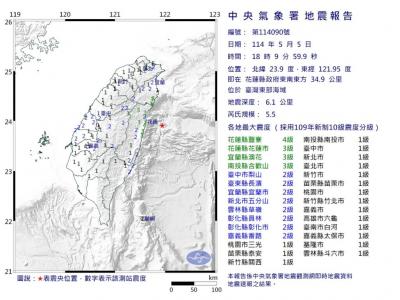
A magnitude 5.9 earthquake that struck about 33km off the coast of Hualien City was the "main shock" in a series of quakes in the area, with aftershocks expected over the next three days, the Central Weather Administration (CWA) said yesterday. Prior to the magnitude 5.9 quake shaking most of Taiwan at 6:53pm yesterday, six other earthquakes stronger than a magnitude of 4, starting with a magnitude 5.5 quake at 6:09pm, occurred in the area. CWA Seismological Center Director Wu Chien-fu (吳健富) confirmed that the quakes were all part of the same series and that the magnitude 5.5 temblor was
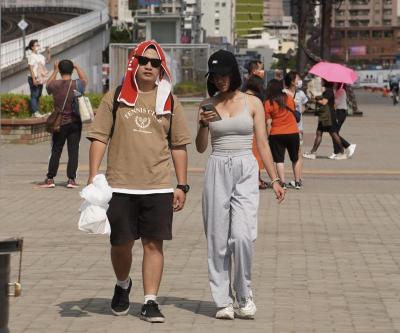
The Central Weather Administration has issued a heat alert for southeastern Taiwan, warning of temperatures as high as 36°C today, while alerting some coastal areas of strong winds later in the day. Kaohsiung’s Neimen District (內門) and Pingtung County’s Neipu Township (內埔) are under an orange heat alert, which warns of temperatures as high as 36°C for three consecutive days, the CWA said, citing southwest winds. The heat would also extend to Tainan’s Nansi (楠西) and Yujing (玉井) districts, as well as Pingtung’s Gaoshu (高樹), Yanpu (鹽埔) and Majia (瑪家) townships, it said, forecasting highs of up to 36°C in those areas

IN FULL SWING: Recall drives against lawmakers in Hualien, Taoyuan and Hsinchu have reached the second-stage threshold, the campaigners said Campaigners in a recall petition against Chinese Nationalist Party (KMT) Legislator Yen Kuan-heng (顏寬恒) in Taichung yesterday said their signature target is within sight, and that they need a big push to collect about 500 more signatures from locals to reach the second-stage threshold. Recall campaigns against KMT lawmakers Johnny Chiang (江啟臣), Yang Chiung-ying (楊瓊瓔) and Lo Ting-wei (羅廷瑋) are also close to the 10 percent threshold, and campaigners are mounting a final push this week. They need about 800 signatures against Chiang and about 2,000 against Yang. Campaigners seeking to recall Lo said they had reached the threshold figure over the


 RSS
RSS