


A team comprised of Taiwanese and US scientists say they have discovered a novel way to "disarm" methicillin-resistant Staphylococcus aureus (MRSA)with medication designed to lower cholesterol.
The research, published on Thursday in the online version of ScienceXpress is a collaborative effort between the scientists of Academia Sinica, the University of California at San Diego (UCSD) and the University of Illinois at Urbana-Champaign in the US.
"Instead of killing the bacteria with an anti-bacterial, we have found a way to make it take off its armor," lead author of the research Liu Chia-i (
The media have dubbed MRSA a "superbug" because of its resistance to conventional antibiotics. Especially prevalent in hospitals and other medical institutions, MRSA infections have been rising sharply in recent years as the bacteria mutates and develops even more resistance.
Staphylococcus aureus is so named because of the golden pigment Staphyloxanthin produced by the bacteria. A coating of Staphyloxanthin protects the bacteria from the body's immune system, Liu said.
"The production process of Staphyloxanthin is similar with the production process of cholesterol in the human body." Liu said. "This explains why a medicine used to inhibit cholesterol production will simultaneously inhibit Staphyloxanthin production."
Stripped of its golden armor, the superbug is defenseless against the body's immune system, Liu said.
"The advantage is, the drug does not kill the bacteria directly, making it less likely to develop resistance," Liu said.
The cholesterol-lowering drug used by the team is not yet on the market, however, trials have already been conducted establishing it's safety. For now, it is known as vph-652.
The scientists on the team not only come from different countries, but also from different fields.
Liu explained that the initial insight that started the project came from chemistry professor Eric Oldfield of the University of Illinois at Urbana-Champaign.
"The University of Illinois took care of the chemistry component, UCSD researchers did the bioessays while the team at the Institute of Biological Chemistry at Academia Sinica did the structural biology," Liu said. "We were responsible for determining the 3D structure of the relevant proteins and seeing how it all fit together."
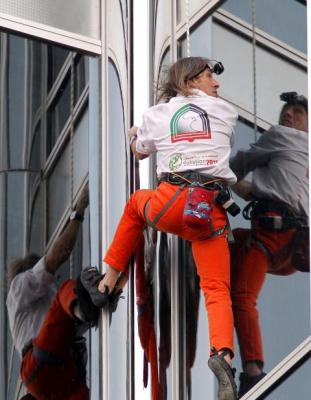
Alain Robert, known as the "French Spider-Man," praised Alex Honnold as exceptionally well-prepared after the US climber completed a free solo ascent of Taipei 101 yesterday. Robert said Honnold's ascent of the 508m-tall skyscraper in just more than one-and-a-half hours without using safety ropes or equipment was a remarkable achievement. "This is my life," he said in an interview conducted in French, adding that he liked the feeling of being "on the edge of danger." The 63-year-old Frenchman climbed Taipei 101 using ropes in December 2004, taking about four hours to reach the top. On a one-to-10 scale of difficulty, Robert said Taipei 101

Nipah virus infection is to be officially listed as a category 5 notifiable infectious disease in Taiwan in March, while clinical treatment guidelines are being formulated, the Centers for Disease Control (CDC) said yesterday. With Nipah infections being reported in other countries and considering its relatively high fatality rate, the centers on Jan. 16 announced that it would be listed as a notifiable infectious disease to bolster the nation’s systematic early warning system and increase public awareness, the CDC said. Bangladesh reported four fatal cases last year in separate districts, with three linked to raw date palm sap consumption, CDC Epidemic Intelligence

Two Taiwanese prosecutors were questioned by Chinese security personnel at their hotel during a trip to China’s Henan Province this month, the Mainland Affairs Council (MAC) said yesterday. The officers had personal information on the prosecutors, including “when they were assigned to their posts, their work locations and job titles,” MAC Deputy Minister and spokesman Liang Wen-chieh (梁文傑) said. On top of asking about their agencies and positions, the officers also questioned the prosecutors about the Cross-Strait Joint Crime-Fighting and Judicial Mutual Assistance Agreement, a pact that serves as the framework for Taiwan-China cooperation on combating crime and providing judicial assistance, Liang

US climber Alex Honnold left Taiwan this morning a day after completing a free-solo ascent of Taipei 101, a feat that drew cheers from onlookers and gained widespread international attention. Honnold yesterday scaled the 101-story skyscraper without a rope or safety harness. The climb — the highest urban free-solo ascent ever attempted — took just more than 90 minutes and was streamed live on Netflix. It was covered by major international news outlets including CNN, the New York Times, the Guardian and the Wall Street Journal. As Honnold prepared to leave Taiwan today, he attracted a crowd when he and his wife, Sanni,


 RSS
RSS