


"It was cold and chilly and like now it was close to the Lunar New Year," said retired professor Wu Yi-man (吳漪曼), remembering Jan. 27, 1949, when she and her cousin stood at Keelung Harbor, waiting for her father who was coming to Taiwan on the cross-strait steamer the Taiping (太平輪).
Fifty-nine years have passed, and like Wu the family members of passengers again stood near the same harbor on the same day of the year, in the same sprinkling rain. But this time, they were holding a minute of silence in front of a monument.
"In memory of those passengers who died in the Taiping sinking," the characters on the monument read.
In January 1949, when the Chinese Communist Party clearly had the upper hand in the Chinese Civil War against the Chinese Nationalist Party (KMT) regime, waves of Mainlanders were anxious to escape their war-torn hometowns and head for safety, with Taiwan being the most popular destination.
Two million mainlanders are estimated to have migrated to Taiwan, which at the time had a population of just 6 million.
Among the migrants were more than 1,500 people who crowded onto the Taiping on the eve of Jan. 27 -- although only 508 tickets were sold for the journey.
"Because it was so chaotic in [China] at the time, my father was coming to Taiwan to see if it was possible to move the National Conservatory of Music in Nanjing to here," Wu Yi-man said.
Wu Yi-man's father, Wu Poh-chao (吳伯超), was the president of the conservatory, while she was 17 and studying music at National Taiwan Normal University (NTNU) in Taipei. Wu Yi-man later became a music professor at several universities, including NTNU.
"My cousin and I went to Keelung to wait for my father, while my mother stayed in Taipei preparing a big dinner -- it was `Little Lunar New Year's Eve' that night," Wu Yi-man said.
"Little Lunar New Year's Eve" is a festive night that falls on the day before the official Lunar New Year's Eve.
"It was odd that no one was at the harbor when we arrived, so we asked and found out that the Taiping had sunk," Wu Yi-man said.
"My father was our family's only source of income, we -- my mother and I -- both suffered a great deal after his death," she said.
According to Searching for the Taiping (
Although the steamer was sailing at night, the lights were all out because of a curfew.
Not long before midnight, a smaller cargo boat, the Chienyuan (建元輪), ran into the practically invisible Taiping near the Zhoushan Archipelago (舟山群島) off the coast of China's Zhejiang Province and quickly sank.
Wang Shu-liang (
"My brother was on the boat, watching some new friends he met on board playing poker, and all of a sudden, they heard a big bang," Wang said. "So the others asked my brother to go see what had happened."
Water started flowing in soon after Wang Kuo-fu started walking toward the source of the noise, "and he was never seen again," Wang Shu-liang said, adding that the story was told to her by one of the survivors.
The fate of the Wang family was changed forever.
Wang Kuo-fu was planning to get married after the Lunar New Year; their younger sister, who was also engaged, ended up falling ill after hearing the bad news and eventually died, Wang Shu-liang said.
"We never dared tell my parents about my brother's death, so they believed he was alive until their own deaths," she said.
As the monument is now located within the perimeter of a naval base with restricted access, victims' family members hoped that it could be moved to a public place so that everyone can learn about the tragedy.
"It bears an important historical meaning and should be seen by more people," Wu Yi-man said. "It's really inconveniently located within the naval base."
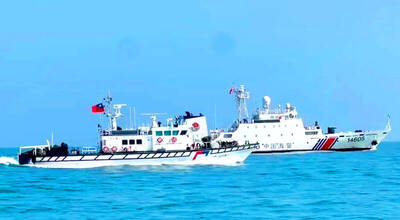
Instead of focusing solely on the threat of a full-scale military invasion, the US and its allies must prepare for a potential Chinese “quarantine” of Taiwan enforced through customs inspections, Stanford University Hoover fellow Eyck Freymann said in a Foreign Affairs article published on Wednesday. China could use various “gray zone” tactics in “reconfiguring the regional and ultimately the global economic order without a war,” said Freymann, who is also a nonresident research fellow at the US Naval War College. China might seize control of Taiwan’s links to the outside world by requiring all flights and ships entering or leaving Taiwan
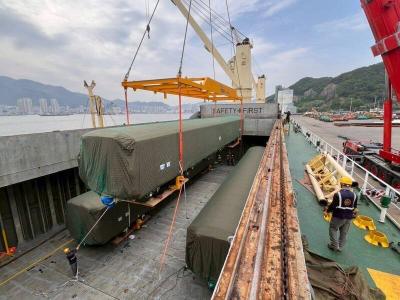
The first of 10 new high-capacity trains purchased from South Korea’s Hyundai Rotem arrived at the Port of Taipei yesterday to meet the demands of an expanding metro network, Taipei Rapid Transit Corp (TRTC) said yesterday. The train completed a three-day, 1,200km voyage from the Port of Masan in South Korea, the company said. Costing NT$590 million (US$18.79 million) each, the new six-carriage trains feature a redesigned interior based on "human-centric" transportation concepts, TRTC said. The design utilizes continuous longitudinal seating to widen the aisles and optimize passenger flow, while also upgrading passenger information displays and driving control systems for a more comfortable
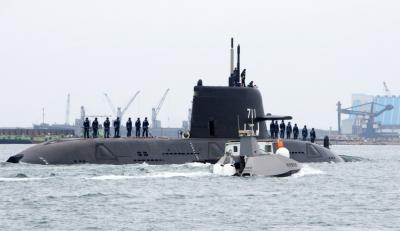
Taiwan's first indigenous defense submarine, the SS-711 Hai Kun (海鯤, or Narwhal), departed for its 13th sea trial at 7am today, marking its seventh submerged test, with delivery to the navy scheduled for July. The outing also marked its first sea deployment since President William Lai (賴清德) boarded the submarine for an inspection on March 19, drawing a crowd of military enthusiasts who gathered to show support. The submarine this morning departed port accompanied by CSBC Corp’s Endeavor Manta (奮進魔鬼魚號) uncrewed surface vessel and a navy M109 assault boat. Amid public interest in key milestones such as torpedo-launching operations and overnight submerged trials,
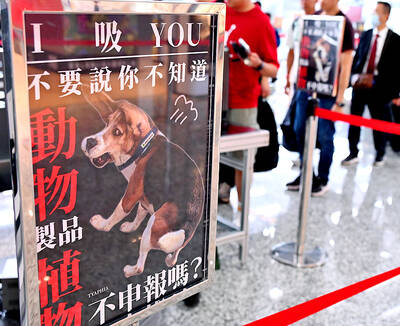
Quarantine awareness posters at Taiwan Taoyuan International Airport have gone viral for their use of wordplay. Issued by the airport branch of the Animal and Plant Health Inspection Agency, the posters feature sniffer dogs making a range of facial expressions, paired with advisory messages built around homophones. “We update the messages for holidays and campaign needs, periodically refreshing materials to attract people’s attention,” quarantine officials said. “The aim is to use the dogs’ appeal to draw focus to quarantine regulations.” A Japanese traveler visiting Taiwan has posted a photo on X of a poster showing a quarantine dog with a


 RSS
RSS