


Employment for the nation's physically and mentally challenged residents remains far from ideal, although improvements have been made in the areas of health coverage and education, a survey showed.
The results of a survey released on Friday conducted by academics at the commission of the Ministry of the Interior in October last year showed that the unemployment rate among physically and mentally challenged citizens stands at more than 10 percent, or about three times the national average.
The results of the survey were released by Wang Kuo-yu (王國羽), a professor at National Chung Cheng University's Department of Social Welfare.
Wang said employment has not significantly improved for the physically and mentally challenged in recent years despite government programs offering subsidies and job training programs.
He attributed the lack of progress to several factors, including an unwillingness among employers in established industries to hire disabled job seekers, difficult economic times, a lack of facilities for handicapped people and other structural problems.
Despite the lack of progress in finding employment opportunities, Wang said advances have been made in other areas, including health coverage and education.
For example, he said, all of Taiwan's 960,000 physically and mentally challenged people are now covered by the national health insurance system. The figure stood at just 92 percent in 2002.
In the area of education, government programs over the past decade have also significantly increased the number of physically and mentally challenged individuals entering college or university, Wang said.
He acknowledged, however, there was still room for improvement in education, with the survey showing that only 30 percent of mentally and physically challenged people in Taiwan have a high school diploma and their illiteracy rate is around 25 percent.
The average income of households with physically and mentally challenged members is also lower than the national average and about 30 percent of these families do not make enough money to cover their basic living expenses.
Only about 20,000 of the country's disabled citizens have an income above minimum wage, the survey found, indicating that many must rely on their families to make ends meet.
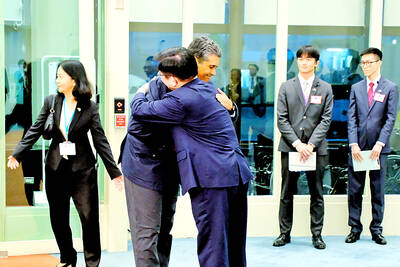
Palauan President Surangel Whipps Jr arrived in Taiwan last night to kick off his first visit to the country since beginning his second term earlier this year. After arriving at Taoyuan International Airport at around 6:30 pm, Whipps and his delegation were welcomed by Minister of Foreign Affairs Lin Chia-lung (林佳龍). Speaking to gathered media, the Palauan leader said he was excited and honored to be back in Taiwan on his first state visit to Taiwan since he was sworn in this January. Among those traveling with Whipps is Minister of State Gustav N. Aitaro, Public Infrastructure

RESOLUTIONS DEBATE: Taiwan’s allies said that UN and WHA resolutions cited by China and other nations ‘do not determine Taiwan’s participation in WHO activities’ A proposal to invite Taiwan to this year’s World Health Assembly (WHA) was rejected on Monday, resulting in Taipei’s absence from the annual meeting for a ninth consecutive year, although partners spoke up for Taiwan’s participation at the first day of the meeting. The first agenda item after the opening was a “two-on-two debate” on a proposal to invite Taiwan to participate at the WHA as an observer. Similar to previous years, two countries made statements in favor of the proposal, while two others expressed their opposition. Philippine Secretary of Health Teodoro Herbosa, president of the 78th WHA, accepted the WHA General Committee’s
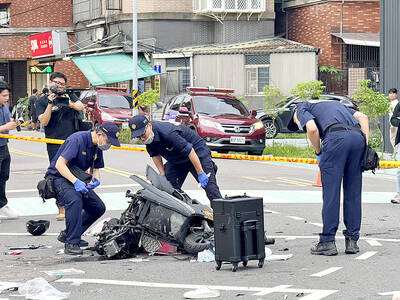
At least three people died and more than a dozen were injured yesterday afternoon when a vehicle struck a group of pedestrians in New Taipei City’s Sansia District (三峽). The incident happened at about 4pm when a car rammed into pedestrians at an intersection near Bei Da Elementary School. Witnesses said the sedan, being driven at a high speed, ran a red light, knocking scooters out of the way and hitting students crossing the road before careening into a median near the intersection of Guocheng and Guoguang streets. The incident resulted in three deaths and 13 injuries, including the driver, a 78-year-old man

Premier Cho Jung-tai (卓榮泰) on Friday laid out the Cabinet’s updated policy agenda and recapped the government’s achievements ahead of the one-year anniversary of President William Lai’s (賴清德) inauguration. Cho said the government had made progress across a range of areas, including rebuilding Hualien, cracking down on fraud, improving pedestrian safety and promoting economic growth. “I hope the public will not have the impression that the Cabinet only asked the legislature to reconsider a bunch of legal amendments,” Cho said, calling the moves “necessary” to protect constitutional governance and the public’s interest. The Cabinet would work toward achieving its “1+7” plan, he said. The


 RSS
RSS