


Minister without Portfolio Huang Hwei-chen (黃輝珍) said on Tuesday that the government would work toward an agreement with the Chiang family of dictator Chiang Kai-shek (蔣介石) and his son, late president Chiang Ching-kuo (蔣經國), regarding their interment before they are relocated to their mausoleums.
He said that until a consensus was reached on a relocation project, the Ministry of National Defense would continue to maintain the Taoyuan County park in which the two mausoleums are located, including dispatching military police to patrol the area and increase security.
Huang said the Legislative Yuan had spent NT$30 million (US$924,300) in taxpayers' money to build tombs for the former leaders at the Wuchishan military cemetery in suburban Taipei in 2005, but added that a relocation plan was suspended pending further negotiations with the family.
The ministry closed the two mausoleums on Dec. 24 and subsequently removed the military guards stationed there, sparking concern over who would assume management of the sites.
The Cabinet has explored several measures to address the matter -- including relocating the mausoleums and requesting that the Taoyuan County Government take over the management of the site -- an anonymous source said.
The source said that takeover measures would be adopted only if the family disagreed with the relocation.
Members of the Chiang family have expressed divergent opinions on the issue, the source said, quoting a statement by Chiang Fang Chih-yi (蔣方智怡), Chiang Ching-kuo's daughter-in-law, saying that the remains should be buried in their hometown in China rather than in the military cemetery outside Taipei.
Chiang Ching-kuo's son John Chiang (
Demos Chiang (
If the administration no longer wants to take care of the mausoleums, the family would follow the wishes of the two late rulers and have their remains cremated and returned to their birthplace in Fenghua City, Zhejiang Province, he said.
During an interview with BBC Chinese.com last month, Demos Chiang said the statue of Chiang Kai-shek was the fourth-largest in the world after those of Vladimir Ilyich Lenin, Joseph Stalin and Mao Zedong (
"The establishment of the statue was wrong. Building a statue and a memorial hall for a national leader immediately after his death has nothing glorious about it," he said during the interview. "A person is truly a mighty leader if people want to set up a statue and memorial hall for you 50 or 100 years after you died."
In an article published on Tuesday, Demos Chiang condemned Chiang Kai-shek for his direct role in the murder of hundreds of thousands of people between 1921 and 1948, but challenged those who criticized Chiang Ching-kuo as a "dictator."
"If [my grandfather] was truly a dictator, why would he have lifted bans on many things in his late years, decisions that contributed to the development of a democratic system [in Taiwan]?" he said.
Additional reporting by Mo Yan-chih
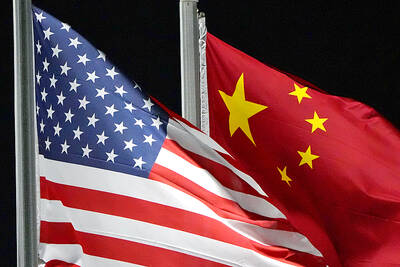
The brilliant blue waters, thick foliage and bucolic atmosphere on this seemingly idyllic archipelago deep in the Pacific Ocean belie the key role it now plays in a titanic geopolitical struggle. Palau is again on the front line as China, and the US and its allies prepare their forces in an intensifying contest for control over the Asia-Pacific region. The democratic nation of just 17,000 people hosts US-controlled airstrips and soon-to-be-completed radar installations that the US military describes as “critical” to monitoring vast swathes of water and airspace. It is also a key piece of the second island chain, a string of
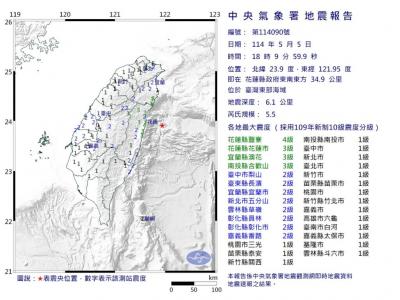
A magnitude 5.9 earthquake that struck about 33km off the coast of Hualien City was the "main shock" in a series of quakes in the area, with aftershocks expected over the next three days, the Central Weather Administration (CWA) said yesterday. Prior to the magnitude 5.9 quake shaking most of Taiwan at 6:53pm yesterday, six other earthquakes stronger than a magnitude of 4, starting with a magnitude 5.5 quake at 6:09pm, occurred in the area. CWA Seismological Center Director Wu Chien-fu (吳健富) confirmed that the quakes were all part of the same series and that the magnitude 5.5 temblor was
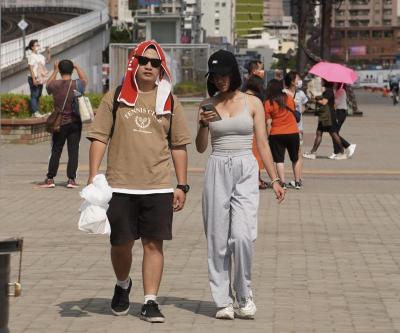
The Central Weather Administration has issued a heat alert for southeastern Taiwan, warning of temperatures as high as 36°C today, while alerting some coastal areas of strong winds later in the day. Kaohsiung’s Neimen District (內門) and Pingtung County’s Neipu Township (內埔) are under an orange heat alert, which warns of temperatures as high as 36°C for three consecutive days, the CWA said, citing southwest winds. The heat would also extend to Tainan’s Nansi (楠西) and Yujing (玉井) districts, as well as Pingtung’s Gaoshu (高樹), Yanpu (鹽埔) and Majia (瑪家) townships, it said, forecasting highs of up to 36°C in those areas

IN FULL SWING: Recall drives against lawmakers in Hualien, Taoyuan and Hsinchu have reached the second-stage threshold, the campaigners said Campaigners in a recall petition against Chinese Nationalist Party (KMT) Legislator Yen Kuan-heng (顏寬恒) in Taichung yesterday said their signature target is within sight, and that they need a big push to collect about 500 more signatures from locals to reach the second-stage threshold. Recall campaigns against KMT lawmakers Johnny Chiang (江啟臣), Yang Chiung-ying (楊瓊瓔) and Lo Ting-wei (羅廷瑋) are also close to the 10 percent threshold, and campaigners are mounting a final push this week. They need about 800 signatures against Chiang and about 2,000 against Yang. Campaigners seeking to recall Lo said they had reached the threshold figure over the


 RSS
RSS