


Although Taiwan and South Korea have managed to implement democratic systems, neither country has as yet achieved "quality democracy," a former Taiwanese foreign minister said at a forum in Taipei yesterday.
"Quality democracy tends to be kinder and gentle, and accountability, responsibility and transparency should be integral parts of the political system ... But in both cases we witness political confrontations all the time," Fredrick Chien (錢復) said in an address to the 16th Taipei-Seoul Forum yesterday.
Chien was speaking in his capacity as chairman of the Cathay Charity Foundation.
The two-day forum was co-sponsored by National Chengchi University's Institute of International Relations and the Seoul Forum for International Affairs.
Political freedom
Chien, who has served as foreign minister under the Chinese Nationalist Party (KMT) administration and later as head of the Control Yuan under the Democratic Progressive Party administration, said that when an electoral democracy is transformed into a liberal democracy, a nation's citizens will be politically free and equal to each other before the law, while elected officials will not only be law-abiding, but also accountable and responsible to the electorate.
"There are considerable hurdles we need to overcome before reaching that desirable goal," Chien said.
US assistance
He said that the democratization process in both countries was driven by the affluence brought about by economic development, as well as generous assistance from the US.
"Increased affluence brings people more opportunities for contact with the outside world, through travel, business, study or even subscriptions to foreign publications," he said.
"People begin to realize that a democratic system is far better than authoritarianism, and calls for changes inevitably follow," Chien said.
The difference between the two countries' democratization processes was that the South Korean student movement had played a much more significant role than had been the case in Taiwan, he said.
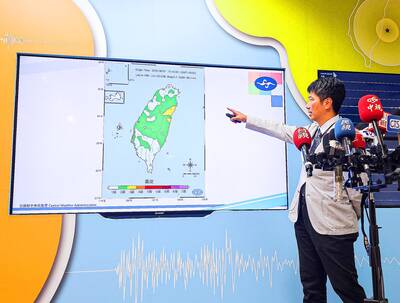
Aftershocks from a magnitude 6.2 earthquake that struck off Yilan County at 3:45pm yesterday could reach a magnitude of 5 to 5.5, the Central Weather Administration (CWA) said. Seismological Center technical officer Chiu Chun-ta (邱俊達) told a news conference that the epicenter of the temblor was more than 100km from Taiwan. Although predicted to measure between magnitude 5 and 5.5, the aftershocks would reach an intensity of 1 on Taiwan’s 7-tier scale, which gauges the actual effect of an earthquake, he said. The earthquake lasted longer in Taipei because the city is in a basin, he said. The quake’s epicenter was about 128.9km east-southeast

The Taipei Summer Festival is to begin tomorrow at Dadaocheng Wharf (大稻埕), featuring four themed firework shows and five live music performances throughout the month, the Taipei Department of Information and Tourism said today. The festival in the city’s Datong District (大同) is to run until Aug. 30, holding firework displays on Wednesdays and the final Saturday of the event. The first show is scheduled for tomorrow, followed by Aug. 13, 20 and 30. To celebrate the 30th anniversary of Disney Pixar's movie Toy Story, the festival has partnered with Walt Disney Co (Taiwan) to host a special themed area on
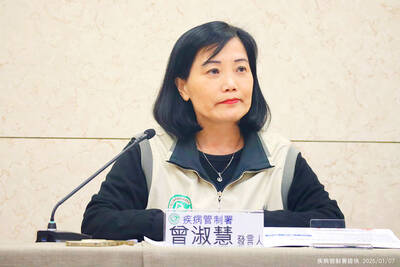
BE CAREFUL: The virus rarely causes severe illness or death, but newborns, older people and those with medical conditions are at risk of more severe illness As more than 7,000 cases of chikungunya fever have been reported in China’s Guangdong Province this year, including 2,892 new cases last week, the Centers for Disease Control (CDC) yesterday said it is monitoring the situation and considering raising the travel notice level, which might be announced today. The CDC issued a level 1 travel notice, or “watch,” for Guangdong Province on July 22, citing an outbreak in Foshan, a manufacturing hub in the south of the province, that was reported early last month. Between July 27 and Saturday, the province reported 2,892 new cases of chikungunya, reaching a total of 7,716
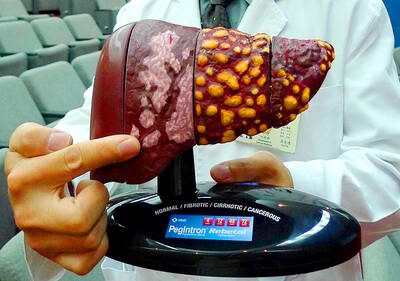
STAY VIGILANT: People should reduce the risk of chronic liver inflammation by avoiding excessive alcohol consumption, smoking and eating pickled foods, the physician said A doctor last week urged people to look for five key warning signs of acute liver failure after popular producer-turned-entertainer Shen Yu-lin (沈玉琳) was reportedly admitted to an intensive care unit for fulminant hepatitis. Fulminant hepatitis is the rapid and massive death of liver cells, impairing the organ’s detoxification, metabolic, protein synthesis and bile production functions, which if left untreated has a mortality rate as high as 80 percent, according to the Web site of Advancing Clinical Treatment of Liver Disease, an international organization focused on liver disease prevention and treatment. People with hepatitis B or C are at higher risk of


 RSS
RSS