


The Democratic Progressive Party (DPP) administration's efforts over the past year for the country to enter the UN under the name Taiwan havve helped put Taiwan on the map, members of the Taiwan Association of University Professors (TAUP) said yesterday.
Speaking at a news conference marking the publication of TAUP observations on Taiwan's political climate this year, Hsu Chu-feng (
Hsu claimed that the UN bid efforts have forged a new, nationwide consensus. In turn this has helped consolidate the national identity of the people of Taiwan, and so the international community has for the first time heard the common voice of Taiwan's people, which is making the Beijing leadership unhappy.
Chen Chun-sheng (陳春生), an honorary professor with National Taiwan University's Graduate Institute of National Development, said that although the maiden bid for UN entry under the name Taiwan did not succeed, the motion was, for the first time, brought up for discussion by the UN General Assembly.
The number of international media reports on the bid was four or five times greater than that given to bids made by the ex-Chinese Nationalist Party (KMT) administration seeking to return the Republic of China to the UN, Chen said.
He claimed the DPP-initiated UN bid had significantly increased Taiwan's visibility in the international community.
On the issue of cross-strait relations, Chen said that rationally speaking, Taiwan is not the Republic of China.
He suggested that Taiwan return the outlying islands of Kinmen and Matsu, which are located closer to China than to Taiwan proper, to China and then found a Republic of Taiwan under the spirit of the UN Chapter.
He also suggested that the Taiwanese authorities bring those Kinmen and Matsu residents who recognize Taiwan to settle in Taiwan and resettle those Taiwanese residents who recognize the ROC to Kinmen and Matsu.
Chen said that both notions of the signing of a cross-strait peace accord and the drafting of an act governing peaceful engagement between Taiwan and China are pitfalls.
He also called on Taiwan's voters to remain alert to Chinese espionage, claiming that Chinese influence has already been felt in the upcoming presidential race and referendums.
Chuang Han-lin (莊翰林), a lecturer with the Minghsin University of Science and Technology, said Taiwan's hard-earned democracy will face an "unprecedented crisis" if the KMT and its allies win a majority of seats in the next legislature and if KMT presidential candidate Ma Ying-jeou (馬英九) wins next year's presidential race.
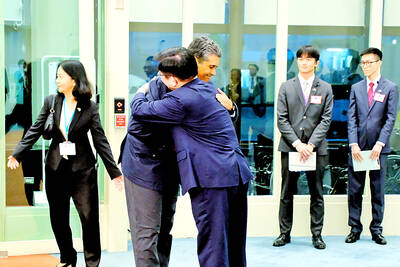
Palauan President Surangel Whipps Jr arrived in Taiwan last night to kick off his first visit to the country since beginning his second term earlier this year. After arriving at Taoyuan International Airport at around 6:30 pm, Whipps and his delegation were welcomed by Minister of Foreign Affairs Lin Chia-lung (林佳龍). Speaking to gathered media, the Palauan leader said he was excited and honored to be back in Taiwan on his first state visit to Taiwan since he was sworn in this January. Among those traveling with Whipps is Minister of State Gustav N. Aitaro, Public Infrastructure
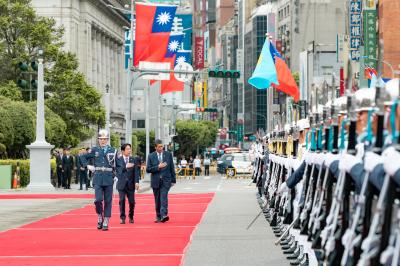
President William Lai (賴清德) yesterday thanked Palau for its continued support of Taiwan's international participation, as Taipei was once again excluded from the World Health Assembly (WHA) currently taking place in Switzerland. "Palau has never stopped voicing support for Taiwan" in the UN General Assembly, the WHO and other UN-affiliated agencies, Lai said during a bilateral meeting with visiting Palau President Surangel Whipps Jr. "We have been profoundly touched by these endorsements," Lai said, praising the Pacific island nation's firm support as "courageous." Lai's remarks came as Taiwan was excluded for the ninth consecutive year from the WHA, which is being held in
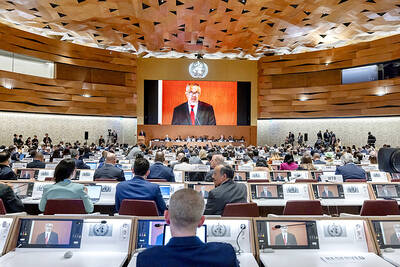
RESOLUTIONS DEBATE: Taiwan’s allies said that UN and WHA resolutions cited by China and other nations ‘do not determine Taiwan’s participation in WHO activities’ A proposal to invite Taiwan to this year’s World Health Assembly (WHA) was rejected on Monday, resulting in Taipei’s absence from the annual meeting for a ninth consecutive year, although partners spoke up for Taiwan’s participation at the first day of the meeting. The first agenda item after the opening was a “two-on-two debate” on a proposal to invite Taiwan to participate at the WHA as an observer. Similar to previous years, two countries made statements in favor of the proposal, while two others expressed their opposition. Philippine Secretary of Health Teodoro Herbosa, president of the 78th WHA, accepted the WHA General Committee’s
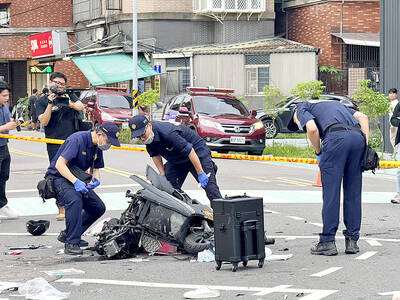
At least three people died and more than a dozen were injured yesterday afternoon when a vehicle struck a group of pedestrians in New Taipei City’s Sansia District (三峽). The incident happened at about 4pm when a car rammed into pedestrians at an intersection near Bei Da Elementary School. Witnesses said the sedan, being driven at a high speed, ran a red light, knocking scooters out of the way and hitting students crossing the road before careening into a median near the intersection of Guocheng and Guoguang streets. The incident resulted in three deaths and 13 injuries, including the driver, a 78-year-old man


 RSS
RSS