


The aroma of beef noodles and leek dumplings filled the air at the Chenggong Community yesterday afternoon as Taipei City's biggest juan cun (眷村), or military village, launched its second annual "Taipei Mainland Veteran Villages Festival" with homemade delicacies and traditional Chinese handicrafts made by veterans and their offspring.
Military villages are residential compounds that were set up to house soldiers and their families who followed dictator Chiang Kai-shek (
"Our purpose is to preserve the veteran culture that is slowly disappearing as more and more veterans are dying off. One of the most unique things about the culture is the strong sense of community care and neighborhood watch which has become quite rare in modern society," said Chang Ling-chen from the city's Department of Culture Affairs.
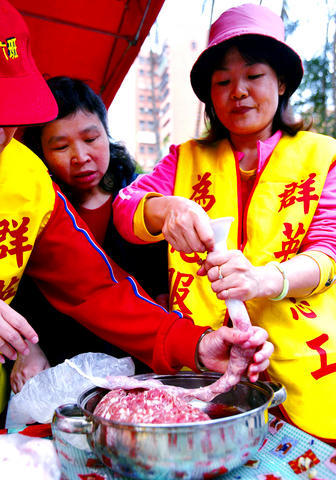
PHOTO: CNA
Chang said the festival not only allows the veterans to show off their culinary skills and other talents such as paper cutting and Chinese calligraphy, but it also provides a chance for their second, and even third generations to learn about their grandparents' era.
This year's festival was organized entirely by the community residents, instead of being outsourced to an event-planning company like last year, she said.
At one point, as many as 880 military residential compounds were spread across the nation, housing more than 100,000 families.
The Chenggong Community, located in Qunying Borough (群英), is nestled in the middle of Taipei's Da-an District (大安). Borough Chief Shih Chung-sheng (石忠勝) said during its peak in the mid-1980s, over 700 veteran households, mostly families of former army men, occupied the community.
"Now we have only about 300 veteran households left. The majority of the veterans have passed away and some have opted to live with their children elsewhere. However, one thing that has remained amidst all the comings and goings is the harmony among the residents," Shih said.
One resident, Chen Du Jih-kuei (
Another resident, Wu Cheih-chun (
"This is where all my friends are. I have no reason to go back to China because Taiwan has been good to me," said Wu also an ex-army man who came to Taiwan in 1949.
The two-week festival will also offer movie screenings and music concerts featuring old tunes. Some veterans will also host story times to tell tales of the past.
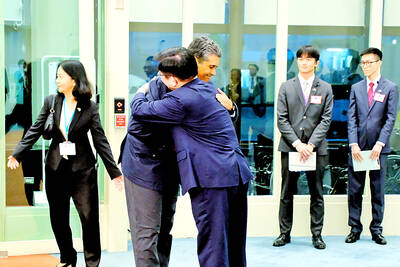
Palauan President Surangel Whipps Jr arrived in Taiwan last night to kick off his first visit to the country since beginning his second term earlier this year. After arriving at Taoyuan International Airport at around 6:30 pm, Whipps and his delegation were welcomed by Minister of Foreign Affairs Lin Chia-lung (林佳龍). Speaking to gathered media, the Palauan leader said he was excited and honored to be back in Taiwan on his first state visit to Taiwan since he was sworn in this January. Among those traveling with Whipps is Minister of State Gustav N. Aitaro, Public Infrastructure
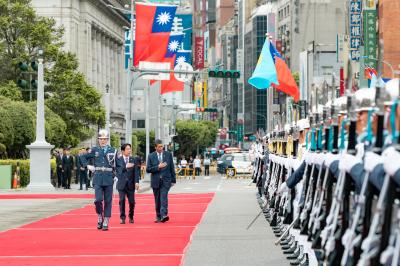
President William Lai (賴清德) yesterday thanked Palau for its continued support of Taiwan's international participation, as Taipei was once again excluded from the World Health Assembly (WHA) currently taking place in Switzerland. "Palau has never stopped voicing support for Taiwan" in the UN General Assembly, the WHO and other UN-affiliated agencies, Lai said during a bilateral meeting with visiting Palau President Surangel Whipps Jr. "We have been profoundly touched by these endorsements," Lai said, praising the Pacific island nation's firm support as "courageous." Lai's remarks came as Taiwan was excluded for the ninth consecutive year from the WHA, which is being held in

RESOLUTIONS DEBATE: Taiwan’s allies said that UN and WHA resolutions cited by China and other nations ‘do not determine Taiwan’s participation in WHO activities’ A proposal to invite Taiwan to this year’s World Health Assembly (WHA) was rejected on Monday, resulting in Taipei’s absence from the annual meeting for a ninth consecutive year, although partners spoke up for Taiwan’s participation at the first day of the meeting. The first agenda item after the opening was a “two-on-two debate” on a proposal to invite Taiwan to participate at the WHA as an observer. Similar to previous years, two countries made statements in favor of the proposal, while two others expressed their opposition. Philippine Secretary of Health Teodoro Herbosa, president of the 78th WHA, accepted the WHA General Committee’s
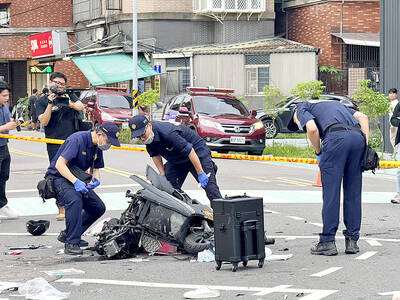
At least three people died and more than a dozen were injured yesterday afternoon when a vehicle struck a group of pedestrians in New Taipei City’s Sansia District (三峽). The incident happened at about 4pm when a car rammed into pedestrians at an intersection near Bei Da Elementary School. Witnesses said the sedan, being driven at a high speed, ran a red light, knocking scooters out of the way and hitting students crossing the road before careening into a median near the intersection of Guocheng and Guoguang streets. The incident resulted in three deaths and 13 injuries, including the driver, a 78-year-old man


 RSS
RSS