


Convicts will be allowed to apply to change their names three years after the completion of their prison sentence following the legislature's approval of the third reading of the Name Act (姓名條例) yesterday.
The bill, proposed by Chinese Nationalist Party (KMT) Legislator Chen Ken-te (
"Many people hope to change their names after they get out of jail because many people believe it will bring good luck. So it is a good thing for us to shorten the waiting period for people who have paid their debt to society. They deserve a second chance to resume a normal life as soon as possible," Chen said.
Chen made the remarks during the legislative session yesterday afternoon. He said he proposed the amendment on Nov. 26 and he was glad to see lawmakers across party lines support the idea.
The amendment also allows family names to be changed when an adoptive relationship begins or ends.
It further stipulates that women can change their family name following a divorce.
In addition, the amendment stipulates that Aboriginal people whose family names were wrongly registered when they were rendered into Chinese decades ago could apply to the Ministry of the Interior to have them corrected.
In addition, the legislature also approved amendments to the Indigenous Peoples Intellectual Property Act (
The act was first proposed and approved in 2000.
The changes were proposed by the Cabinet's Council of Indigenous People on Nov. 26 along with the amendment concerning Aboriginal names.
Infringement of indigenous intellectual property rights, including traditional music and lyrics, can be penalized with compensation claims of up to NT$6 million (US$185,750), the newly passed act says.
Victims of intellectual property rights infringement can seek compensation ranging between NT$50,000 to NT$3 million under normal circumstances and up to NT$6 million if the infringement is found to be "extremely serious," the act stipulates.
The act also stipulates that if intellectual property is considered to be the collective property of an Aboriginal tribe or community, members of the tribe or community should establish a foundation to manage any profits generated from the asset.

Costa Rica sent a group of intelligence officials to Taiwan for a short-term training program, the first time the Central American country has done so since the countries ended official diplomatic relations in 2007, a Costa Rican media outlet reported last week. Five officials from the Costa Rican Directorate of Intelligence and Security last month spent 23 days in Taipei undergoing a series of training sessions focused on national security, La Nacion reported on Friday, quoting unnamed sources. The Costa Rican government has not confirmed the report. The Chinese embassy in Costa Rica protested the news, saying in a statement issued the same

Taiwan’s Liu Ming-i, right, who also goes by the name Ray Liu, poses with a Chinese Taipei flag after winning the gold medal in the men’s physique 170cm competition at the International Fitness and Bodybuilding Federation Asian Championship in Ajman, United Arab Emirates, yesterday.
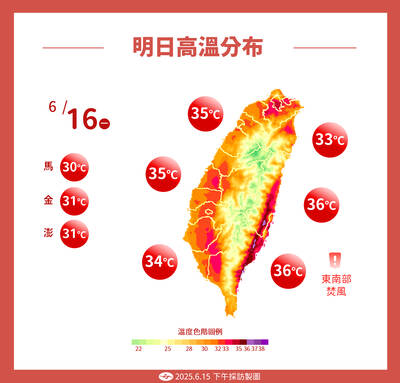
Temperatures in New Taipei City’s Sindian District (新店) climbed past 37°C yesterday, as the Central Weather Administration (CWA) issued heat alerts for 16 municipalities, warning the public of intense heat expected across Taiwan. The hottest location in Taiwan was in Sindian, where the mercury reached 37.5°C at about 2pm, according to CWA data. Taipei’s Shilin District (士林) recorded a temperature of 37.4°C at noon, Taitung County’s Jinfeng Township (金峰) at 12:50 pm logged a temperature of 37.4°C and Miaoli County’s Toufen Township (頭份) reached 36.7°C at 11:40am, the CWA said. The weather agency yesterday issued a yellow level information notice for Taipei, New

A year-long renovation of Taipei’s Bangka Park (艋舺公園) began yesterday, as city workers fenced off the site and cleared out belongings left by homeless residents who had been living there. Despite protests from displaced residents, a city official defended the government’s relocation efforts, saying transitional housing has been offered. The renovation of the park in Taipei’s Wanhua District (萬華), near Longshan Temple (龍山寺), began at 9am yesterday, as about 20 homeless people packed their belongings and left after being asked to move by city personnel. Among them was a 90-year-old woman surnamed Wang (王), who last week said that she had no plans


 RSS
RSS