


Effective reporting and more publicity on climate change would help the battle against global warming, experts said yesterday at a Climate Change Symposium held by the British Trade and Cultural Office (BTCO) in Taipei.
The BTCO organized the seminar to coincide with the UN Framework Convention on Climate Change (UNFCCC) currently being held in Bali, Indonesia, a BTCO spokesman said.
He said the office would like to take the opportunity to establish ties with the government's Environmental Protection Administration and the nation's non-governmental organizations (NGOs) as environmental issues played an important role in the British government's diplomatic policy.
Addressing the occasion, Alex Palman, the climate change consultant at the UK's Foreign and Commonwealth Office, who developed and implemented Britain's Climate Change Communications Initiative (CCCI), said that creating fear in the public was not the right strategy for educating people about climate change. He said individuals should remain positive on the issue and understand that everyone could contribute to mitigating global warming by changing their behavior and way of life.
Palman gave two successful examples of CCCI campaigns, including the television documentaries My CO2 and Climate Change Champions, both of which he said could serve as models for Taiwan.
The first documentary shows how the general public can help on climate change simply by switching off unused electrical devices or walking instead of driving the car, while the latter shows a project that brought together schools, community groups, NGOs as well as central and local governments to create competitions for youngsters on taking anti-global warming action.
Fiona Harvey, a journalist on environmental issues and a correspondent for the Financial Times, said allowing the public to visualize the issues -- such as flooding occurring more frequently in the UK, or dengue fever spreading north in Taiwan because of warmer temperatures -- was a good way of targeting the issue.
The media should avoid "sensationalizing" its reports -- making them "scary reading" -- because too much pessimism was likely to make people give up making an effort to address the issue or cause them to wonder about its credibility, she said.
"There is optimism as well as gloom," she said, adding that focusing on solutions and empowering people by showing how they could help was more important.
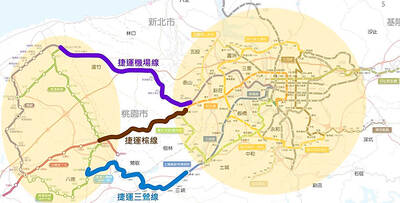
The Executive Yuan yesterday approved a southwestern extension of the Sanying MRT Line from New Taipei to Bade District (八德) in Taoyuan, with a goal of starting construction by late 2026. The 4.03-kilometer extension, featuring three new stations, will run from the current terminus at Yingtao Fude Station (LB12) in New Taipei City to Dannan Station (LB14), where it will connect with Taoyuan’s Green Line, New Taipei City Metro Corp said in a statement. This extension will follow the completion of core Sanying Line, a 14.29-kilometer medium-capacity system linking Tucheng (土城), Sansia (三峽)
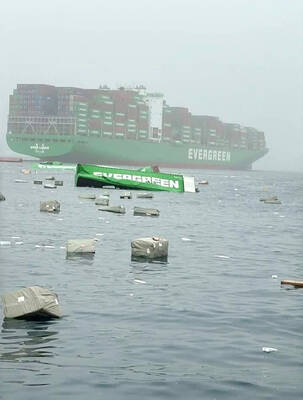
CARGO LOSS: About 50 containers at the stern of the ‘Ever Lunar’ cargo ship went overboard, prompting the temporary closure of the port and disrupting operations Evergreen Marine Corp, Taiwan’s largest container shipper, yesterday said that all crew members aboard the Ever Lunar (長月) were safe after dozens of containers fell overboard off the coast of Peru the previous day. The incident occurred at 9:40am on Friday as the Ever Lunar was anchored and waiting to enter the Port of Callao when it suddenly experienced severe rolling, Evergreen said in a statement. The rolling, which caused the containers to fall, might have been caused by factors including a tsunami triggered by an earthquake in Russia, poor winter sea conditions in South America or a sudden influx of waves,

The Ministry of Culture yesterday officially launched the “We TAIWAN” cultural program on Osaka’s Nakanoshima sandbank, with the program’s mascot receiving overwhelming popularity. The cultural program, which runs from Aug. 2 to 20, was designed to partner with and capitalize on the 2025 World Expo that is being held in Osaka, Japan, from April 13 to Oct. 13, the ministry said. On the first day of the cultural program, its mascot, a green creature named “a-We,” proved to be extremely popular, as its merch was immediately in high demand. Long lines formed yesterday for the opening

The Taipei Summer Festival is to begin tomorrow at Dadaocheng Wharf (大稻埕), featuring four themed firework shows and five live music performances throughout the month, the Taipei Department of Information and Tourism said today. The festival in the city’s Datong District (大同) is to run until Aug. 30, holding firework displays on Wednesdays and the final Saturday of the event. The first show is scheduled for tomorrow, followed by Aug. 13, 20 and 30. To celebrate the 30th anniversary of Disney Pixar's movie Toy Story, the festival has partnered with Walt Disney Co (Taiwan) to host a special themed area on


 RSS
RSS