


The Ministry of Education (MOE) and early childhood education representatives reached a preliminary agreement after more than 10,000 pre-school and kindergarten educators took to the streets yesterday, calling on the ministry to stop neglecting education for young children and to withdraw a bill from legislative review.
After a closed-door meeting lasting an hour, MOE Secretary-General Chen Ming-yin (
Because childcare centers and kindergartens are subject to separate regulations, standards for teacher qualifications, operations and government subsidies differ, she said.

PHOTO: WANG YI-SUNG, TAIPEI TIMES
To integrate the two systems, the Cabinet introduced a childhood care and education bill to the Legislature in May.
Early Childhood Education Alliance president Huang Li-chu (
Huang said it was wrong to include babysitting services and education for children up to 12 years old in the bill.
Huang said that the government and sector agree it is necessary to integrate nurseries, preschools and kindergartens, but added that the ministry's proposal was "ridiculous" because it included such a wide range of services.
"We are educators, not businessmen. We should not be treated like we are running commercial cram schools. It is obvious the ministry does not care about early childhood education. Why is it that the ministry is willing to spend NT$50 billion (US$1.5 billion) on tertiary education for the next five years, but only a few million on pre-elementary education?" she asked.
The protesters demanded the ministry remove a regulation in the bill that would require parents to sign a contract with the school their child attends before the school year's start.
The contract template proposed by the ministry "commercializes" early-childhood education and treats children as commodities, the educators said.
"The regulation is dangerous and unfair for parents with troubled children because according to the contract, schools have the right to refuse to accept students if the students or parents do not fulfill the terms. This will indirectly create many unwanted students," Huang said.
In response to the protest, Chen said the ministry would drop the regulation and draw up an alternative proposal to ensure the quality of early childhood education.
At a separate setting, however, Democratic Progressive Party Legislator Huang Sue-ying (
In addition to integrating different kinds of education for young children under one law, the bill also aims to solve other problems, she said.
One issue is the quality of privately run schools, Alliance for Integrated Childcare Policy convener Liu Yu-hsiu (
"More than 70 percent of kindergartens and childcare centers nationwide are privately owned and operated," Liu said. "They charge parents very high fees, but a lot of them hire unqualified teachers and pay them minimal salaries."
Monthly fees for private childcare centers and kindergartens in Taipei can range from NT$11,000 to NT$17,000, while public schools average around NT$6,000, she said.
"Although operators are charging so much, the nationwide average salary for childcare workers and kindergarten teachers is only about NT$28,000," she said.
To combat the issue, the bill proposes creating more public kindergartens and encouraging non-profit organizations working with childcare issues to set up non-profit kindergartens.
Standardized contracts for private kindergartens would also be imposed under the bill, Huang Sue-ying said.
To ensure affordable childcare, both public and non-profit kindergartens would receive subsidies from the government, Huang said.
"Of course private childcare operators will be against it, but I don't think they need to worry," Liu said.
"There will always be parents who are willing to pay more to have their children attend private kindergartens," Liu said.

The Taipei Summer Festival is to begin tomorrow at Dadaocheng Wharf (大稻埕), featuring four themed firework shows and five live music performances throughout the month, the Taipei Department of Information and Tourism said today. The festival in the city’s Datong District (大同) is to run until Aug. 30, holding firework displays on Wednesdays and the final Saturday of the event. The first show is scheduled for tomorrow, followed by Aug. 13, 20 and 30. To celebrate the 30th anniversary of Disney Pixar's movie Toy Story, the festival has partnered with Walt Disney Co (Taiwan) to host a special themed area on
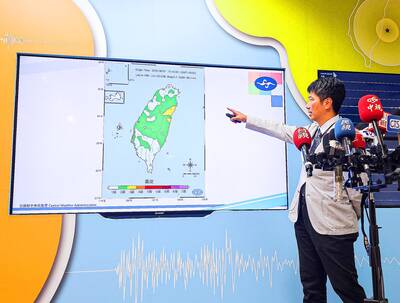
Aftershocks from a magnitude 6.2 earthquake that struck off Yilan County at 3:45pm yesterday could reach a magnitude of 5 to 5.5, the Central Weather Administration (CWA) said. Seismological Center technical officer Chiu Chun-ta (邱俊達) told a news conference that the epicenter of the temblor was more than 100km from Taiwan. Although predicted to measure between magnitude 5 and 5.5, the aftershocks would reach an intensity of 1 on Taiwan’s 7-tier scale, which gauges the actual effect of an earthquake, he said. The earthquake lasted longer in Taipei because the city is in a basin, he said. The quake’s epicenter was about 128.9km east-southeast

BE CAREFUL: The virus rarely causes severe illness or death, but newborns, older people and those with medical conditions are at risk of more severe illness As more than 7,000 cases of chikungunya fever have been reported in China’s Guangdong Province this year, including 2,892 new cases last week, the Centers for Disease Control (CDC) yesterday said it is monitoring the situation and considering raising the travel notice level, which might be announced today. The CDC issued a level 1 travel notice, or “watch,” for Guangdong Province on July 22, citing an outbreak in Foshan, a manufacturing hub in the south of the province, that was reported early last month. Between July 27 and Saturday, the province reported 2,892 new cases of chikungunya, reaching a total of 7,716
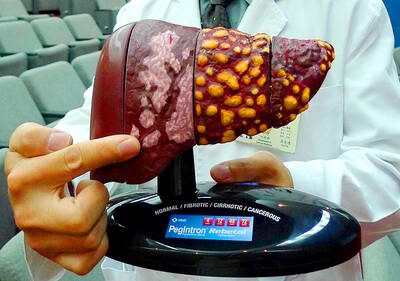
STAY VIGILANT: People should reduce the risk of chronic liver inflammation by avoiding excessive alcohol consumption, smoking and eating pickled foods, the physician said A doctor last week urged people to look for five key warning signs of acute liver failure after popular producer-turned-entertainer Shen Yu-lin (沈玉琳) was reportedly admitted to an intensive care unit for fulminant hepatitis. Fulminant hepatitis is the rapid and massive death of liver cells, impairing the organ’s detoxification, metabolic, protein synthesis and bile production functions, which if left untreated has a mortality rate as high as 80 percent, according to the Web site of Advancing Clinical Treatment of Liver Disease, an international organization focused on liver disease prevention and treatment. People with hepatitis B or C are at higher risk of


 RSS
RSS