


Hsiao Tai-fu (
Hsiao, who was released yesterday after having been detained since late Wednesday night, told a press conference that he had been very cautious not to include any confidential information or cite any confidential documentation when writing his book, Thirty Years as an Intelligence Agent.
"This [book] has absolutely nothing to do with leaking national security secrets," Hsiao said. "Throughout the entire book, I do not mention any information regarding cooperation on intelligence between the Republic of China and any other country."
Hsiao said he had also adhered to his principles and not touched on any case he had personally dealt with, adding that all the cases mentioned in the book were the subject of documents or publications in the public domain.
The Taipei Prosecutors Office and NSB personnel seized about 1,000 copies of the book, which only recently hit the shelves, after searching Taiwan Elite Press, the publisher of the book, the distributors and Hsiao's home on Wednesday morning.
Taipei prosecutors sought to detain Hsiao yesterday morning after he was unable to pay his NT$500,000 (US$15,400) bail on Wednesday night.
The Taipei District Court rejected the prosecutors' request and released Hsiao yesterday morning on condition he does not leave the country.
The NSB issued a press release on Wednesday saying it took legal action against Hsiao because the bureau had advised him not to publish the book when Hsiao sent a draft to the bureau for review.
Classified information was included throughout the book, the bureau said.
Hsiao confirmed that correspondence with the bureau, but said the bureau had never specified which part of his book constituted confidential information.
Hsiao said he wrote the book to pass on the knowledge gained from his 30 years of experience as a NSB official. He said his book should be regarded as a "textbook."
The book addresses topics such as "theories of intelligence," "intelligence gathering," "intelligence analysis," "intelligence strategies," "international intelligence cooperation" and "management of intelligence organizations," copies of the book's index showed.
Hsiao said he agreed that he should "take the confidential information I knew to the grave because leaking the information may endanger people who are still alive."
"This [the NSB's action] was much more terrible than the publication screening of the Taiwan Garrison Command [a key military group during the martial law era]," he said.
The owner of the publisher, Wu Hsin-chien (吳心建), who was also at the press conference, said he felt very upset about the incident as this was the first time in the past three decades that a publication from his company had been seized and banned.
"I don't think there is anything problematic about the content of the book," said Wu, adding that he had read through Hsiao's manuscript before printing the book.
Chinese Nationalist Party (KMT) Legislator Joanna Lei (雷倩), who accompanied Hsiao at the conference, said "so-called national security was only an excuse" in the Hsiao case, adding that the seizing of 1,000 "textbook-like" books by prosecutors was a "setback" for the nation's human rights.
Hsiao is not the only former intelligence officer who has been charged with allegedly leaking classified information in a personal publication after retirement.
Pang Ta-wei (龐大為), a former deputy section chief of the Military Intelligence Bureau, was indicted on Sept. 17 on charges of collecting and leaking classified information that was published in his book.

FUKUOKA SITUATION: Japanese media reported that the pathogen is expected to be identified by the summer, while the CDC downplayed the idea that it was hMPV A “mysterious cold-like illness” reported in Japan’s Fukuoka Prefecture does not seem to be a new disease, but Japanese authorities have been asked about the situation, the Centers for Disease Control (CDC) said yesterday. The Fukuoka Prefectural Medical Association on Wednesday told a news conference that a “mystery cold” that has become a hot topic on social media is “highly likely to be caused by some kind of viral infection,” Japan’s KBC News reported. “Many people are experiencing symptoms starting with a sore throat, followed by a runny nose, phlegm and a severe cough,” KBC News reported, citing association officials. Health authorities are

Nvidia Corp CEO Jensen Huang (黃仁勳) arrived in Taiwan yesterday ahead of upcoming AI and technology events, saying he plans to meet with clients and Taiwan Semiconductor Manufacturing Co Chairman C.C. Wei (魏哲家) during his visit. After landing at Taipei Songshan Airport, Huang posed for photos with fans and handed out Yakult drinks to reporters and supporters waiting at the scene, saying he has “a lot to do” during the trip. Asked about reports that Nvidia’s planned headquarters site in Taipei’s Beitou Shilin Technology Park could break ground on May 27, Huang said that if the company holds an event, he would

The Ministry of Finance this afternoon announced the winning numbers for the March-April uniform invoice lottery. The winning number for the NT$10 million (US$318,060) special prize is 19531471, and the winning number for the NT$2 million grand prize is 85941329. Three numbers were drawn for the NT$200,000 first prize: 07225810, 20231230 and 83518781. Those with receipts matching the last seven digits of any of the first-prize numbers will win the NT$40,000 second prize, while those matching the last six digits will win the NT$10,000 third prize. Those whose receipts match the last five digits of the first-prize numbers can claim the NT$4,000 fourth prize,
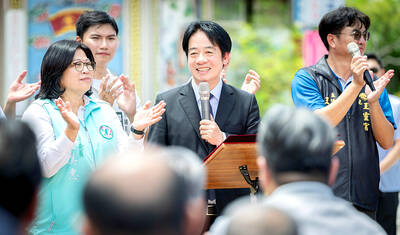
SIX SUBSIDIES: The monthly allowance for older farmers is to increase to NT$10,000, and NT$5,000 is to be given to homemakers under the national pension system, Lai said The government is to implement major welfare policies for disadvantaged groups, including raising the monthly allowance for older farmers to NT$10,000 and providing homemakers with NT$5,000 per month, President William Lai (賴清德) said yesterday. Lai made the remarks during a visit to Wangling Temple in Chiayi County, saying that the planned increases were being introduced amid economic growth and an increase in tax revenue. Touting a policy, in which the government plans to provide a monthly allowance of NT$5,000 for every child under the age of 18 in a bid to address Taiwan’s low birthrate, Lai said that if received for the


 RSS
RSS