


The legislature yesterday gave its initial approval to a draft law promising better protection of the intellectual property rights of traditional Aboriginal arts.
The legislature's Home and Nations Committee passed the statute governing the protection of traditional religious rituals, music, dances, songs, sculpture, crochet, totems and other traditional arts.
"While the Copyrights Law [
An Aboriginal tribe or Aboriginal community may apply for ownership of the intellectual right of a traditional art, the statute said.
If the origin of the traditional art cannot be clearly defined, "more than one community or tribe may share intellectual property right ownership," the statute said.
A panel of experts will review the applications, it said.
Anyone convicted of violating Aboriginal intellectual property rights may be fined between NT$50,000 (US$1,500) and NT$500,000. If the "violation is intentional and the act is severe, the fine may be increased to NT$6 million," the statute said.
The statute still has to go through a second and third reading before it becomes legally binding, said Chinese Nationalist Party (KMT) Legislator Kung Wen-chi (
"With the long legislative queue, I'm not so optimistic that the third reading can be completed before this legislative session ends," he said.
Meanwhile, the Cabinet yesterday passed a draft law governing Aboriginal land and marine areas and will submit it for legislative review, a CIP news release said.
The draft bill seeks to restore the collective right to handle land and marine areas within their traditional domain to the nation's Aborigines, the news release said.
The Cabinet also passed draft amendments to the Organic Statute of the Council of Indigenous Peoples (行政院原住民族委員會組織條例) to establish an office specializing in handling issues related to Aboriginal traditional domains and the survey of natural resources within those domains.
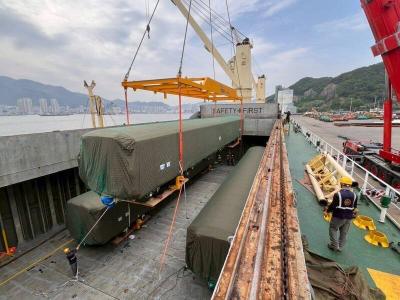
The first of 10 new high-capacity trains purchased from South Korea’s Hyundai Rotem arrived at the Port of Taipei yesterday to meet the demands of an expanding metro network, Taipei Rapid Transit Corp (TRTC) said yesterday. The train completed a three-day, 1,200km voyage from the Port of Masan in South Korea, the company said. Costing NT$590 million (US$18.79 million) each, the new six-carriage trains feature a redesigned interior based on "human-centric" transportation concepts, TRTC said. The design utilizes continuous longitudinal seating to widen the aisles and optimize passenger flow, while also upgrading passenger information displays and driving control systems for a more comfortable

AGING: While Japan has 22 submarines, Taiwan only operates four, two of which were commissioned by the US in 1945 and 1946, and transferred to Taiwan in 1973 Taiwan would need at least 12 submarines to reach modern fleet capabilities, CSBC Corp, Taiwan chairman Chen Cheng-hung (陳政宏) said in an interview broadcast on Friday, citing a US assessment. CSBC is testing the nation’s first indigenous defense submarine, the Hai Kun (海鯤, Narwhal), which is scheduled to be delivered to the navy next month or in July. The Hai Kun has completed torpedo-firing tests and is scheduled to undergo overnight sea trials, Chen said on an SET TV military affairs program. Taiwan would require at least 12 submarines to establish a modern submarine force after assessing the nation’s operational environment and defense

A white king snake that frightened passengers and caused a stir on a Taipei MRT train on Friday evening has been claimed by its owner, who would be fined, Taipei Rapid Transit Corp (TRTC) said yesterday. A person on Threads posted that he thought he was lucky to find an empty row of seats on Friday after boarding a train on the Bannan (Blue) Line, only to spot a white snake with black stripes after sitting down. Startled, he jumped up, he wrote, describing the encounter as “terrifying.” “Taipei’s rat control plan: Release snakes on the metro,” one person wrote in reply, referring

Taiwan’s two cases of hantavirus so far this year are on par with previous years’ case numbers, and the government is coordinating rat extermination work, so there should not be any outbreaks, Centers for Disease Control (CDC) Director-General Philip Lo (羅一鈞) said today in an interview with the Liberty Times (the Taipei Times’ sister newspaper). An increase in rat sightings in Taipei and New Taipei City has raised concerns about the spread of hantavirus, as rats can carry the disease. In January, a man in his 70s who lived in Taipei’s Daan District (大安) tested positive posthumously for hantavirus, Taiwan’s


 RSS
RSS