


The octogenarian Kuan Yin-chai (關英才) was the only non-Hakka delegate to travel from Brunei to Taiwan recently to attend this year's World Hakka City Leader-ship Conference, but he is proud to be participating in "world Hakka affairs" as he has three Hakka wives.
Kuan, 85, a renowned business tycoon in Brunei who started his business kingdom from an electrical appliance store and went on to expand to the construction, hotel, cabaret, education, shipbuilding and maritime transportation industries, doubles as the chairman of the World Liu, Kuan, Chang, Chao Clans Federation.
The energetic and strong-voiced Kuan said about half of his children have Hakka blood and he is proud to have fathered Hakka children, which is why he traveled to Taiwan for this conference.
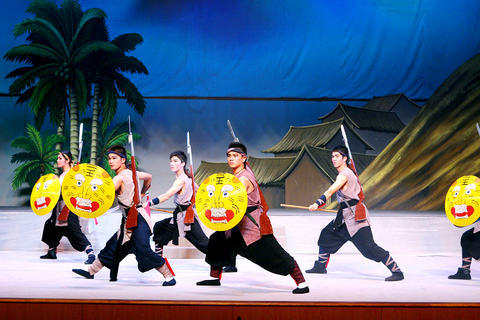
PHOTO COURTESY OF HSINCHU COUNTY COUNCIL
Kuan, nevertheless, seems to be even prouder to be a descendant of "Kuan Kong (
The Brunei-based business tycoon said he is a 72nd-generation offspring of General Kuan Yu.
The name "Hakka" is a word of Cantonese origin, literally meaning "guest" or "stranger." In many parts of South China, these "guests" are still treated as outsiders or intruders even though everyone now concedes that they are Han Chinese.
The Hakka identify themselves as northern Chinese, and this contention has some basis in fact. Some genealogies and other historical records indicated that many of the ancestors of the Hakka were originally from the northern plains and that they moved south in a series of migration waves, including to Taiwan.
Historically, the Hakka began to emigrate out of China as early as the Tang Dynasty (618 to 906) , but most Hakka emigrated overseas in the 19th and 20th centuries, with many becoming political or business leaders in their countries of residence.
According to Chen Yu-yan (
Thailand's former prime minister Thaksin Shinawatra, who was forced from office in last year's coup d'etat, is Hakka, Chen said, adding that Thaksin met with members of a Japan-based Hakka association in Tokyo in January this year and spoke in a Hakka dialect.
According to Lu Chun-yuan (盧鈞元), a Hakka leader from Thailand who graduated from National Taiwan University, among the people of Chinese origin currently living in Bangkok, Hakka descendants form the second largest group.
The Hakka people in Thailand made extraordinary contributions in the early 20th century to help the then overseas Chinese leader Sun Yat-sen (
Nevertheless, Lu said, a great majority of the Hakka descendants in Thailand today don't know the Hakka dialect nor can they read Chinese characters.
Lu offered his appreciation to Chinese Nationalist Party (KMT) Chairman Wu Poh-hsiung (吳伯雄), a Hakka who visited Thailand five years ago in his capacity as chairman of the World Confederation of Hakka Associations to promote Hakka culture, for having helped rekindle efforts to revive the Hakka language and culture in Thailand, where the first Hakkas arrived during the Tang Dynasty.
Hou Ya-ling (
Hou said she traveled to Taiwan to attend the conference in memory of her late uncle, Sir Moilin Jean Ah-Chuen, who was the second Hakka, after Sun Yat-sen, to have his portrait printed on the bills of a country's currency.
Moilin Jean Ah-Chuen, who descended from a Hakka family that emigrated from Guangdong, China in 1654, was conferred a knighthood by the Queen Elizabeth II for his contributions to helping Mauritius develop into an independent nation in 1968.
A successful businessman and parliamentarian, Moilin Jean Ah-Chuen died at the age of 82 in Mauritius in 1991. The Mauritian government printed his picture on Mauritian bills issued between 1998 and 1999 to commemorate his outstanding contributions to the nation.
Huang Kuan-ming (黃冠明), president of the Tsung Tsin Association in Great Britain said a number of Hakka have been listed among the 50 richest people of foreign origin in the UK.
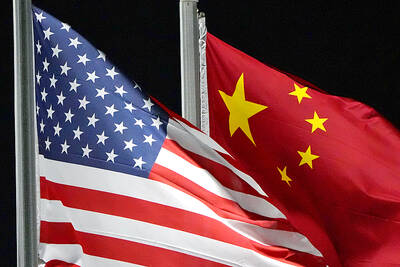
The brilliant blue waters, thick foliage and bucolic atmosphere on this seemingly idyllic archipelago deep in the Pacific Ocean belie the key role it now plays in a titanic geopolitical struggle. Palau is again on the front line as China, and the US and its allies prepare their forces in an intensifying contest for control over the Asia-Pacific region. The democratic nation of just 17,000 people hosts US-controlled airstrips and soon-to-be-completed radar installations that the US military describes as “critical” to monitoring vast swathes of water and airspace. It is also a key piece of the second island chain, a string of
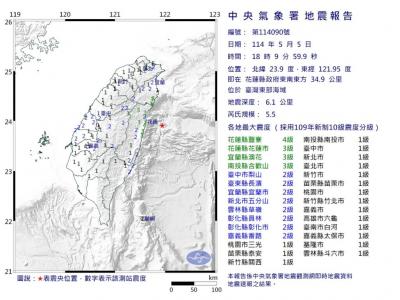
A magnitude 5.9 earthquake that struck about 33km off the coast of Hualien City was the "main shock" in a series of quakes in the area, with aftershocks expected over the next three days, the Central Weather Administration (CWA) said yesterday. Prior to the magnitude 5.9 quake shaking most of Taiwan at 6:53pm yesterday, six other earthquakes stronger than a magnitude of 4, starting with a magnitude 5.5 quake at 6:09pm, occurred in the area. CWA Seismological Center Director Wu Chien-fu (吳健富) confirmed that the quakes were all part of the same series and that the magnitude 5.5 temblor was
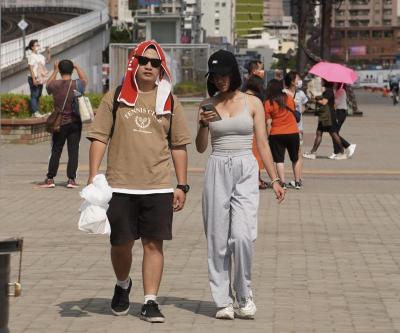
The Central Weather Administration has issued a heat alert for southeastern Taiwan, warning of temperatures as high as 36°C today, while alerting some coastal areas of strong winds later in the day. Kaohsiung’s Neimen District (內門) and Pingtung County’s Neipu Township (內埔) are under an orange heat alert, which warns of temperatures as high as 36°C for three consecutive days, the CWA said, citing southwest winds. The heat would also extend to Tainan’s Nansi (楠西) and Yujing (玉井) districts, as well as Pingtung’s Gaoshu (高樹), Yanpu (鹽埔) and Majia (瑪家) townships, it said, forecasting highs of up to 36°C in those areas

IN FULL SWING: Recall drives against lawmakers in Hualien, Taoyuan and Hsinchu have reached the second-stage threshold, the campaigners said Campaigners in a recall petition against Chinese Nationalist Party (KMT) Legislator Yen Kuan-heng (顏寬恒) in Taichung yesterday said their signature target is within sight, and that they need a big push to collect about 500 more signatures from locals to reach the second-stage threshold. Recall campaigns against KMT lawmakers Johnny Chiang (江啟臣), Yang Chiung-ying (楊瓊瓔) and Lo Ting-wei (羅廷瑋) are also close to the 10 percent threshold, and campaigners are mounting a final push this week. They need about 800 signatures against Chiang and about 2,000 against Yang. Campaigners seeking to recall Lo said they had reached the threshold figure over the


 RSS
RSS