


Bill Voss, president of the Flight Safety Foundation, said yesterday that this year's global aviation safety performance seemed lackluster compared to that of last year.
"Overall, safety performance for commercial jets remains excellent, but not as good as last year," he said at the 15th National Flight Safety Conference in Taipei, jointly hosted by the Aviation Safety Council (ASC) and the Civil Aeronautics Administration (CAA).
Voss' presentation showed that 13 accidents have already happened from January to October of this year, in which a China Airlines' airplane explosion in Naha was listed.
Voss was referring to a China Airlines Boeing 737-800 airliner that caught fire moments after landing AT Naha Airport, Okinawa, in August. All 165 passengers on board escaped unscathed.
A total of nine aviation accidents happened worldwide last year, he said.
According to Voss, an aviation incident was classified as an accident either when the aircraft is destroyed or there are multiple fatalities to the occupants. An accident also refers to the situation where there is one fatality and the aircraft is substantially damaged.
Statistics in his presentation indicated that the major accident rate has been decreasing from 31 per million departures in 1996 to 11 per million departures last year.
Voss also pointed out that accidents as a result of commercial jet loss of control and turbo propeller controlled flight into terrain (CFIT) dominate the fatality numbers this year.
Voss added that more than 50 percent of all major accidents this year occurred during the "approach and landing" phase of an aircraft's operation, which begins when an airplane news its destination airport and prepares for landing. Meanwhile, he said more efforts have been made to reduce the risks in runway safety.
The council originally decided to cancel the conference this year in order to host the 60th Annual International Air Safety Seminar, which is deemed one of the most important events by flight safety authorities around the world.
However, the ASC was informed by the Flight Safety Foundation (FSF) in June that it had to forgo the right to host the seminar because of China's opposition to the arrangement. Eventually, the council decided to resume the opening of its annual Flight Safety Conference.
Besides Voss, the International Civil Aviation Organization (ICAO) Ambassador Edward Stimpson and former FSF president Stuart Matthews also attended the conference yesterday.
Matthews called for Taiwan's participation in an initiative called the Global Aviation Safety Road Map, which was created to coordinate and guide aviation safety policies among members of ICAO.
"We invite Taiwan to embrace the road map," Matthews said.
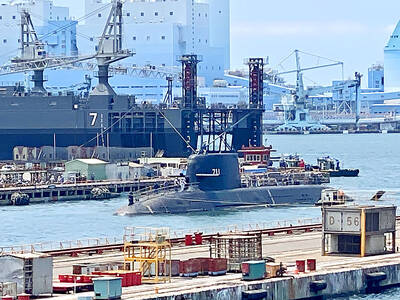
AGING: While Japan has 22 submarines, Taiwan only operates four, two of which were commissioned by the US in 1945 and 1946, and transferred to Taiwan in 1973 Taiwan would need at least 12 submarines to reach modern fleet capabilities, CSBC Corp, Taiwan chairman Chen Cheng-hung (陳政宏) said in an interview broadcast on Friday, citing a US assessment. CSBC is testing the nation’s first indigenous defense submarine, the Hai Kun (海鯤, Narwhal), which is scheduled to be delivered to the navy next month or in July. The Hai Kun has completed torpedo-firing tests and is scheduled to undergo overnight sea trials, Chen said on an SET TV military affairs program. Taiwan would require at least 12 submarines to establish a modern submarine force after assessing the nation’s operational environment and defense
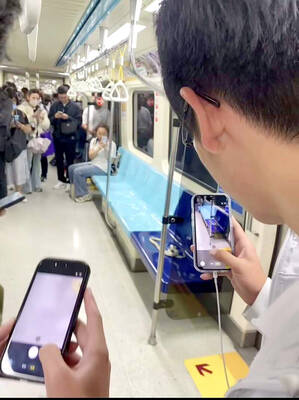
A white king snake that frightened passengers and caused a stir on a Taipei MRT train on Friday evening has been claimed by its owner, who would be fined, Taipei Rapid Transit Corp (TRTC) said yesterday. A person on Threads posted that he thought he was lucky to find an empty row of seats on Friday after boarding a train on the Bannan (Blue) Line, only to spot a white snake with black stripes after sitting down. Startled, he jumped up, he wrote, describing the encounter as “terrifying.” “Taipei’s rat control plan: Release snakes on the metro,” one person wrote in reply, referring
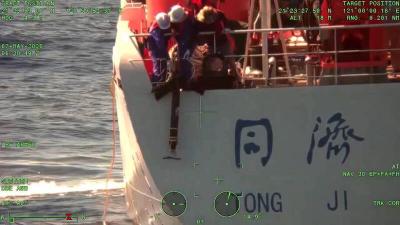
The coast guard today said that it had disrupted "illegal" operations by a Chinese research ship in waters close to the nation and driven it away, part of what Taipei sees a provocative pattern of China's stepped up maritime activities. The coast guard said that it on Thursday last week detected the Chinese ship Tongji (同濟號), which was commissioned only last year, 29 nautical miles (54km) southeast of the southern tip of Taiwan, although just outside restricted waters. The ship was observed lowering ropes into the water, suspected to be the deployment of scientific instruments for "illegal" survey operations, and the coast
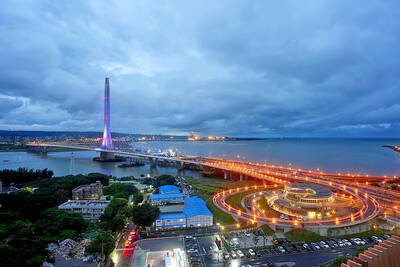
An inauguration ceremony was held yesterday for the Danjiang Bridge, the world’s longest single-mast asymmetric cable-stayed bridge, ahead of its official opening to traffic on Tuesday, marking a major milestone after nearly three decades of planning and construction. At the ceremony in New Taipei City attended by President William Lai (賴清德), Premier Cho Jung-tai (卓榮泰), Minister of Transportation and Communications Chen Shih-kai (陳世凱) and New Taipei City Mayor Hou Yu-ih (侯友宜), the bridge was hailed as both an engineering landmark and a long-awaited regional transport link connecting Tamsui (淡水) and Bali (八里)


 RSS
RSS