

The Department of Health pledged yesterday to step up inspections to prevent the illegal use of materials made from cattle bone in dental implant surgery, amid fears that such material may have been imported from regions affected by mad cow disease.
Liu Li-ling (劉麗玲), deputy chief of the department's Bureau of Medical Affairs, said that medical devices made from bovine bone are currently forbidden unless they are sent to the department for inspection in advance and are issued a permit.
As no permits for bovine bone-based medical devices have been issued by the department to date, it is safe to say that any such devices available on the market are illegal, Liu said.
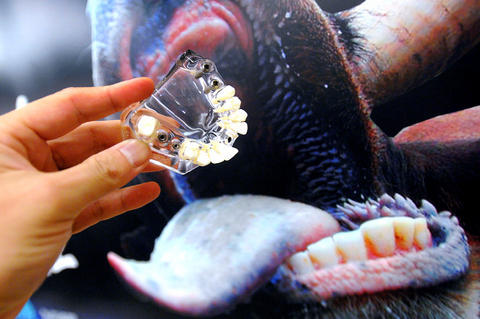
PHOTO: CNA
Liu made the remarks in response to a claim by Chinese Nationalist Party (KMT) Legislator Chu Chun-hsiao (朱俊曉) that approximately 30 percent of dental clinics in the country use bone graft material made of bovine bone from countries that have been affected by mad cow disease, such as the US, a practice which the legislator said exposed patients to an unnecessary risk of being infected with the deadly disease.
In some cases, bone grafting is required in dental implant treatment, and bovine bone is one of the options for a substance in the process that is aimed at regenerating lost bone and tissue to create a better quality bone site for the implantation.
Liu said that anyone caught manufacturing, importing, selling or supplying unlicensed medical devices will be subject to imprisonment of up to three years and a maximum fine of NT$100,000.
Lu said that members of the public can call the department's hot line at 0800-625748 to report any such activity.
Peng Ming-hsing (彭明興), a section chief at the Bureau of Animal and Plant Health Inspection and Quarantine's Animal Quarantine Division, said that there is no evidence showing that using the bone material from animals infected with mad cow disease in bone grafting can transmit the disease to the patients.
Nevertheless, the government should still deal with the issue carefully to minimize the possibility of infection, Peng said

The National Police Agency’s Third Special Police Corps yesterday said that from May to July, it intercepted five smuggling operations from China, seizing more than 70,000 counterfeit Beyblades with an estimated infringement value of NT$34.45 million (US$1.08 million). It added that any bootleg unit that reached the local market could present hidden health hazards to players. Beyblades, a line of spinning toy tops used in competitive gaming and developed in Japan by toy company Takara Tomy, have become popular in Taiwan, making them a target for fraudsters. The Third Special Police Corps, dedicated to safeguarding maritime borders and trade lines,

Five customers who made purchases at 7-Eleven stores across Taiwan won the top NT$10 million (US$313,716) special prize in the July-August uniform invoice lottery, including one who spent just NT$27 on photocopying, the convenience store chain said today. The five special prize winners made their purchases at stores in Taoyuan, Taipei, Taichung and Kaohsiung, 7-Eleven operator President Chain Store Corp said. The five winning purchases included NT$29 spent on snacks at a store in Taoyuan's Zhongli District (中壢), NT$27 on photocopying at a store in Taipei's Zhongzheng District (中正), NT$139 on City Cafe coffee and daily necessities at a store in Taipei's
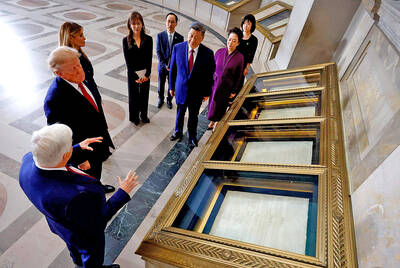
Chinese President Xi Jinping (習近平) reportedly cut short his visit to the National Archives in Washington after the Chinese delegation objected to plans to view the Treaty of San Francisco, sources in Washington’s media circles said. Xi and his wife, Peng Liyuan (彭麗媛), concluded their three-day state visit to the US on Friday after having tea with US President Donald Trump and first lady Melania Trump at the White House and visiting the archives. Chinese democracy advocates and members of pro-China groups gathered outside the venue during Xi’s visit, with the two groups exchanging competing slogans while police kept them separated. The US
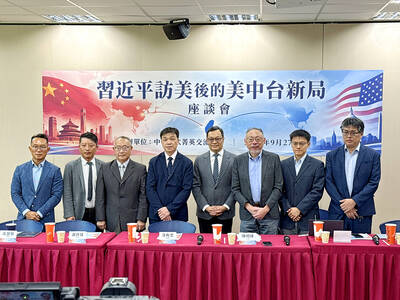
TRICKY ISSUE: Taiwan’s defense of the ROC in WWII could conflict with the government’s narrative on Taiwanese history and identity, an academic said Chinese President Xi Jinping (習近平) had no standing to discuss US-China relations in World War II (WWII), as the People’s Republic of China did not exist at that time, Mainland Affairs Council (MAC) Deputy Minister Shen Yu-chung (沈有忠) said yesterday. Taipei would ensure that Washington has a clear understanding that it was the Republic of China (ROC), not the People’s Republic of China (PRC), that was a steadfast ally of the US in WWII, Shen said. Shen was referring to a White House fact sheet released on Friday about Xi’s meeting with US President Donald Trump in Washington. It said that “the two


 RSS
RSS