


While avoiding political issues when questioned by lawmakers in his capacity as candidate for president of the Judicial Yuan yesterday, Grand Justice Lai Ying-jaw (賴英照) vowed to defend judicial independence from political interference if his nomination were accepted.
The legislature held a question-and-answer session yesterday to review Lai's nomination as well as that of Hsieh Tsai-chuan (謝在全), the candidate for the deputy chair at the Judicial Yuan.
Pan-blue lawmakers focused their questions on recent political issues stemming from the name-change controversy over the government's proposal for UN membership under the name "Taiwan" rather than "Republic of China [ROC]."
KMT Legislator Kao Su-po (
"The country's name stipulated in the Constitution is ROC. Only when we go through the necessary procedure of amending the Constitution can it be changed," Lai said.
But Lai refused to comment on whether it was constitutional to alter the symbols of the country by means of amending the Constitution, saying that the Council of Grand Justice had never delivered an interpretation on the matter.
Asked by People First Party Legislator Chang Hsien-yao (張顯耀) whether the country was qualified to take the UN's rejection of the nation's membership bid to the International Court of Justice in The Hague, Lai responded by saying that "we all know the answer."
Democratic Progressive Party (DPP) Legislator William Lai (賴清德) asked the two nominees to define the country's territory, which he said had ramifications for the constitutionality of the UN application.
"We don't have a specific definition of the country's territory, as the Constitution defines the ROC territory as `its existing national boundaries,'" Lai Ying-jaw said, refusing to say whether China was included in that definition.
William Lai said he was not satisfied with the two nominees' responses after Lai Ying-jaw said that highly political issues were outside the range of constitutional interpretation.
"How could you be able to interpret related constitutional disputes about sovereign-related issues if you don't have the definitions in mind?" William Lai asked.
Also of concern to the pan-blue lawmakers was the demarcation between politics and the judiciary following President Chen Shui-bian's (
Using former US president Harry Truman's famous "The buck stops here," Lai Ying-jaw told lawmakers he would "take necessary action" to resist political pressure.
Answering a question by DPP Legislator Wang Shih-cheng (王世堅) on how to address public discontent with a large number of verdicts, Lai Ying-jaw said the Judicial Yuan was considering the possibility of setting up a jury system.
Lai Ying-jaw vowed to continue pushing for judicial reform and shorten the litigation period and improve the quality of verdicts.
As for the dispute over whether judicial personnel should be banned from joining political parties, Lai Ying-jaw said he believed "party registration is one thing and party affiliation is another," adding they would be asked to renounce party membership if an amendment to the Judge Law (法官法) passed the legislature.
A confirmation vote on the two nominees is scheduled for next Thursday.

The brilliant blue waters, thick foliage and bucolic atmosphere on this seemingly idyllic archipelago deep in the Pacific Ocean belie the key role it now plays in a titanic geopolitical struggle. Palau is again on the front line as China, and the US and its allies prepare their forces in an intensifying contest for control over the Asia-Pacific region. The democratic nation of just 17,000 people hosts US-controlled airstrips and soon-to-be-completed radar installations that the US military describes as “critical” to monitoring vast swathes of water and airspace. It is also a key piece of the second island chain, a string of
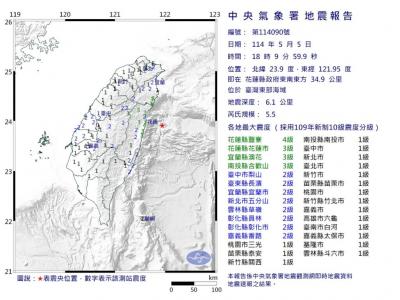
A magnitude 5.9 earthquake that struck about 33km off the coast of Hualien City was the "main shock" in a series of quakes in the area, with aftershocks expected over the next three days, the Central Weather Administration (CWA) said yesterday. Prior to the magnitude 5.9 quake shaking most of Taiwan at 6:53pm yesterday, six other earthquakes stronger than a magnitude of 4, starting with a magnitude 5.5 quake at 6:09pm, occurred in the area. CWA Seismological Center Director Wu Chien-fu (吳健富) confirmed that the quakes were all part of the same series and that the magnitude 5.5 temblor was

The Central Weather Administration has issued a heat alert for southeastern Taiwan, warning of temperatures as high as 36°C today, while alerting some coastal areas of strong winds later in the day. Kaohsiung’s Neimen District (內門) and Pingtung County’s Neipu Township (內埔) are under an orange heat alert, which warns of temperatures as high as 36°C for three consecutive days, the CWA said, citing southwest winds. The heat would also extend to Tainan’s Nansi (楠西) and Yujing (玉井) districts, as well as Pingtung’s Gaoshu (高樹), Yanpu (鹽埔) and Majia (瑪家) townships, it said, forecasting highs of up to 36°C in those areas

IN FULL SWING: Recall drives against lawmakers in Hualien, Taoyuan and Hsinchu have reached the second-stage threshold, the campaigners said Campaigners in a recall petition against Chinese Nationalist Party (KMT) Legislator Yen Kuan-heng (顏寬恒) in Taichung yesterday said their signature target is within sight, and that they need a big push to collect about 500 more signatures from locals to reach the second-stage threshold. Recall campaigns against KMT lawmakers Johnny Chiang (江啟臣), Yang Chiung-ying (楊瓊瓔) and Lo Ting-wei (羅廷瑋) are also close to the 10 percent threshold, and campaigners are mounting a final push this week. They need about 800 signatures against Chiang and about 2,000 against Yang. Campaigners seeking to recall Lo said they had reached the threshold figure over the


 RSS
RSS