


■ POLITICS
TSU challenges singer
The Taiwan Solidarity Union (TSU) named its own legislative candidate for Taipei County's Sanchung City to fight it out with a candidate from the Democratic Progressive Party (DPP). The TSU's Deputy Secretary-General Liu Yi-teh (劉一德) was named by the party's Central Executive Committee to run in Sanchung after the DPP decided to ask -- Yu Tian (余天), a 60-year-old singer -- to vie for the seat. Liu will now be pitted against Yu and the Chinese Nationalist Party's (KMT) candidate, Chu Chun-hsiao (朱俊嘵), the incumbent legislator. TSU spokeswoman Chou Mei-li (周美里) deplored the DPP's failure to respond to the TSU's suggestion that the two parties jointly present one candidate after negotiations. Liu said he was surprised that the DPP chose a singer with no past connection to the party to run for the seat. "I liked Yu Tian's singing, but he is totally irrelevant to the legislative election. His contribution to Taiwan's democracy movement is almost nil," Liu said. Liu expressed confidence that, with his 30 years of devotion to Taiwan's democracy movement, he is in a favorable position to compete with Yu in the election scheduled for Jan. 12, next year.
■ POLITICS
Confirmation votes set
Lawmakers scheduled confirmation votes yesterday for President Chen Shui-bian's (陳水扁) nominations for auditor-general of the Ministry of Audit, Judicial Yuan president, Judicial Yuan vice president and members of the Council of Grand Justices for Sept. 14. The new legislative session start on Friday. Caucus whips met yesterday to negotiate the agenda for confirmation matters. They decided to have a plenary session for a question-and-answer meeting with the Ministry of Audit's auditor-general candidate Lin Ching-lung (林慶隆) next Tuesday and a two-day plenary session for a question-and-answer meeting with the candidate for Judicial Yuan president, Lai Ying-jaw (賴英照), and the candidates for grand justices on the following days. The weekly question-and-answer sessions with Premier Chang Chun-hsiung (張俊雄) will begin on Sept. 18, when Chang will brief lawmakers on his administration's policies.
■ Transportation
THSR to increase trains
Taiwan High Speed Rail Corp (THSR) announced yesterday that it would increase the number of southbound and northbound daily trains to 91 next Friday. THSR officials also said that passengers can book regular and group tickets for the added trains starting today and new schedules will be available at station information desks on Thursday. The THSR also announced it has cooperated with an international credit card company to provide contactless credit card payment services at the ticketing counter at each station. Passengers can now pay for their tickets using their contactless credit cards.
■ SOCIETY
Kaohsiung loses bid
Kaohsiung lost its bid to host the Asia-Pacific Cities Summit 2009, delegates to this year's summit in Brisbane, Australia, said yesterday. A press release issued by the city quoted Deputy Mayor Cheng Wen-lon (鄭文龍), leader of the five-member delegation, as saying Incheon, South Korea, won the most votes at the end of the four-day Brisbane meeting and so will host the 2009 meet. Kaohsiung Mayor Chen Chu (陳菊) said her administration would endeavor to enhance the city's profile by playing host to other international activities. The biannual Asia-Pacific City Summit provides a forum for regional leaders to discuss urban problems.


UPGRADE: The Kang Ding-class frigate is replacing its Chaparall missiles with Tien Chien II and Hua Yang VLS, which would provide it with long-range, 360° air defense Taiwan plans to produce 1,200 to 1,376 Hai Chien II missiles (海劍二, Sea Sword II) — also known as TC-2N — to serve as the standard air defense system of the navy’s surface combatant fleet, a source said yesterday. Last week, the Hai Chien II, the naval version of the Tien Kung II missile (天劍二, Sky Sword II), completed a live-fire test in waters off the National Chungshan Institute of Science and Technology’s Jiupeng facility (九鵬) in Pingtung County’s Manjhou Township (滿州). The MIM72 Chaparral and other dated air defense missiles that currently arm Taiwanese ships have inadequate range to combat Chinese

REASONS FOR TRAVEL: An assistant professor said that proposed amendments to penalize drivers if they used drugs overseas would not deter people from traveling People who operate a motor vehicle under the influence of marijuana would have their driver’s license revoked, even if they used the substance while overseas, the Ministry of Transportation and Communications said yesterday, citing proposed amendments to the Road Traffic Management and Penalty Act (道路交通管理處罰條例). The amendments would also authorize the government to revoke the licenses of people determined to have used Category 1 or Category 2 narcotics, even if they were not operating a vehicle while under the influence of drugs, as well as ban them from taking the license test for three years, the ministry said. People aged 18 or
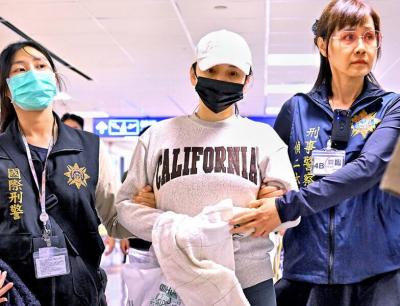
Johanne Liou (劉喬安), a Taiwanese woman who shot to unwanted fame during the Sunflower movement protests in 2014, returned to Taiwan last night after being deported from the US. She is to stand trial in Taiwan for charges involving embezzlement, fraud and drug crimes. The Criminal Investigation Bureau (CIB) said it took her into custody at Taiwan Taoyuan International Airport and would first question her before transferring her to the New Taipei District Prosecutors’ Office. She was arrested upon disembarking a flight from San Francisco that landed shortly before 7pm. Liou absconded to the US in 2019 after jumping bail
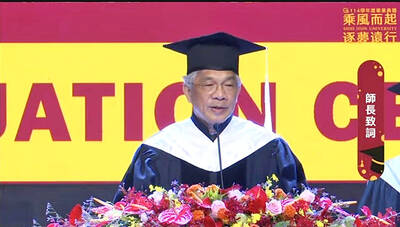
Shih Hsin University President Chen Ching-he (陳清河) yesterday issued a public apology for comments made in his commencement speech last week, stating that he has asked the school to suspend his duties and halt his wages for two months as a show of contrition. At the commencement ceremony on May 30, Chen said, “If you don’t manage your time well, or your own emotions, or your health, then I am telling every one of you — put a quick end to ‘you,’ because the world has no need for ‘you.’” The comments have sparked significant controversy online, and Chen through an open


 RSS
RSS