

The Rand Corporation, a US think tank, has issued a study arguing that positive US-China relations hinge on finding a peaceful resolution of cross-strait tensions.
The report, titled US-China Relations after Resolution of Taiwan's Status concludes that "as China's power and confidence in its military capabilities grow and therefore the possibility of Beijing attempting to bring about unification through force increases, preventing such an attempt from occurring while maintaining the capability to defeat it will become increasingly important even as it becomes increasingly difficult."
The report was sponsored by the US Air Force's assistant deputy chief of staff for long-term planning. It discusses ten scenarios in cross-strait developments, including events leading to unification, de jure independence or a continued deadlock.
The think tank study describes four peaceful scenarios: the continuation of the "status quo," a peaceful unification, peaceful de jure independence and a compromise.
The report also describes six scenarios involving Chinese military action against Taiwan: forced unification, with and without US intervention; de jure independence sparking Chinese military action, with and without US intervention; and a violent clash over Taiwan's status without leading to a resolution, with and without US intervention.
Armed conflict in the Taiwan Strait, the report says, would "likely be confined to the use of conventional weapons, even though both the United States and China possess nuclear weapons."
The think tank study also says that most Asian countries are unwilling to get involved if China invades Taiwan -- with the notable exception of Japan -- and would be loathe to choose sides between Washington and Beijing.
The report says that the nature of future US-China relations will depend on how the issue of Taiwan's status is resolved.
Although relations with Beijing may be friendly and peaceful in the future, there is potential for a situation that "in some ways is comparable to the relationship between the United States and the Soviet Union during the Cold War," it says.
Only a peaceful resolution of the Taiwan issue would be conducive to positive relations, it says.
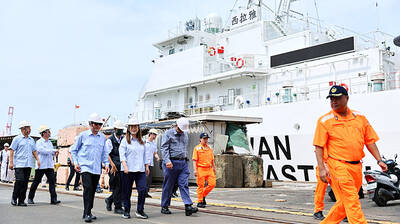
Ocean Affairs Council (OAC) Minister Kuan Bi-ling (管碧玲) on Wednesday said decommissioned coast guard vessels were given to the Philippines to enhance regional rescue capacity and would not affect Taiwanese fishers’ rights and benefits. Kuan made the remarks after confirmation on Tuesday that a 500-tonne Coast Guard Administration (CGA) patrol and rescue vessel would be given to the Philippine Coast Guard. The donation ceremony was reportedly done in Manila, but whether the vessel — previously numbered “CG123” and named Kinmen (金門) — has been handed over has yet to be confirmed. China’s Taiwan Affairs Office (TAO) on Wednesday criticized the donation for “taking

The Ministry of Finance today announced the winning numbers for the July-August uniform invoice lottery. The winning number for the NT$10 million (US$314,663) special prize is 89996565, while the winning number for the NT$2 million grand prize is 91098182. Three numbers were drawn for the NT$200,000 first prize: 54348835, 44991397 and 06595111. Those with receipts matching the last seven digits of any of the first-prize numbers can claim the NT$40,000 second prize, while those matching the last six digits qualify for the NT$10,000 third prize. Those whose receipts match the last five digits of the first-prize numbers are eligible for the NT$4,000 fourth prize,

The National Police Agency’s Third Special Police Corps yesterday said that from May to July, it intercepted five smuggling operations from China, seizing more than 70,000 counterfeit Beyblades with an estimated infringement value of NT$34.45 million (US$1.08 million). It added that any bootleg unit that reached the local market could present hidden health hazards to players. Beyblades, a line of spinning toy tops used in competitive gaming and developed in Japan by toy company Takara Tomy, have become popular in Taiwan, making them a target for fraudsters. The Third Special Police Corps, dedicated to safeguarding maritime borders and trade lines,
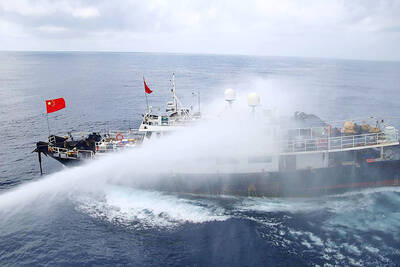
Taiwan has upgraded its maritime patrol capacity around the Pratas Islands (Dongsha Islands, 東沙群島) in the disputed South China Sea, including regularly sending larger ships there, the government said on Wednesday, responding to an increase in Chinese activities. Lying roughly between southern Taiwan and Hong Kong, the Taiwan-controlled Pratas Islands are seen by security experts as vulnerable to a Chinese attack due to their distance — more than 400km — from Taiwan. In a statement late on Wednesday, the Coast Guard Administration (CGA) said its overall patrol and enforcement capacity in Pratas waters has been “comprehensively upgraded.” With the completion of a wharf


 RSS
RSS